Rattle Re-Introduced

Latest version of Rattle just went online-

Here is the change log- Dr Graham Williams is also coming out with a book on using Rattle- the R GUI devoted to data mining.

Source-http://cran.r-project.org/web/packages/rattle/index.html

rattle (2.5.42) unstable; urgency=low

  * Update rattle.info() to recursively identify all dependencies,
 report
    their version number and any updates available from CRAN and generate
    command to update packages that have updates available. See
    ?rattle.info for the options.

  * Fix bug causing R Dataset option of the Evaluate window to always
    revert to the first named dataset.

  * Fix bug in transforms where weights were not being handled in
    refreshing of the Data tab.

  * Fix a bug in box plots when trying to label outliers when there aren't
    any.

 -- Graham Williams <Graham.Williams@togaware.com>  Sun, 
19 Sep 2010 05:01:51 +1000

rattle (2.5.41) unstable; urgency=low

  * Use GtkBuilder for Export dialog.

  * Test use of glade vs GtkBuilder on multiple platforms.

  * Rename rattle.info to rattle.version.

  * Add weight column to data tab.

  * Support weights for nnet, multinom, survival.

  * Add weights information to PMML as a PMML Extension.

  * Ensure GtkFrame is available as a data type whilst waiting for 
updated
    RGtk2.

  * Bug fix to packageIsAvailable not reruning any result.

  * Replace destroy with withdraw for plot window as the former has
    started crashing R.

  * Improve Log formatting for various model build commands.

  * Be sure to include the car package for Anova for multinom models.

  * Release pmml 1.2.24: Bug fix glm binomial regression - note as
    classification model.

 -- Graham Williams <Graham.Williams@togaware.com>  Wed, 15 Sep 2010 
14:56:09 +1000
And a video I did of exploring various Rattle options using Camtasia,
 a very useful software for screen capture and video tutorials
from http://www.techsmith.com/download/camtasiatrial.asp
Updated- my video skils being quite bad- I replaced it with another video. 
However Camtasia is the best screen capture video tool
Also , an update Analyticdroid is on hold for now. see- for more details http://rattle.togaware.com/

Making NeW R

Tal G in his excellent blog piece talks of “Why R Developers  should not be paid” http://www.r-statistics.com/2010/09/open-source-and-money-why-r-developers-shouldnt-be-paid/

His argument of love is not very original though it was first made by these four guys

I am going to argue that “some” R developers should be paid, while the main focus should be volunteers code. These R developers should be paid as per usage of their packages.

Let me expand.

Imagine the following conversation between Ross Ihaka, Norman Nie and Peter Dalgaard.

Norman- Hey Guys, Can you give me some code- I got this new startup.

Ross Ihaka and Peter Dalgaard- Sure dude. Here is 100,000 lines of code, 2000 packages and 2 decades of effort.

Norman- Thanks guys.

Ross Ihaka- Hey, What you gonna do with this code.

Norman- I will better it. Sell it. Finally beat Jim Goodnight and his **** Proc GLM and **** Proc Reg.

Ross- Okay, but what will you give us? Will you give us some code back of what you improve?

Norman – Uh, let me explain this open core …

Peter D- Well how about some royalty?

Norman- Sure, we will throw parties at all conferences, snacks you know at user groups.

Ross – Hmm. That does not sound fair. (walks away in a huff muttering)-He takes our code, sells it and wont share the code

Peter D- Doesnt sound fair. I am back to reading Hamlet, the great Dane, and writing the next edition of my book. I am glad I wrote a book- Ross didnt even write that.

Norman-Uh Oh. (picks his phone)- Hey David Smith, We need to write some blog articles pronto – these open source guys ,man…

———–I think that sums what has been going on in the dynamics of R recently. If Ross Ihaka and R Gentleman had adopted an open core strategy- meaning you can create packages to R but not share the original where would we all be?

At this point if he is reading this, David Smith , long suffering veteran of open source  flameouts is rolling his eyes while Tal G is wondering if he will publish this on R Bloggers and if so when or something.

Lets bring in another R veteran-  Hadley Wickham who wrote a book on R and also created ggplot. Thats the best quality, most often used graphics package.

In terms of economic utilty to end user- the ggplot package may be as useful if not more as the foreach package developed by Revolution Computing/Analytics.

Now http://cran.r-project.org/web/packages/foreach/index.html says that foreach is licensed under http://www.apache.org/licenses/LICENSE-2.0

However lets come to open core licensing ( read it here http://alampitt.typepad.com/lampitt_or_leave_it/2008/08/open-core-licen.html ) which is where the debate is- Revolution takes code- enhances it (in my opinion) substantially with new formats XDF for better efficieny, web services API, and soon coming next year a GUI (thanks in advance , Dr Nie and guys)

and sells this advanced R code to businesses happy to pay ( they are currently paying much more to DR Goodnight and HIS guys)

Why would any sane customer buy it from Revolution- if he could download exactly the same thing from http://r-project.org

Hence the business need for Revolution Analytics to have an enhanced R- as they are using a product based software model not software as a service model.

If Revolution gives away source code of these new enhanced codes to R core team- how will R core team protect the above mentioned intelectual property- given they have 2 decades experience of giving away free code , and back and forth on just code.

Now Revolution also has a marketing budget- and thats how they sponsor some R Core events, conferences, after conference snacks.

How would people decide if they are being too generous or too stingy in their contribution (compared to the formidable generosity of SAS Institute to its employees, stakeholders and even third party analysts).

Would it not be better- IF Revolution can shift that aspect of relationship to its Research and Development budget than it’s marketing budget- come with some sort of incentive for “SOME” developers – even researchers need grants and assistantships, scholarships, make a transparent royalty formula say 17.5 % of the NEW R sales goes to R PACKAGE Developers pool, which in turn examines usage rate of packages and need/merit before allocation- that would require Revolution to evolve from a startup to a more sophisticated corporate and R Core can use this the same way as John M Chambers software award/scholarship

Dont pay all developers- it would be an insult to many of them – say Prof Harrell creator of HMisc to accept – but can Revolution expand its dev base (and prospect for future employees) by even sponsoring some R Scholarships.

And I am sure that if Revolution opens up some more code to the community- they would the rest of the world and it’s help useful. If it cant trust people like R Gentleman with some source code – well he is a board member.

——————————————————————————————–

Now to sum up some technical discussions on NeW R

1)  An accepted way of benchmarking efficiencies.

2) Code review and incorporation of efficiencies.

3) Multi threading- Multi core usage are trends to be incorporated.

4) GUIs like R Commander E Plugins for other packages, and Rattle for Data Mining to have focussed (or Deducer). This may involve hiring User Interface Designers (like from Apple 😉  who will work for love AND money ( Even the Beatles charge royalty for that song)

5) More support to cloud computing initiatives like Biocep and Elastic R – or Amazon AMI for using cloud computers- note efficiency arguements dont matter if you just use a Chrome Browser and pay 2 cents a hour for an Amazon Instance. Probably R core needs more direct involvement of Google (Cloud OS makers) and Amazon as well as even Salesforce.com (for creating Force.com Apps). Note even more corporates here need to be involved as cloud computing doesnot have any free and open source infrastructure (YET)

_______________________________________________________

Debates will come and go. This is an interesting intellectual debate and someday the liitle guys will win the Revolution-

From Hugh M of Gaping Void-

http://www.gapingvoid.com/Moveable_Type/archives/cat_microsoft_blue_monster_series.html

HOW DOES A SOFTWARE COMPANY MAKE MONEY, IF ALL

SOFTWARE IS FREE?

“If something goes wrong with Microsoft, I can phone Microsoft up and have it fixed. With Open Source, I have to rely on the community.”

And the community, as much as we may love it, is unpredictable. It might care about your problem and want to fix it, then again, it may not. Anyone who has ever witnessed something online go “viral”, good or bad, will know what I’m talking about.

and especially-

http://gapingvoid.com/2007/04/16/how-well-does-open-source-currently-meet-the-needs-of-shareholders-and-ceos/

Source-http://gapingvoidgallery.com/

Kind of sums up why the open core licensing is all about.

Google AppInventor -Android and Business Intelligence

Here is a great new tool for techies to start creating Android Apps right away- even if you have no knowledge of the platform. Of course there are existing great number of apps- including my favorite Android Data Mining App in R – called AnalyticDroid http://analyticdroid.togaware.com/

Basically it calls the Rattle (R Analytical Tool To Learn Easily) Data Mining GUI -enabling data mining from an Android Mobile using remote computing.

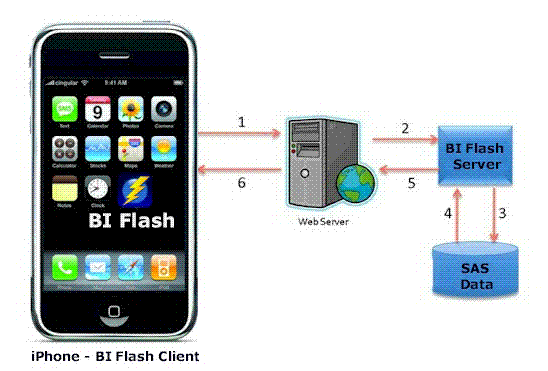
I dont know if any other statistical application is available on Android Mobiles- though SAS did have a presentation on using SAS on IPhone

http://www.wuss.org/proceedings09/09WUSSProceedings/papers/dpr/DPR-Truong.pdf


SAS Mobile -Iphone App

All you need to do is go to http://appinventor.googlelabs.com/about/index.html and request access (yes there is a 2 week approval waiting line)

Because App Inventor provides access to a GPS-location sensor, you can build apps that know where you are. You can build an app to help you remember where you parked your car, an app that shows the location of your friends or colleagues at a concert or conference, or your own custom tour app of your school, workplace, or a museum.
You can write apps that use the phone features of an Android phone. You can write an app that periodically texts “missing you” to your loved ones, or an app “No Text While Driving” that responds to all texts automatically with “sorry, I’m driving and will contact you later”. You can even have the app read the incoming texts aloud to you (though this might lure you into responding).
App Inventor provides a way for you to communicate with the web. If you know how to write web apps, you can use App Inventor to write Android apps that talk to your favorite web sites, such as Amazon and Twitter.

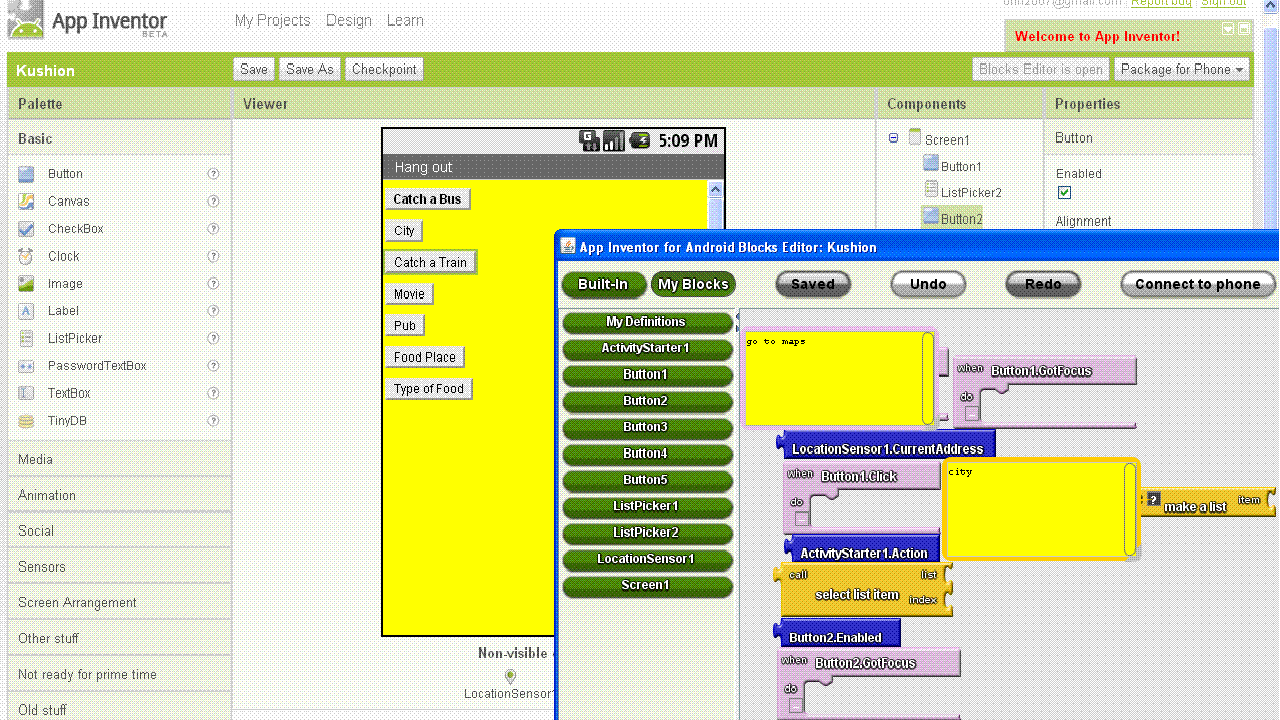
Here is a not so statistical Android App I am trying to create called Hang-Out

using the current GPS location of your phone to find nearest Pub, Movie or Diner and catch Bus- Train based on your location city, the GPS and time of request and schedule of those cities public transport- very much WIP

Data Mining through the Android

Here is something interesting (I probably have to ask someone or wait for Android to come to India to do this personally0.

It uses the Android App Development ( which is quite easy if you have a Linux) and basically runs R from the cloud using a GUI Rattle. Fire away the data while watching a movie or just on the go !

See this-

http://analyticdroid.togaware.com/

Question- How useful do you think it will be to do this?  Would you like to run R on your mobile?

Towards better Statistical Interfaces

I was just walking about the U Tenn campus thinking about my next month departure from the school back to India when I ran into Bob Muenchen , head of the Stats consulting centre and more famously the author of ” R for SAS and SPSS users” . Bob mentioned that the edition for R for Stata should be ready for next month. It was also his idea for the article on Red R.

In fact what perplexes users of statistical software like me is why complex softwares like R or SAS choose interfaces that are clearly not as well designed in simplicity as they are in statistical rigor. I think SPSS to some extent and JMP to a much greater extent represent well designed user interfaces. While Rattle , R Commander , R Analytical Flow and Red R are examples for R interfaces SAS also invested in the Enterprise class interfaces.

On all these I belive there is a much greater need for say a Pro UI designer and clean it up. I was reading Prof Maeda’s laws of simplicity ( see http://lawsofsimplicity.com ) and just comparing and contrasting that with some of the softwares I end up using.

The Principles of Reduce ( Shrink, Hide , Embody ) and Organize ( Sort , Label , Integrate and Priortize ) need to be looked into by the Chief Software Interface designers for analytics and BI. While attempts to create more and more robust and faster algorithms and prettier dashboards are important is it not important to simplify the process and procedures to do so . The software which is easier to learn and pick up will tend to have an edge over less visually designed softwares. Keeping it simple helped Apple in the retail electronics and software , it needs to be seen who or which enterprise BI or BA software will make attempts to do the same. An ideal stats or BI interface should be simple and powerful enough to be used by decision makers directly on occasion rather rely on the middleware of analysts and consultants solely.

R is an epic fail or is it just overhyped

I came across this nice post from someone who is both knowledgeable and experienced in data. I mean I totally agree that data visualization , user interfaces and unstructured data mining are the trends of the future.

What caught my attention were the words from http://www.thejuliagroup.com/blog/?p=433

However, for me personally and for most users, both individual and organizational, the much greater cost of software is the time it takes to install it, maintain it, learn it and document it. On that, R is an epic fail. It does NOT fit with the way the vast majority of people in the world use computers. The vast majority of people are NOT programmers. They are used to looking at things and clicking on things.

Let me analyze this scientifically and dispassionately

R Documentation

I believe that the SAS Online Doc and the SPSS Documentation are both good examples of structured documentation. I do belive that despite the many corporate R products floating- the quality of R documentation is both very extensive and perhaps too big to be put in a neat document something like the ” The Little R Book” or “R Online Doc” would really help.

Entering ? or ?? to search for documentation seems like too difficult work and complex for corporate users it seems. However the documentation for R is not really enterprise software quality is a valid enough point.

Maintaining R

It takes a single line of code or even a single click to update and maintain R.

Apparently the author of the fore mentioned post that existing corporate users are too STUPID OR LAZY to do this.

I like to think most corporate users of statistical software are actually way smarter ( One Hint : They earn money doing that stuff)

Installing R

Anyone who mentions installation costs of software as a reason for enhanced software costs and then mentions R is either biased against R or has not worked with R. Or Both

Learn R

I think anyone cannot learn all R packages just as you cannot learn all the modules of SAS ( like ETS, Stat, etc etc)

R does have more time to learn than Base SAS and this is a valid enough point.

However two R GUI like Rattle and R Commander can help the execution time for this learning.

And increasingly R is taught in universities which is where the battle for future developers or users for platforms like SAS , SPSS , Stata or R would ultimately be decided while the short term monetization of other softwares dazzles people R has too many passionate developers or users to allow it to fail.

However,

R is not perfect. It does need a better corporate version than is currently offered especially to people who are simple users not developers , and it could also to well to better the marketability and visibility of R.

Regarding software costs, ironically while it is easier to estimate how much SAS will cost you in terms of licenses and training time. A similar comparitive document between R and SAS in terms of costs and estimated training costs etc should settle this debate more rationally and more dispassionately than is currently the norm in comparing softwares