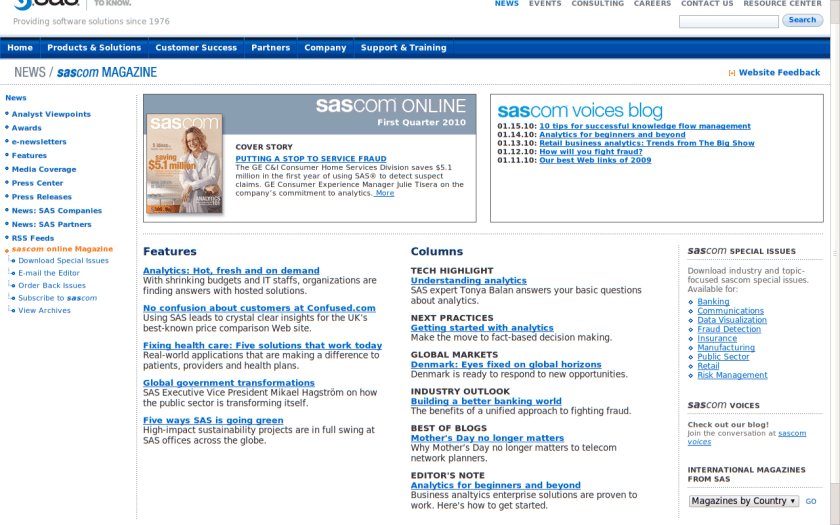
New Edition of SAS.com Magazine q 1 2010

As always a great edition of an excellent online magazine.

The cover story of GE on stopping service fraud is great ( I am an ex GE alumnus- DIS claimer)

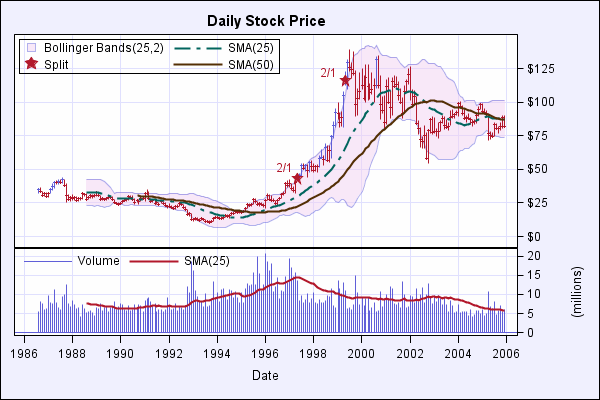
Click the screenshot for the real thing itself.

ps-
As my friends used to say, a magazine is something that can shoot multiple times.

Audio Interviews -Dr. Colleen McCue National Security Expert

During times of National Insecurity, I remembered and dug up an interview at SAS Data Mining 2009 in which Dr Colleen McCue talks of how working with SAS and Data Mining can help.

[tweetmeme=”Decisionstats”]

Interview Dr Colleen

Dr. Colleen McCue, President & CEO of MC2 Solutions, brings over 18 years of experience in advanced analytics and the development of actionable solutions to complex information processing problems in the applied public safety and national security environment. Dr. McCue’s areas of expertise include the application of data mining and predictive analytics to the analysis of crime and intelligence data, with particular emphasis on deployment strategies, surveillance detection, threat and vulnerability assessment and the behavioral analysis of violent crime. Her experience as the Crime Analysis Program Manager for the Richmond, Virginia Police Department and pioneering work in operationally relevant and actionable analytical strategies has been used to support a wide array of national security and public safety clients. Dr. McCue has authored a book on the use of advanced analytics in the applied public safety environment entitled, “Data Mining and Predictive Analysis: Intelligence Gathering and Crime Analysis.” Dr. McCue earned her undergraduate degree from the University of Illinois at Chicago and Doctorate in Psychology from Dartmouth College, and completed a five-year postdoctoral fellowship in the Department of Pharmacology & Toxicology at the Medical College of Virginia, Virginia Commonwealth University. Dr. McCue can be reached atcolleen@mc2solutions.net or 804.894.1154.

MC2 Solutions, LLC specializes in the provision of public safety and national security research, analysis and training.

Watch Colleen’s Webinar, Why Just Count Crime When You Can Prevent It?

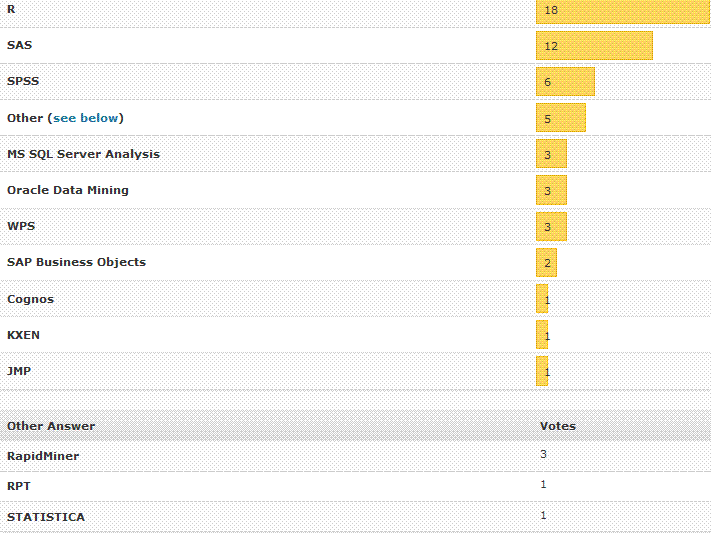
What softwares do you plan to use/learn in the next one year?

The results for the question-

Which software do you plan to use/learn in the next one year  ?

Wealth = function (numeracy, memory recall)

As per a recent paper by the National Bureau of Economic Research

It has been postulated that wealth is simply a function of your ability to handle numbers as well as recall memory.

That is – answering just three numerical questions for Retirement/ people with age above 50 years. This alone should serve as a wake up call for greater investment in Education (than just banks and corporations).

Citation- NBER

Cognition and Economic Outcomes

Household wealth is strongly associated with numeracy and memory recall.

In Cognition and Economic Outcomes in the Health and Retirement Survey, (NBER Working Paper No. 15266), co-authors John McArdle, James Smith, and Robert Willis show that the ability to answer three simple mathematical questions is a significant predictor of wealth, wealth growth, and wealth composition for people over 50 years of age.

Using data from the Health and Retirement Survey (HRS) — a nationally representative longitudinal survey for the United States, which combines comprehensive information on household wealth with “cognition variables” designed to measure memory, intactness of mental status, numerical reasoning, broad numeracy, and vocabulary — these authors find that household wealth is strongly associated with numeracy and memory recall.

To test memory recall, respondents listened to a list of ten simple nouns, answered other questions for five minutes, and then were asked to recall as many of the nouns as possible. Two-thirds of the HRS survey respondents were able to recall between three and seven of the words. Most respondents answered just one of the three numeric questions correctly.

Answering a numeric question correctly in the three-question sequence was associated with a $20,000 increase in total household wealth and about a $7,000 increase in total financial wealth. Wealth also tended to increase with a higher numeracy score for either spouse in a married couple—when neither spouse answered any numeric questions correctly, which was about 10 percent of the cases, household wealth was about $200,000. When both spouses answered all questions correctly, household wealth was about $1,700,000.

In households where one spouse, the financial respondent, was in charge of finances, household financial wealth was larger if the financial respondent had the higher numeracy score. Answering a question correctly was associated with a $30,000 increase in household wealth if the financial respondent answered correctly and only a $10,000 increase if the non-financial respondent answered correctly. Households with higher numeracy scores were also more likely to have higher fractions of their portfolios in stock.

In this sample, wealth was higher for couples than for single-person households, and lower for minorities than non-minorities. Wealth increased with age and family income, and rose steeply with education. In the HRS, median household wealth was $198,000, and 9 percent of that was held in stocks. Median total income was $37,000, and the typical sample member was a high school graduate.

The authors point out that their exploratory analysis has only established that specific cognitive measures are useful predictors of accumulated wealth and that they have not established causal pathways. It is possible, for example, that a lifetime interest in investments and the stock market can improve numerical ability. However, they note that the fact that numeracy seems to predict total and financial wealth at lower wealth quartiles where people are less likely to be active investors does seem to weigh against a purely reverse pathway from investments to cognitive ability.

— Linda Gorman

Speaking of Educational Programs I came across a good example on education in numeracy –

SAS Institute has been working in the field in the following  manner- directly as provider of SAS® Curriculum Pathways®

Fully funded by SAS and offered at no cost to US educators and students, SAS Curriculum Pathways is designed to enhance student achievement and teacher effectiveness by providing Web-based curriculum resources in all the core disciplines: English, math, science, social studies/history and Spanish, to educators and students in grades 8-14 in virtual schools, home schools, high schools and community colleges.

I believe other statistical softwares (like RE Computing, IBM SPSS , etc ) can also donate a small part of their product portfolio to K12 education (not just college education) as well. Education is an area where software companies especially in the field of statistics and analytics, co-operation and co-mpetition can co-exist to enhance the pool of potential developers , users and enhance life skills in numeracy as well .

Data Mining Survey Results :Tools and Offshoring

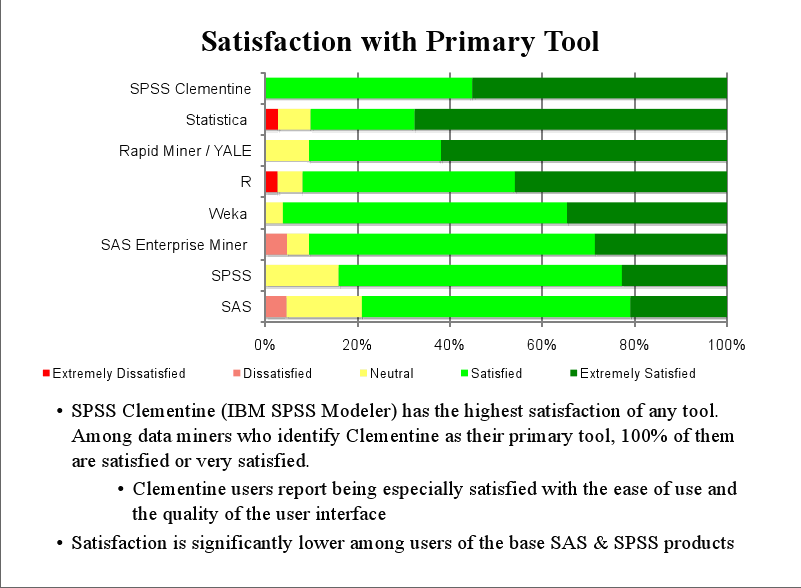
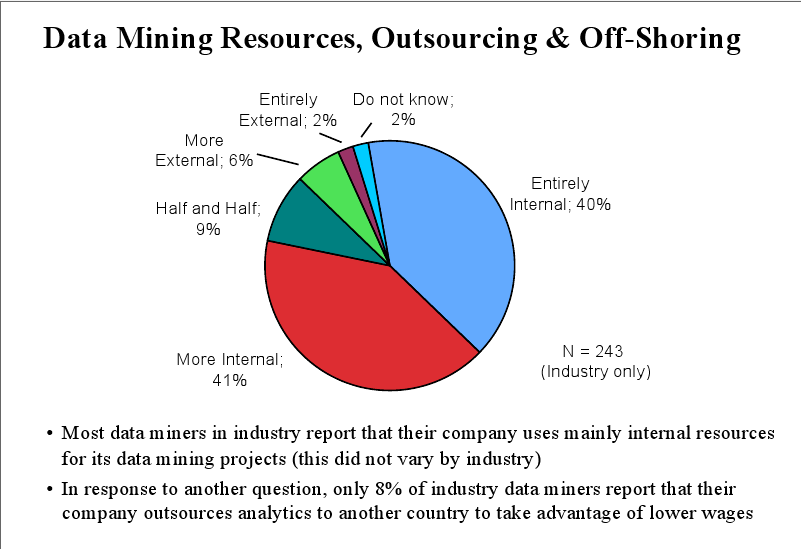
Here are some survey results from  Rexer Analytics

The Graphics seem self explanatory: terrific Data Visualization

1) The field of Data Mining seems ripe for either more offshoring to cut down costs or

there will be price pressures to cut costs on software ( read More R and SaaS) and Hardware ( more cloud /time sharing  ?)

2) Satisfaction with both R and SAS seems similar but R seems to score higher than other flavors.

3) An added dimension of  utility ( or say

(satisfaction in terms of analyst comfort + functionality in terms of business benefit) divided by (License + Training + Installation + Transition costs)

would have even extra analysis.

But these are not final results- for that you need to see Dr Karl at Rexer Analytics

Christmas Carol: The Best Software (BI-Stats-Analytics)

There is no best software- they are just optimized for various constraints and tangible as well as intangible needs as defined for users.

  1. There is no best software- they are just optimized for various constraints and tangible as well as intangible needs as defined for users.  ( Image below Citation- support.sas.com )
  2. Price in products is defined as Demand divided by Supply. Sometimes this is Expected Demand over Expected Supply ( see Oil Prices) Everyone grumbles over prices but we pay what we think is fair. ( citation http://bm2.genes.nig.ac.jp/RGM2/index.php?ctv=Survival
  3. Prices in services are defined by value creation as well- Value= Benefit Divided by Cost  Benefits are tangible as in how much money it saves in fraud as well as intangible – how easy it is to start using JMP versus R Commander  Costs are Tangible- How much do we have to pay using our cheque book for this annual license or perpetual license or one time license or maintain contract or application support.Intangible costs are how long I have to hold the phone while talking to customer support and how much time it takes me to find the best solution using the website on my own without a sales person bothering me with frequent calls. (citation- http://academic.udayton.edu/gregelvers/psy216/spss/graphs.htm#tukey
  4. All sales people ( especially in the software industry) spam you with frequent calls, email reminders and how their company is the best company ever with the best software in the history of mankind. That is their job and they are pushed by sales quotas and pulled by their own enthusiasm to sell more to same customer. If you ever bought three licences and found out you just needed two at the end of the year- forgive the salesman. As Arthur Miller said’ All Salesmen are Dreamers  (Citation of STATA graph below http://www.ats.ucla.edu/stat/Stata/library/GraphExamples/code/grbartall.htm)
  5. Technology moves faster than you can say Jackie Robinson. and it is getting faster. Research and Development ( R and D) will always move slower than the speed at which Marketing thinks they can move. See http://www.dilbert.com for more insights on this. You either build a Billion Dollar in house lab ( like Palo Alto – remember) or you go for total outsourcing (like semi conductors and open source do). Or you go for a mix and match. ( Citation- http://people.sc.fsu.edu/~burkardt/html/matlab_graphics/matlab_graphics.html )

Based on the above parameters the best statistical software for 2009 continues to be the software that uses a mixture of Genetic Algorithms, Time Series Based Regression and Sampling – it is the software that runs in the head of the statistical /mathematical / customer BRAIN

Thats the best Software ever.

(Citation – Hugh of http://gapingvoid.com/ )

Happy Hols

SAS with the GUI Enterprise Guide (Updated)

Here is a slideshow I made using Google Docs ( which is good except the PDF version is much worse than Microsoft Slidehare). It is on the latest R GUI called AwkWard. It is based on the webpage here

http://docs.google.com/View?id=dcvss358_1015frg4k8gj

In my last post on WPS , R and Sas I had briefly shown a screenshot of SAS Enterprise Guide with a single comment on how it could do with a upgrade in it’s GUI. Well it seems that the upgrade has been available since March 2009, but probably not applied since no one noticed even once in the Fall Semester here in the Tennessee ( including people from the University who read this blog 🙂 Actually the upgrade was made to local machines but there is also a cloud version but didnt apply the upgrade – where we can use Citrix Server to just run analytics on the browser

Here is a revised update of SAS Enterprise Guide 4.2

SAS Enterprise Guide is a Windows interface to SAS that allows for SAS programming *and* point-and-click tasks for reporting, graphs, analytics, and data filter/query/manipulation. SAS Enterprise Guide can work with SAS on your local machine, and it can connect to SAS servers on Windows, Unix/Linux, and the mainframe.

It doesn’t have decision tree support; that’s provided by a more specialized application for data mining called SAS Enterprise Miner.

And you can easily extend SAS Enterprise Guide with your own tasks. See http://support.sas.com/eguide. You do not need SAS/Toolkit. You can use off-the-shelf development tools for Microsoft .NET, including the freely available express editions of Microsoft Visual C# or Visual Basic .NET.

With credit to Chris from SAS for forwarding me the correct document and answers.

PS-
It would be great if the SAS User Conferences Archives used slideshare or Google Docs ( PDFs are so from the 90s) for saying displaying the documents at the sascommunity.org ( which took the twitter id @sascommunity after two months of requests,threats and friendly pleas from me- only to not use it actively except for one Tip of the Day Tweet, sigh)