As per a recent paper by the National Bureau of Economic Research
It has been postulated that wealth is simply a function of your ability to handle numbers as well as recall memory.
That is – answering just three numerical questions for Retirement/ people with age above 50 years. This alone should serve as a wake up call for greater investment in Education (than just banks and corporations).
Citation- NBER
Cognition and Economic Outcomes
Household wealth is strongly associated with numeracy and memory recall.
In Cognition and Economic Outcomes in the Health and Retirement Survey, (NBER Working Paper No. 15266), co-authors John McArdle, James Smith, and Robert Willis show that the ability to answer three simple mathematical questions is a significant predictor of wealth, wealth growth, and wealth composition for people over 50 years of age.
Using data from the Health and Retirement Survey (HRS) — a nationally representative longitudinal survey for the United States, which combines comprehensive information on household wealth with “cognition variables” designed to measure memory, intactness of mental status, numerical reasoning, broad numeracy, and vocabulary — these authors find that household wealth is strongly associated with numeracy and memory recall.
To test memory recall, respondents listened to a list of ten simple nouns, answered other questions for five minutes, and then were asked to recall as many of the nouns as possible. Two-thirds of the HRS survey respondents were able to recall between three and seven of the words. Most respondents answered just one of the three numeric questions correctly.
Answering a numeric question correctly in the three-question sequence was associated with a $20,000 increase in total household wealth and about a $7,000 increase in total financial wealth. Wealth also tended to increase with a higher numeracy score for either spouse in a married couple—when neither spouse answered any numeric questions correctly, which was about 10 percent of the cases, household wealth was about $200,000. When both spouses answered all questions correctly, household wealth was about $1,700,000.
In households where one spouse, the financial respondent, was in charge of finances, household financial wealth was larger if the financial respondent had the higher numeracy score. Answering a question correctly was associated with a $30,000 increase in household wealth if the financial respondent answered correctly and only a $10,000 increase if the non-financial respondent answered correctly. Households with higher numeracy scores were also more likely to have higher fractions of their portfolios in stock.

In this sample, wealth was higher for couples than for single-person households, and lower for minorities than non-minorities. Wealth increased with age and family income, and rose steeply with education. In the HRS, median household wealth was $198,000, and 9 percent of that was held in stocks. Median total income was $37,000, and the typical sample member was a high school graduate.
The authors point out that their exploratory analysis has only established that specific cognitive measures are useful predictors of accumulated wealth and that they have not established causal pathways. It is possible, for example, that a lifetime interest in investments and the stock market can improve numerical ability. However, they note that the fact that numeracy seems to predict total and financial wealth at lower wealth quartiles where people are less likely to be active investors does seem to weigh against a purely reverse pathway from investments to cognitive ability.
— Linda Gorman
Speaking of Educational Programs I came across a good example on education in numeracy –
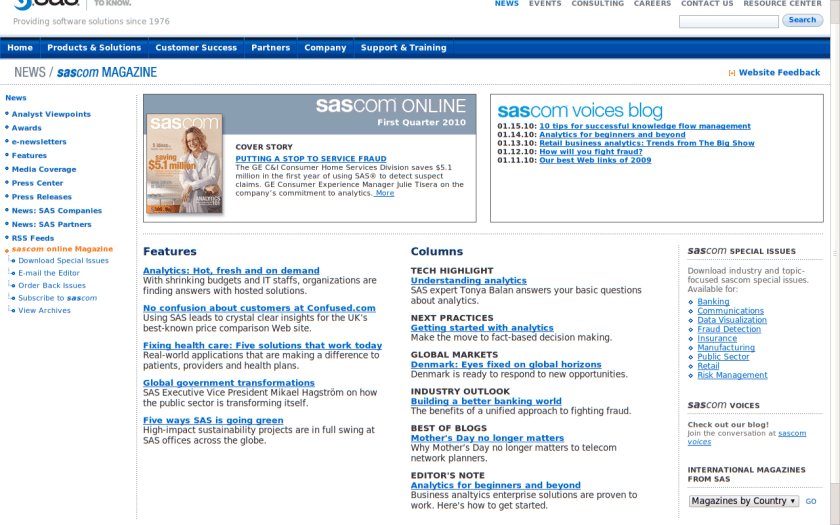
SAS Institute has been working in the field in the following manner- directly as provider of SAS® Curriculum Pathways®
Fully funded by SAS and offered at no cost to US educators and students, SAS Curriculum Pathways is designed to enhance student achievement and teacher effectiveness by providing Web-based curriculum resources in all the core disciplines: English, math, science, social studies/history and Spanish, to educators and students in grades 8-14 in virtual schools, home schools, high schools and community colleges.
I believe other statistical softwares (like RE Computing, IBM SPSS , etc ) can also donate a small part of their product portfolio to K12 education (not just college education) as well. Education is an area where software companies especially in the field of statistics and analytics, co-operation and co-mpetition can co-exist to enhance the pool of potential developers , users and enhance life skills in numeracy as well .
28.635308
77.224960

 DECISION STATS
