Using Yahoo Finance, I plotted the past three years stock price of Indian Offshores (Genpact, Wns, Exl) and in comparison with Indian Software companies (Infosys, Wipro, TCS, Sify) and market index.
The following insights emerge-
1) Indian Software companies have constantly created wealth.
2) Indian Offshoring companies have constantly lost market value – perhaps because they were able to dump IPO prices at much higher prices by creating hype.
3) You are much better off investing in Indian stock market or a blue chip Indian software company than take part in an Indian offshorers IPO.
4) SIFY lost most value and its founder CEO is now in jail for fraud. The fraud was he added phantom employees, and phantom revenue to boost balance sheet. Auditors from PwC (were jailed) included a board member of Indian Chartered Accountants and Satyam (SIFY) had won awards for corporate governance. It makes sense to do rigorous cash flow due diligence this side of the pond.
5) I won no stock in any of this companies (not surprisingly) but do have a portfolio of mutual funds (index).
So the next time you are promised the moon by an Indian IPO- KPO, remember to do the math 😉
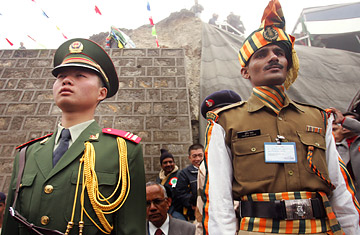
I was reading a couple of articles about India and China ‘s position in the existing world as well as the projected rise of power of both and the tensions inherent in that. For some one completely new to this- Indian-Chinese relationships can be summarized till today at a Governmental level as following-
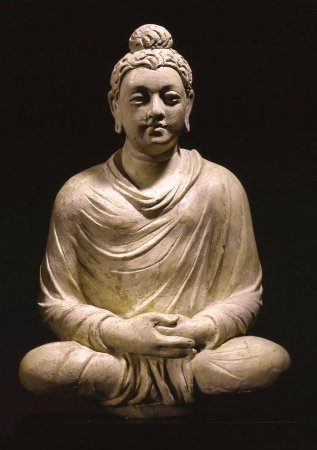
1) No history of war in ancient times. The Mongols who eventually became the Mughals came to India via Afghanistan. India exported Buddhism and imported silk mainly during this era. In between, the Himalayas stood to give them a distinct culture and boundary.
2) Post 1947- Indo Chinese relationships were initially fine as they both freed themselves from colonialism. This however steadily disintegrated following border troubles leading to the 1962 war which led to loss of territory to China and a traumatic setback for Indian geo-political ambitions in Asia. The conflict defines Indian mistrust of Chinese government till today and was responsible for Indo-China skirmishes in the 1980’s.
3) India’s support for TIbet and Dalai Lama and Chinese support for Pakistan complicates any sign of allying themselves too closely. Both their respective allies have costs more than benefits for China and India- yet the traditional real politik continues. This extends to other relationships like Vietnam and Burma also.
4) Hardly any people contact. Indian and Chinese students are much more likely to meet in the United States than in each other countries. Trade tends to be import of cheap Chinese goods and export of mineral sources. Almost all higher value trade ends up being facilitated by the Western or third party companies.
5) The corruption prone Indian democracy is more similar to the controlled Chinese communism than Western countries realize. The press in India is not that free from corporate or political pressures and China does have positive internal checks and balances for safeguarding it’s administration and governance.
6) Indian and Chinese attitudes to diplomacy and negotiation are markedly different- with India oscillating between periods of Western/Russian neo- colonialism to bouts of skepticism while China continues a cautious yet increasingly belligerent focus on it’s own interests. Due to linguistic reasons India is more susceptible to Western influence than the Chinese.
Looking forward, as the purchasing power of the huge demographics of both countries increases they will end up with more focus of the World- and it would be tragic if they fall to the ancient roman rule of Divide and Conquer- to squander away any benefits they can get from a collective bargaining position.
Indeed if China and India can find a realistic way to end their differences and be allies they will find that this relationship can be the most profitable to each other in terms of return on diplomatic time and effort. Enabling direct people to people contact and more fraternal ties in education and socio-cultural arts could be an interesting low risk first step towards such relationships.
and pseudo-science, to put pressure on India to take stronger action on climate change or to put greater responsibility for the climate crisis on it.
The ‘2035 demise’ date drawn by IPCC in its fourth assessment report for Himalayan glaciers was used very often to demand that India should take greater action to reduce its emissions in order to protect people from catastrophes like glacial melts and floods. Similarly, a ‘premature’ release of information on the so-called Asian Brown Cloud was used by several western NGOs and governments to pin the blame on the melting of glaciers and other climate change impacts on pollution from burning firewood and cow dung in India.
I had earlier pointed out the same based on my proximity to Oakridge , TN and some data ( see here-
1) What is the expected date of melting of glaciers in Himalayas thus affecting sacred rivers like Ganges and also causing floods in densely populated Asia. How would nation states with shareable resources like Water react on the disputes, dams , hydro electricity and floods.
2) How would you count per capita CO2 consumption- Assume a Factory in China makes 3 tonnes of C02 every year but exports all its products to USA on Indian Cargo ship. Travel contributes another 1 tonne of C02 including air travel, visits etc.
As of now this will be counted as 3 tonne for China, 1 Tonne for India, X tonne for USA ? What is wrong in these assumptions
Indeed I gave a presentation ro senior Times Group People on using data which is available on my Linkedin profile with the Google Docs presentation at
The nation’s top scientists and spies are collaborating on an effort to use the federal government’s intelligence assets — including spy satellites and other classified sensors — to assess the hidden complexities of environmental change. They seek insights from natural phenomena like clouds and glaciers, deserts and tropical forests.
Not a coincidence this comes close on the National Security Function in India coming totally revamped
The exit of M K Narayanan as national security advisor has set the stage for a significant re-ordering of UPA-2’s power structure with
home minister P Chidambaram set to gain fuller control of internal security reducing the role of the next NSA to foreign policy.
Debate and discussion between the freest and largest democracy are welcome steps.
But who is right?
Is climate change negotiations also a proxy for negotiation on terror co operation- as pointed out by me the Sikhs and Indians remain the only forces to be in Kabul (respectively the Sikhs in recent (late 18th-19th Century) Source- A Brief History of Sikhs and ancient history ( 8 th Century AD) while Churchill’s memoirs in Young Winston talk of the stellar role of the Indian Army in Afghanistan or NWFP. Remember we have been here before- the Bush Administration negotiated and failed to get Indian troops in Iraq in 2004 over lack of monetary negotiations- the Indians turned to be right on true costs!
Are the Chinese or the Americans using India’s insecurities as a proxy?
ps- on Movies Why was Shekhar Kapur’s ( The Oscar nomianted director of Elizabeth ) documentary Paani stopped due to funding issues?
How can ice melting in North Pole lead to lack of water. Do water projections measure that rainwater harvesting has been low in India and ancient Indian religion is okay with Saraswati as one dis appeared river. If the Ganges dries up- the people in India may riot or may just blame it on sin and build smaller rain water dams.
Recently some influential bloggers got nailed by TSA for leaking security directives of Airlines that were issued post the failed Christmas Day attack. While the first Amendment is a much admired piece of legislation, a blogger’s right to blog cannot be greater than his desire to see his fellow citizens safe.
[tweetmeme=”Decisionstats”]
As someone who is brown , male, single ( and thus automatically a TSA curiousity) I travel to places like New York, San Fransisco, Austin, Atlanta, Ohio, Las Vegas for both personal and professional work- some of the following may be purely personal experiences.
1) Some of the biggest drawbacks that Airlines have had in the past were- Airport checks Susceptibility to social engineering. – They would rarely glance at a photo id if it is an American driver license but would do a proper job if it is a external passport. Unfortunately the second generation of Arab/ Asian exiles that are prone to internet based clerics have American issued passports as well as licenses. In addition they go to colleges and play soccer with actual citizens of foreign countries who can motivate or guide them. A look at the number of Arabic- Asian students in the University system who are not vetted by the TSA would reveal the magnitude of the problem.
I flew from Knoxville Tennessee to Las Vegas some months back on college I card, en route on my way back, I went through Washington, and was also hospitalized. Thus using a Vol Card, an Indian driving license and an American social security card – I managed to travel almost all the landscape. In addition I passed through enough transit airports to switch my destination. Sometimes I am so good I scare myself..
In order to catch a thief, the TSA needs to think like a thief rather than waste time and precious agents on just another liberal blogger. Have a contest open to all members of the public, and especially hackers, social media spammers, identity thieves- most of whom are starving people who need money AND respect. Say here is our system- and our processes. Break it to win a million dollars but share the solution with us in private.
2) Some elements of social media should be reviewed for a secure online identity. Twitter has a system for authenticating prominent people, that should be rolled out for all users of Facebook, Twitter, Linkedin. The costs should be subsidized by the airlines given the bail outs they received in 2004. or the Airlines should simply give an equity stake as the banks and the car companies did- to ensure there is no cutting of corners to make profits
3) Analyzing chatter– While the NSA and the TSA and CIA and the AAA etc monitor the internet for data and specifically terror linked chatter- these cases point to the fact that they need to adopt faster ways of crunching data ( MapReduce for fighting Terror- maybe is not a bad idea after all). Companies like SAS, SPSS, Revolution Computing can then collaborate with the data gathering companies by embedded analytical solutions.
What is more important? Catching people who are defaulting on their mortgages ( that can wait for a quarter and you can still catch them with more penal interest)
or Catching people who are defaulting on their conscience ( within 2 days of writing that email, tweet, facebook). Think of it as creating a big new system of online parking tickets, you can even create a lucrative online health insurance market by asking people to seek compulsory identity theft protection and insurance.
4) Spam and Identity Theft go hand in hand and so far as now have been dismissed by financial authorities as just another operating loss that shaves a few basis points. But when terrorists who are trained to blow up people get a sweet fake identity they can use to cause catastrophic losses in terms of market capitalization. If all onus on fraudulent transactions is placed firmly on the financial organizations including hefty fines they will be move much faster at eliminating these thefts.
5) Modifying customer facing interfaces- All American financial institutions have to abide by Fair Credit Lending Act and the USury act and the PAtriot Act ( ?). Since what they report is more or less the same- the interfaces of forms can be re designed or guideliness issued so that they are easy to read. A lot of fraud is caused because of the fine print phenomenon. Fine print can be fine in quality not just the font size. Design on the web needs to be monitored so that operations and risks forms have the same importance as marketing brochures. ( A sarcastic example below on Image Credits using just color and font size)
6) Kill all the terrorists.
That;s how they did in my native state of Punjab in India.
7) Point 6 may be an analytical over reaction. With social media tools that the new Govt is rolling out- citizens can play more prominent roles in suspicious activities tracking. Use your Android or I Phone to tweet to a secure govt website on anything suspicious. The techies there would have installed Map Reduce and a Data Miner solution to cut the signal and noise chatter and get to the point of impact faster. Rather than wait for Daddy to call.
Disclaimer- The author knows no government sources and no terrorists. Some of his insights are personal given his father helped fight terrorists trained in Pakistan for 2 decades while in India. These are purely personal views only and all trademarks are acknowledged etc etc.
( and yes United Airlines kept me for 4 hours on an airport, that has no co relation to this story)
Image credit ( or how credit card companies charge fees)-
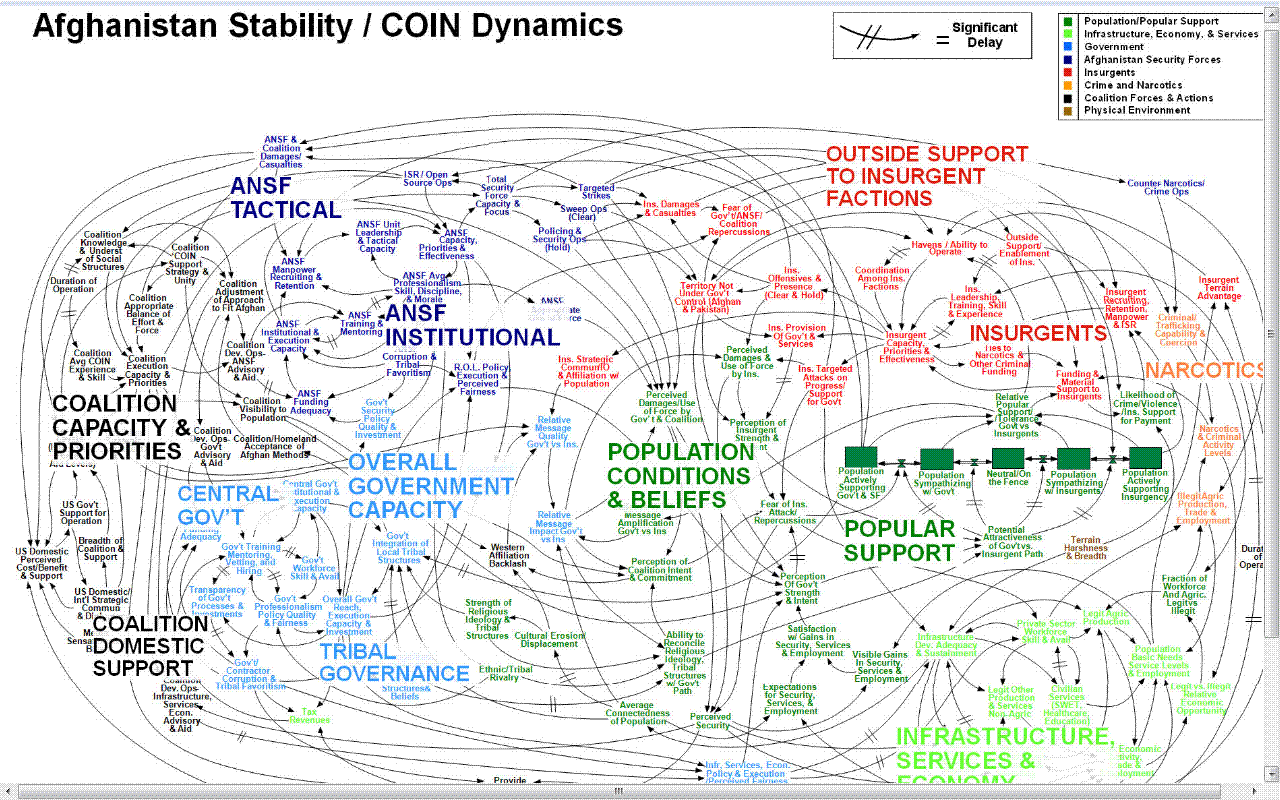
Here is a Data Visualization graphic from Office of the Joint Chiefs of Staff showing the clear way for Afghanistan.
Reminds me of the quote mistakenly attributed to Shakespeare-
Oh what a tangled web ( ^+^) we weave
When first we practice to deceive. – Sir Walter Scott (Marmion, 1808)
Disclaimer- As someone whose Hindu grandparents emigrated from Pakistan, I recommend reading ” A Brief History of the Sikhs” for a military /story on Afghanistan. The Sikhs were the first to conquer and occupy those deserted mountains- after Alexander of Macedonia/SeleceusGraphic Citationhttp://msnbcmedia.msn.com/i/MSNBC/Components/Photo/2009/December/091202/091203-engel-big-9a.jpg
Since time immemorial, countries and corporations have used spies to displace existing equilibriums in balance of power or market share dynamics. An integral part of that was technology. From the pox infested rugs given to natives, to the plague rats, to the smuggling of the secret of silk and gunpowder from China to the West to the latest research in cloud seeding by China and Glaciars melting by India- technology espionage has been an integral part in keeping up with each other.
For the first time in history, technology has evolved to the point where tools for communicating securely , storing data has become cheap to the point of just having a small iPhone 3GS with applications for secure transmission. From an analytical purpose the need for analyzing signal from noise and the criticality in mapping chatter with events (like Major Hasan’s online activities) has also created an opportunity for social media as well as an headache for the people involved. With Citizen Journalism, foreign relations office, and ambassadors with their bully pulpits have been brought down to defending news leaked by Twitter ( Iran) You Tube ( Thailand/Burma/Tibet) and Blogs ( Russia/Georgia). The rise of bot nets, dark clouds to create disruptions as well as hack into accounts for enhancing favourable noise and reducing unfavourable signals has only increased. Blogs have potential to influence customer behavior as they are seen more credible than public relations which is mostly public and rarely on relations.
Techniques like sentiment analysis , social network analysis, text mining and co relation of keywords to triggers remain active research points.
[tweetmeme=”decisionstats”]
The United States remains a leader as you can only think creatively out of a box if you are permitted to behave accordingly out of the box. The remaining countries are torn between a mix of admiration , envy and plain old copy cat techniques. The rising importance of communities that act more tribal than hitherto loyal technology user lists is the reason almost all major corporates actively seek to cultivate social media communities. The market for blogs and twitter in China or Iran or Russia will have impacts on those government’s efforts to manage their growth as per their national strategic interests. Just like the title of an old and quaint novel- “The Brave New World” of social media and it’s convergence with increasing amounts of text data generated on customers, or citizens is evolving into creating new boundaries and space for itself.A fascinating Great Game in itself.