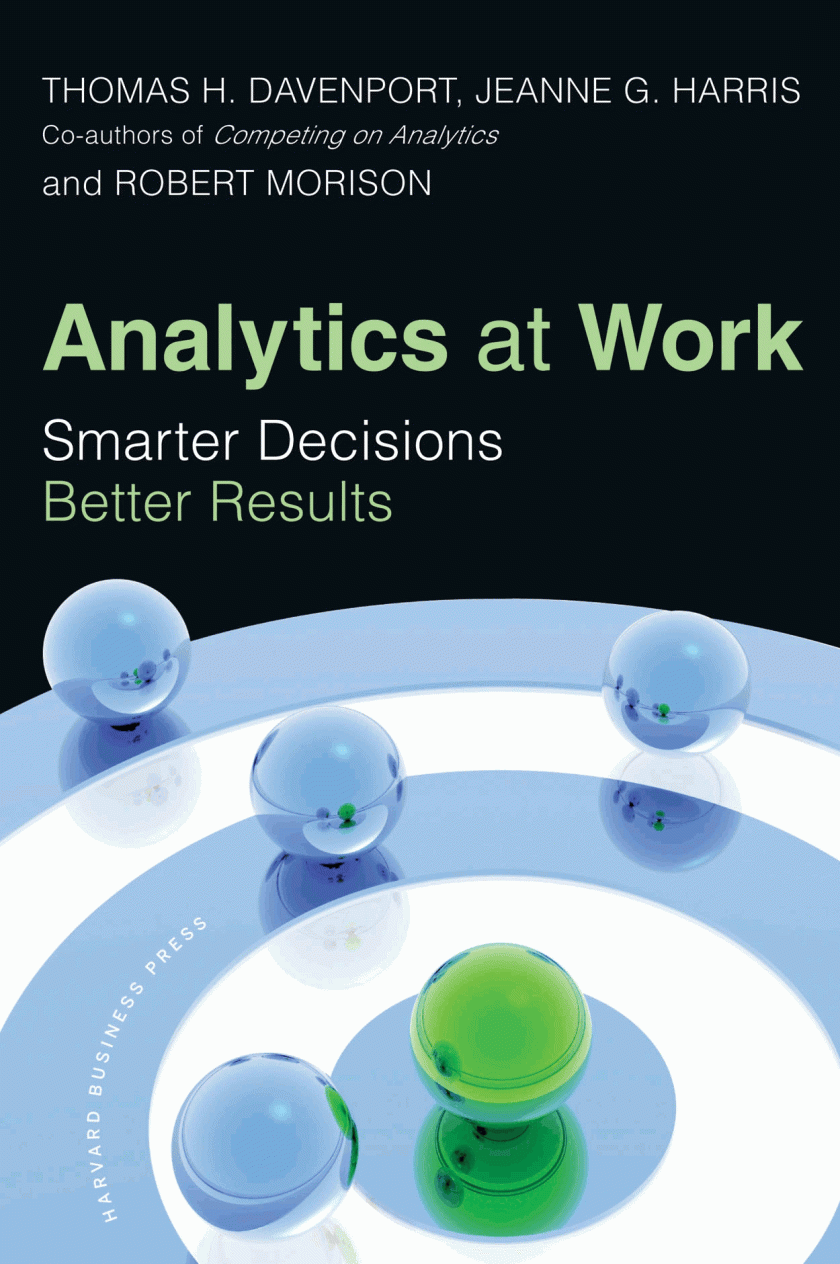
Here is an interview with Jeanne Harris, Executive Research Fellow and a Senior Executive at the Accenture Institute for High Performance and co-author of “Analytics at Work.”

Ajay- Describe your background in analytics and strategy
Jeanne- I’ve been involved in strategy and analytics since the mid 1980s, when I worked as part of a project that resulted in a Harvard Business Review article with Michael Porter entitled “Information for Competitive Advantage.” Since that time, I have led Accenture’s business intelligence, analytics, performance management, knowledge management, and data warehousing consulting practices. I have worked extensively with clients seeking to improve their managerial information, decision-making, analytical and knowledge management capabilities.
I am currently an Executive Research Fellow and a Senior Executive at the Accenture Institute for High Performance in Chicago. I lead the Institute’s global research agenda in the areas of information, technology, analytics and talent.
My research into building an enterprise analytical capability began in 1999, which led to an article called “Data to Knowledge to Results: Building an Analytical Capability” in California Management Review the following year.
In 2007, I co-authored “Competing on Analytics” with Tom Davenport, which argued that successful businesses must start making decisions based on data, not instinct.
Ajay- How is “Analytics at Work” an extension of your previous work? How is it different and distinct?
Jeanne- In “Competing on Analytics” we argued that there are big rewards for organizations that embrace fact-based decision-making. High performers are 5 times as likely to view analytical capabilities as a key element of their strategy. Across the board, high performance is associated with more extensive and sophisticated use of analytical capabilities. Companies like US–based Progressive Insurance which build their corporate culture around analytics have a real and sustainable competitive advantage.
As I spoke to clients, I realized that for every company that viewed analytics as their new core competitive strategy, there were many more who just wanted pragmatic advice on how to use analytics to make smarter business decisions and achieve better results.
If an analytical organization could be established by executive fiat we would not have needed to write another book. But like anything worthwhile, putting analytics to work takes effort and thought.
Fortunately, every organization, regardless of its current analytical capability, can benefit by becoming more analytical, gaining better insights, making better decisions and translating that into improved business performance. In “Analytics at Work,” we describe the elements an organization needs to establish a sustainable, robust, enterprise-wide analytical capability. This book contains a lot of pragmatic “how to” advice gleaned from our research and Accenture’s many client experiences.
Ajay- Do you see Analytics as a tool for cost cutting especially in the present economic scenario?
Jeanne- Certainly, analytics are an important tool for cutting costs and improving efficiency. Optimization techniques and predictive models can anticipate market shifts, enable companies to move quickly to slash costs and eliminate waste. But there are other reasons analytics are more important than ever:
• Manage risk. More precise metrics and risk management models will enable managers to make better decisions, reduce risk and monitor changing business conditions more effectively.
• Know what is really working. Rigorous testing and monitoring of metrics can establish whether your actions are really making desired changes in your business or not.
• Leverage existing investments (in IT and information) to get more insight, faster execution and more business value in business processes.
• Invest to emerge stronger as business conditions improve. High performers take advantage of downturns to retool, gain insights into new market dynamics and invest so that they are prepared for the upturn. Analytics give executives insight into the dynamics of their business and how shifts influence business performance.
• Identify and seize new opportunities for competitive advantage and differentiation.
Ajay- What are some analytics vendors and what do you think are their various differentiating points among each other?
Jeanne- Certain tools are ideally suited for some situations and not others. It’s the same with analytics vendors. At Accenture, we focus on matching the right tool with the demands of the situation, regardless of the vendor.
Ajay- What areas in an organization do you see Analytics applied the most and where do you think it is currently applied the least?
Jeanne- According to new Accenture research, two-thirds of senior managers in all areas of organizations the US and UK say their top long-term objective is to develop the ability to model and predict behavior, actions and decisions to the point where individual decisions and offers can be made in real time based on the analysis at hand[1]. Analytics is most frequently used in customer facing applications to generate customer insights, although in certain industries such as transportation it is also commonly used for logistics and yield management. Right now, analytics is probably most infrequently used in HR, although talent management analytics is a very hot topic.
Ajay- What is the best case study you can think where Analytics made a difference? And name a case study where it back fired.
Jeanne- It is hard to pick one favorite case study, when we wrote a whole book full of them! Harrah’s is a great case study of a company that uses analytics for competitive differentiation. Netflix is another company that has built its entire business model around an algorithm. Of course Google is essentially an analytical company too. What is of note is that during previous downturns, companies that thrived used data-derived insights made by informed decision makers to produce lasting competitive advantage.
In the book, we discuss the use and misuse of analytics as it relates to the global financial crisis, which we found to be a fascinating case study.
Ajay- Universities now offer Master in Analytics? What are your thoughts for an Ideal MS (Analytics) curriculum?
Jeanne- Yes, there are several universities around the world with degrees such as:
· Applied Analytics
· Applied Mathematics
· Econometrics
· Statistics
· Informatics
· Operations Research
Examples of universities in the US offering these programs include:
· Kellogg School of Management, Northwestern University
· Miami University (in Ohio)
· Central Michigan University,
· Villanova University
· North Carolina State University
Obviously analysts require extensive expertise in quantitative methods and modeling technology. But this is just the starting point. To be effective in business they also require industry and business process knowledge. They need to understand enough about IT to understand how analytics fit into the overall IT infrastructure. They need excellent written and verbal communications skills so their insights are understood. Analysts must also have collaboration skills to work with business managers to apply insights and achieve better business performance. So relationship and consultative skills are critical. As analytics become more central to the organization, more analysts need to know how to lead, coach and develop other professional analysts. They also will need to help coach and develop the analytical acumen of other information workers in the organizations.
Leading academic institutions are building more analytics into their business curriculums. And the best analytics degree programs are adding more training to develop industry & business process acumen, as well as relationship, communication & consultative skills.
Biography-
Jeanne G. Harris has worked with analytics, decision support and business intelligence at Accenture for over 23 years and headed the consulting practice in that area for the firm for several years. She is now Executive Research Fellow and Director of Research for the Accenture Institute for High Performance Business. She has been co Author with Tom Davenport for the seminal path breaking book Competing with Analytics and now on Analytics at Work.
Here is a link to the new book-having read some of it (and still reading it) I recommend it highly as a practical actionable guide.

 Not bad for epic software, huh?

 DECISION STATS