Price of Analytics Education from Indian Service Providers

This is an unedited list of education providers from India, with both classroom and online trainings. 1$ =55Rs. The list will be updated as and when changes occur or when a reader suggests. I will only be putting prices that can be referenced via a URL. Also later I will try and create an index to track prices. Because I have had relationships with a lot of people in Indian Analytics- I will try and put this in a Google Docs spreadsheet.

The basic template will  be

  • Service Provider-
  • Location-.
  • Type -Online /Classroom
  • URL (reference)
  • Dated-
  • Screenshot-

Example

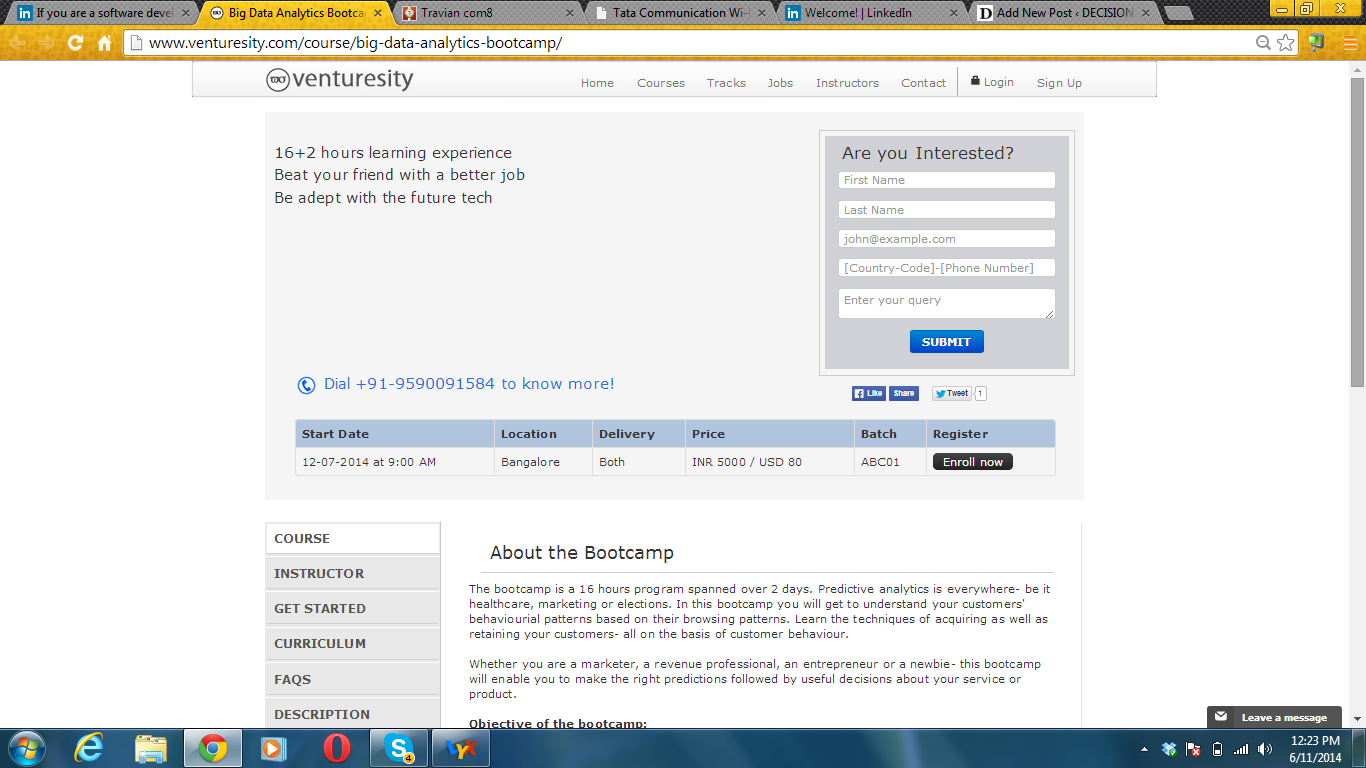
  • Service Provider-Venturesity
  • Location-Bangalore
  • Type -Classroom
  • URL (reference) -http://www.venturesity.com/course/big-data-analytics-bootcamp/
  • Dated-11 June 2014
  • Screenshot-Screenshot 2014-06-11 12.23.59


Brewer’s CAP Theorm

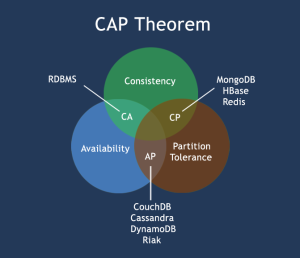
CAP theorem states that there are three basic requirements which exist in a special relation when designing applications for a distributed architecture.

Consistency – This means that the data in the database remains consistent after the execution of an operation. For example after an update operation all clients see the same data.

Availability – This means that the system is always on (service guarantee availability), no downtime.

Partition Tolerance – This means that the system continues to function even the communication among the servers is unreliable, i.e. the servers may be partitioned into multiple groups that cannot communicate with one another.

In theoretically it is impossible to fulfill all 3 requirements. CAP provides the basic requirements for a distributed system to follow 2 of the 3 requirements. Therefore all the current NoSQL database follow the different combinations of the C, A, P from the CAP theorem. Here is the brief description of three combinations CA, CP, AP :

CA – Single site cluster, therefore all nodes are always in contact. When a partition occurs, the system blocks.
CP – Some data may not be accessible, but the rest is still consistent/accurate.
AP – System is still available under partitioning, but some of the data returned may be inaccurate.

from —

http://mydatewithanalytics.wordpress.com/2014/06/01/brewers-cap-theorm/

cap-theoram-image

SAS makes it free to learn SAS

Wanna learn SAS language? Why go elsewhere? Get the original software in a virtual machine from the guys who actually created it!

http://www.sas.com/en_us/offers/14q1/122603-sas-for-academia/overview.html

It’s a 2 1.4 GB download and does require a 2 minute registration but thats all. You can even protype in it before you take that all important call to go for which software to buy for your analytics need. Note – retraining existing SAS analysts in R is expensive in terms of training costs, business disruption and code migration. Now only if someone could create a software to change SAS code into R code – that would make things different !!

SAS language analysts continue to be in much more demand than R language analysts- partly due to the failure of an authentic official R certification as it does not exist ( a fact that has been exploited by various institutes that teach you language syntax but not the analytics) and the poor state of the mothership R website with its huge and sometimes over detailed documentation

https://communities.sas.com/community/sas-analytics-u

and I really like the professionalism as well as the generosity of the institute. Someone famous once predicted SAS will disappear by 2015 ( based on a time series model ). With billions of dollars and it’s kitty and decade long shrewd and street smart management, SAS is going to stay up a wee bit longer and give it’s wannabe killers a bloody nose or two.

Thank you Professor Goodnight

—

testing it myself now !!

—

from

Click to access sas-university-edition-107140.pdf

For whom is SAS® University Edition designed?
SAS University Edition is designed for anyone wanting easy access to statistical software to perform quantitative analysis in an academic setting. This includes undergraduate and graduate students, professors, adult learners, high school students, researchers and postdocs

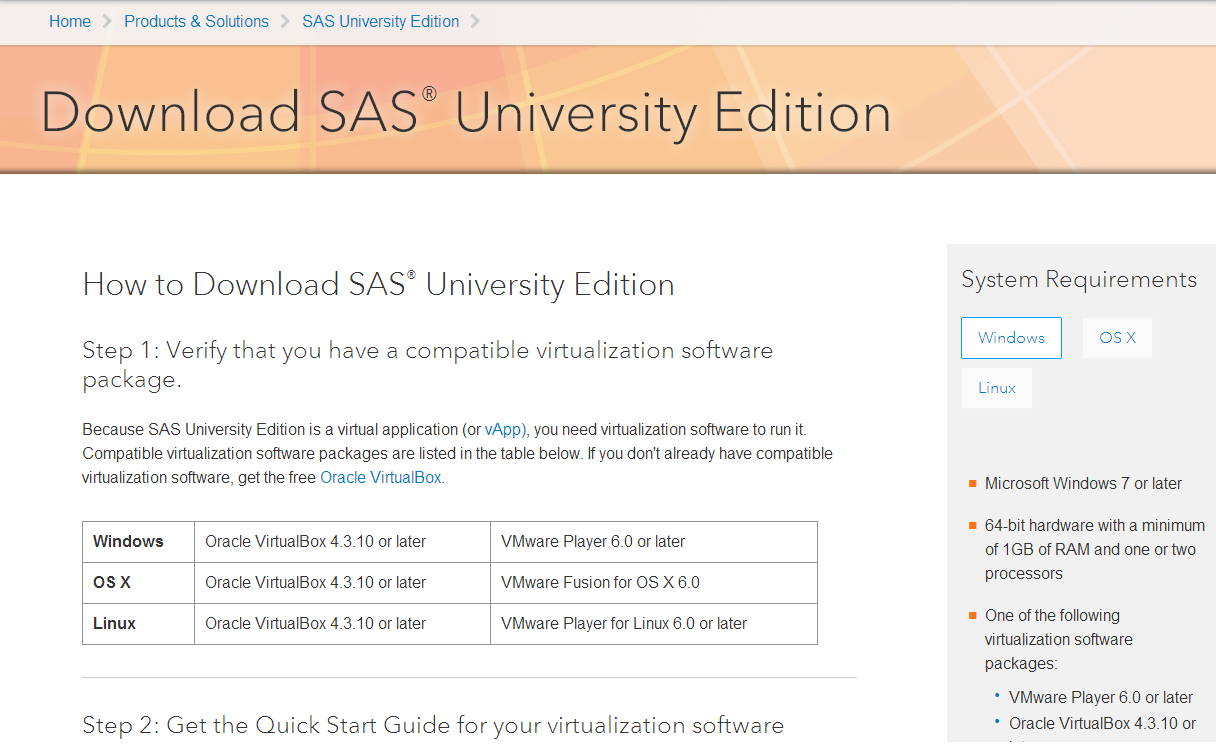
DOWNLOAD URL

http://www.sas.com/en_us/software/university-edition/download.html

Screenshot

download sas for free

KDNuggets Poll- Which software do you use to crunch?

The KDNuggets is an awesome poll for measuring which software you did use in the last 12 months. It already has 10000 voters already. What is unique about this poll is –

  1. takes less than 50 seconds to fill
  2. uses verification (single click) to ensure no duplicate votes are done
  3. transparent publishing of results in real time
  4. independent of vendor conflict of interests and honest.
  5. you can even download the raw data and start crunching your own analysis


I have many friends who send me emails to vote for them, and I have voted. Plus I wrote occasionally for the site.

So here is the link for the powerful KDNuggets.com poll –http://www.kdnuggets.com/


http://vote.sparklit.com/poll.spark/203792

FOAS is now going to reduce your tax if you support open source

Announcement from the retiring founder of http://www.foastat.org/

—

FOAS is a nonprofit public benefit corporation registered in California. It has federal tax-exempt status under Internal Revenue Section 501(c)(3). FOAS has a worldwide mission to to promote free software, open access publishing, and reproducible research in statistics.

FOAS now has 501(c)(3) federal tax exempt status. All donations to FOAS, retroactively from September 2012, are now tax deductible.

—

What is FOAS-  http://www.foastat.org/

The mission of the Foundation for Open Access Statistics (FOAS) is to promote free software, open access publishing, and reproducible research in statistics.

FOAS works to ensure the continued success of the Journal of Statistical Software (JSS), one of the few major open access journals that is free for both readers and authors. We also promote the use and development of free software for statistics, such as the R language and environment for computational statistics. We encourage members and the academic community at large to publish reproducible research that is publicly available online, e.g., in an open access journal or on an open access pre-print server.

You can join FOAS to show your support for free statistical software, open access publishing, and reproducible research in statistics. Membership is free and open to all. Members receive periodic email updates from FOAS, and may wish to join the FOAS-members list, join the Facebook FOAS Group, or follow FOAS on Diaspora.

Consider making a donation to FOAS. All donations are currently being used to support the operation of JSS.

—-

eh, Google how about routing less money through the Irish and giving some to Californian open source…

Related- cultural icon to non open source companies.



This is why code written by scientists gets ugly

brilliant piece of why scientists write bad code

nsaunders's avatarWhat You're Doing Is Rather Desperate

There’s a lot of discussion around why code written by self-taught “scientist programmers” rarely follows what a trained computer scientist would consider “best practice”. Here’s a recent post on the topic.

One answer: we begin with exploratory data analysis and never get around to cleaning it up.

An example. For some reason, a researcher (let’s call him “Bob”) becomes interested in a particular dataset in the GEO database. So Bob opens the R console and use the GEOquery package to grab the data:

Bob is interested in the covariates and metadata associated with the experiment, which he can access using pData().

Bob discovers that pd$characteristics_ch1.2 is “age at examination”, but it’s stored as a factor. He’d like to use it as a numeric variable. So he sets about figuring out how to do the conversion.

Three levels of nested methods. Ugly. However, it works, so Bob moves to…

View original post 34 more words