Using ggplot in Python #python #dataviz

Based on the open source project at http://ggplot.yhathq.com/ here is small training ppt created by one of our wonderful summer interns Sarah

Hat Tip  to http://www.amazon.com/Grammar-Graphics-Statistics-Computing/dp/0387245448

Leland Wilkinson the inventor of Grammar of Graphics now works for Tableau Software


Get you app on Droid

1 Download and Install   IntelliJ IDEA 

https://www.jetbrains.com/idea/help/basics-and-installation.html#d1847332e131

2 To update which version of Java you want

$ sudo update-alternatives --config java

3 Download and Install Android Studio

http://developer.android.com/sdk/installing/index.html?pkg=studio

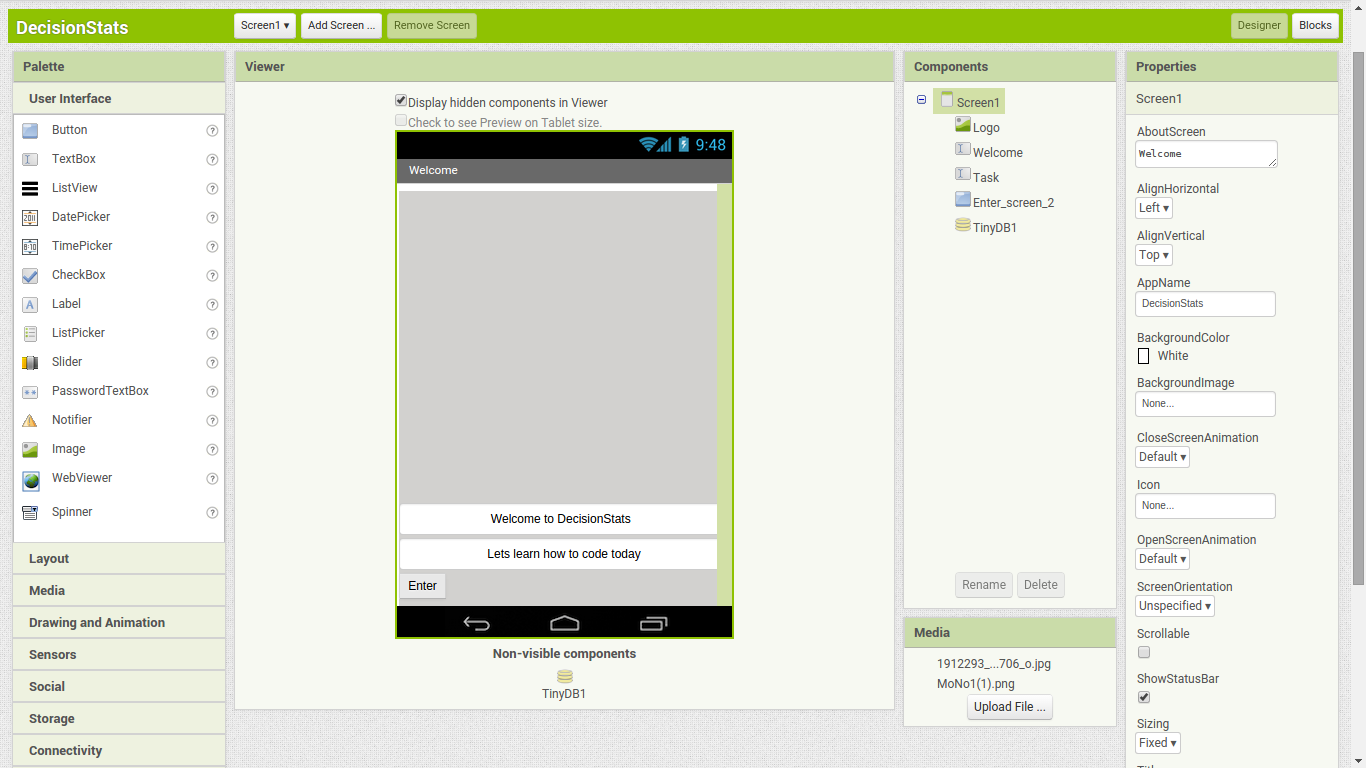
4 Learn about basic app building from MIT App Builder ( its a GUI so relax)

http://ai2.appinventor.mit.edu/ Screenshot from 2015-08-19 11:44:13

5 Give up building yourself and post for a developer for your Android app at http://www.appfutura.com/


Sources-

http://askubuntu.com/questions/64329/how-to-replace-openjdk-6-with-openjdk-7


Installing and Using Spark easily with Python or R on Ubuntu #python #rstats

  1. Download spark from https://spark.apache.org/downloads.html (say to home/ajay/Desktop/BDA )
  2. Change to the directory from terminal cd /home/ajay/Desktop/BDA
  3. Unzip the file
    tar -xvf spark-1.4.1-bin-hadoop2.6.tgz
  4. Change to the directory created ( say you unizpped spark file above and renamed it spark) ajay@Inspiron-3542:~/Desktop/BDA$ cd spark
  5. Run the command ./bin/pyspark Screenshot from 2015-08-18 11:58:34
  6. To look at local jobs see http://192.168.1.18:4040/jobs/ (or based on what you get from your terminal after running command in step 4)

Screenshot from 2015-08-18 11:57:56


to do this with R just use .bin/sparkR

Screenshot from 2015-08-18 12:02:19


Sources- http://stackoverflow.com/questions/30483409/installing-apache-spark-on-ubuntu-14-04


Traps to avoid if you are a grey hat hacker

  1. Bait and Switch – used to plant embedded malware or logging systems https://en.wikipedia.org/wiki/Bait-and-switch the action (generally illegal) of advertising goods which are an apparent bargain, with the intention of substituting inferior or more expensive goods. It can be avoided by periodically changing your hardware and software with a reliance for open source and open market and of course by avoiding things that are too good to be true.
  2. The Honey Traphttps://en.wikipedia.org/wiki/Honey_trapping
    a stratagem in which an attractive person entices another person into revealing information or doing something unwise. This one got Julian Assange
  3. The Honey Pot  –https://en.wikipedia.org/wiki/Honeypot_(computing) a honeypot is a trap set to detect, deflect, or, in some manner, counteract attempts at unauthorized use of information systems. Generally, a honeypot consists of a computer, data, or a network site that appears to be part of a network, but is actually isolated and monitored, and which seems to contain information or a resource of value to attackers. This is similar to the police baiting a criminal and then conducting undercover surveillance. This one got Sabu.
  4. The Tax Trap- This one got Al Capone. Since there is no evidence against your cyber activities they put you in tax court based on the mismatch of your income and expenditure. It can be avoided by creating appropriate legal mechanisms including corporations.
  5. The Informer Trap– God can protect you against your enemies but not your friends. This can be avoided by delineating the personal private and professional life of your activities in different compartments, hardware and virtual machines including your own personality and brain. Reveal you true identity to boast and you will end up a Reservoir Dog

Screenshot from 2015-08-18 10:55:41

Is R going to be better than Python for Big Data Analytics and Data Science? #rstats #python

My last articles seems to have touched a nerve or two judging by the 2000 views I got in a single day on a Sunday ( and India’s national Independence Day / and  V-J Day). Here I am simply reproducing the unedited and very interesting comments I got with an interesting R package.


On Google Plus, there is a vibrant community for R and Statistics. Yes Google plus exists still 😉 The following excellent comment makes you think.

This is pretty much a ho-hum topic with me. I don’t find this article very convincing. If you like Python, fine! Use Python. The problem I have with Python is that it is an interpreted language. Anything written in pure Python is going to take a long time to run on a big data set. Sure, there are Python packages for data analysis that run quickly, but you either have to depend on what someone else provides or develop your own package in compiled code.

I’ve found most software apps written specifically for “big data” to be very limited: a lot of them begin and end at N/N (pretty old hat now and inferior to a number of other methods for many analyses). If you can’t look under the hood and see what goes on in an analysis package, well, then good luck to you if you to use it, but don’t expect me to.

So far I’ve found that R works well for the large data sets I work with. (I’ll leave aside the issue of graphics for now; I have yet to see anything else that can hold a candle to R in that regard.) If the base packages that come with R can’t do a particular task I’ll first search among the over 5,000 packages currently available on CRAN. If that doesn’t work I’ll send a request to the R help list server. If that doesn’t work I’ll write my own routine in C or C# (I prefer the latter). BTW, if you are in the data analysis game you need to know enough to be able to do your own numerical analysis programming, say at the level of Numerical Recipes. Otherwise you are going to be overly dependent on someone else to provide software for you.

I’m not writing this to persuade anyone to pick one over the other. It’s just that there are a lot of possible choices out there — it’s not just R vs Python. And I’m just tired of these endless debates that go nowhere. As we say in the software engineering world: don’t try to convince the other person that your text editor/IDE/programming language is better than theirs.

—-
and
Anthony the creator or RHadoop was kind enough to not only write a comment here but also provide a tech solution AND throw a challenge at all pythonistas.

The lack of activity on rmr2 reflects maturity of the package and a shift away from Hadoop mapreduce toward spark. Please check the dplyr.spark package on github. It’s the easiest way to run spark bar none, including python, in its author very biased opinion. Example: find the best and worst flight by arrival delay on each day:

group_by(flights, year, month, day) %>%
select(flight, arr_delay) %>%
filter(arr_delay == min(arr_delay) || arr_delay == max(arr_delay))

Runs on spark, scales to whatever your cluster can store. Please show me the equivalent in any other language, python included. I am waiting.

and finally after all that violence and doubletalk ( as Dire Straits sang in the Walk of Life)  the R package that will beat all packages on Big Data —-(apparently)

download spark and build it as follows

cd <spark root>
build/mvn -Pyarn -Phadoop-2.4 -Dhadoop.version=2.4.0 -DskipTests -Phive -Phive-thriftserver clean package

Then start the thift service.

sbin/start-thriftserver.sh  
install.packages(c("RJDBC", "dplyr", "DBI", "devtools"))
devtools::install_github("hadley/purrr")  

Indirectly RJDBC needs rJava. Make sure that you have rJava working with:

library(rJava)
.jinit()
install.packages("devtools")
library(devtools)
install_url(
  "https://github.com/RevolutionAnalytics/dplyr-spark/releases/download/0.2.2/dplyr.spark_0.2.2.tar.gz")

library(dplyr)

library(dplyr.spark)

spark.src = src_SparkSQL(localhost, 10000)


Is Python going to be better than R for Big Data Analytics and Data Science? #rstats #python

Uptil now the R ecosystem of package developers has mostly shrugged away the Big Data question. In   a fascinating insight Hadley Wickham said this in a recent interview- shockingly it mimicks the FUD you know who has been accused of ( source

https://peadarcoyle.wordpress.com/2015/08/02/interview-with-a-data-scientist-hadley-wickham/

5. How do you respond when you hear the phrase ‘big data’? Big data is extremely overhyped and not terribly well defined. Many people think they have big data, when they actually don’t.

I think there are two particularly important transition points:

* From in-memory to disk. If your data fits in memory, it’s small data. And these days you can get 1 TB of ram, so even small data is big!

* From one computer to many computers.

R is a fantastic environment for the rapid exploration of in-memory data, but there’s no elegant way to scale it to much larger datasets. Hadoop works well when you have thousands of computers, but is incredible slow on just one machine. Fortunately, I don’t think one system needs to solve all big data problems.

To me there are three main classes of problem:

1. Big data problems that are actually small data problems, once you have the right subset/sample/summary.

2. Big data problems that are actually lots and lots of small data problems

3. Finally, there are irretrievably big problems where you do need all the data, perhaps because you fitting a complex model. An example of this type of problem is recommender systems

Ajay- One of the reasons of non development of R Big Data packages is- it takes money. The private sector in R ecosystem is a duopoly ( Revolution Analytics ( acquired by Microsoft) and RStudio (created by Microsoft Alum JJ Allaire). Since RStudio actively tries as a company to NOT step into areas Revolution Analytics works in- it has not ventured into Big Data in my opinion for strategic reasons.

Revolution Analytics project on RHadoop is actually just one consultant working on it here https://github.com/RevolutionAnalytics/RHadoop and it has not been updated since six months

We interviewed the creator of R Hadoop here https://decisionstats.com/2014/07/10/interview-antonio-piccolboni-big-data-analytics-rhadoop-rstats/

However Python developers have been trying to actually develop systems for Big Data actively. The Hadoop ecosystem and the Python ecosystem are much more FOSS friendly even in enterprise solutions.

This is where Python is innovating over R in Big Data-

http://blaze.pydata.org/en/latest/

  • Blaze: Translates NumPy/Pandas-like syntax to systems like databases.

    Blaze presents a pleasant and familiar interface to us regardless of what computational solution or database we use. It mediates our interaction with files, data structures, and databases, optimizing and translating our query as appropriate to provide a smooth and interactive session.

  • Odo: Migrates data between formats.

    Odo moves data between formats (CSV, JSON, databases) and locations (local, remote, HDFS) efficiently and robustly with a dead-simple interface by leveraging a sophisticated and extensible network of conversions. http://odo.pydata.org/en/latest/perf.html

    odo takes two arguments, a target and a source for a data transfer.

    >>> from odo import odo
    >>> odo(source, target)  # load source into target 
  • Dask.array: Multi-core / on-disk NumPy arrays

    Dask.arrays provide blocked algorithms on top of NumPy to handle larger-than-memory arrays and to leverage multiple cores. They are a drop-in replacement for a commonly used subset of NumPy algorithms.

  • DyND: In-memory dynamic arrays

    DyND is a dynamic ND-array library like NumPy. It supports variable length strings, ragged arrays, and GPUs. It is a standalone C++ codebase with Python bindings. Generally it is more extensible than NumPy but also less mature.  https://github.com/libdynd/libdynd

    The core DyND developer team consists of Mark Wiebe and Irwin Zaid. Much of the funding that made this project possible came through Continuum Analytics and DARPA-BAA-12-38, part of XDATA.

    LibDyND, a component of the Blaze project, is a C++ library for dynamic, multidimensional arrays. It is inspired by NumPy, the Python array programming library at the core of the scientific Python stack, but tries to address a number of obstacles encountered by some of its users. Examples of this are support for variable-sized string and ragged array types. The library is in a preview development state, and can be thought of as a sandbox where features are being tried and tweaked to gain experience with them.

    C++ is a first-class target of the library, the intent is that all its features should be easily usable in the language. This has many benefits, such as that development within LibDyND using its own components is more natural than in a library designed primarily for embedding in another language.

    This library is being actively developed together with its Python bindings,

http://dask.pydata.org/en/latest/

On a single machine dask increases the scale of comfortable data from fits-in-memory to fits-on-diskby intelligently streaming data from disk and by leveraging all the cores of a modern CPU.

Users interact with dask either by making graphs directly or through the dask collections which provide larger-than-memory counterparts to existing popular libraries:

  • dask.array = numpy + threading
  • dask.bag = map, filter, toolz + multiprocessing
  • dask.dataframe = pandas + threading

Dask primarily targets parallel computations that run on a single machine. It integrates nicely with the existing PyData ecosystem and is trivial to setup and use:

conda install dask
or
pip install dask

https://github.com/cloudera/ibis

When open source fights- closed source wins. When the Jedi fight the Sith Lords will win

So will R people rise to the Big Data challenge or will they bury their heads in sands like an ostrich or a kiwi. Will Python people learn from R design philosophies and try and incorporate more of it without redesigning the wheel

Converting code from one language to another automatically?

How I wish there was some kind of automated conversion tool – that would convert a CRAN R package into a standard Python package which is pip installable

Machine learning for more machine learning anyone?

Psychology for Data Miners

Over the past few years I have chosen a few tools primarily driven from Psychology to help me manage complex scenarios, difficult clients and problematic questions. The reason for this is quite simple, data science especially predictive analytics is trying to mimic or predict human behavior which is inherently irrational and driven by impulse or need fulfillment. However when human behavior is aggregated as well as segregated we can predict it but for short periods of time after which predictive models decay.

  1. Johari’s Window – source https://en.wikipedia.org/wiki/Johari_window 

philosopher Charles Handy calls this concept the Johari House with four rooms. Room 1 is the part of ourselves that we see and others see. Room 2 is the aspects that others see but we are not aware of. Room 4 is the most mysterious room in that the unconscious or subconscious part of us is seen by neither ourselves nor others. Room 3 is our private space, which we know but keep from others.

Open or Arena: Adjectives that are selected by both the participant and his or her peers are placed into the Open or Arenaquadrant. This quadrant represents traits of the subjects that both they and their peers are aware of.

Hidden or Façade: Adjectives selected only by subjects, but not by any of their peers, are placed into the Hidden or Façadequadrant, representing information about them their peers are unaware of. It is then up to the subject to disclose this information or not.

Blind : Adjectives that are not selected by subjects but only by their peers are placed into the Blind Spot quadrant. These represent information that the subject is not aware of, but others are, and they can decide whether and how to inform the individual about these “blind spots“.

Unknown: Adjectives that were not selected by either subjects or their peers remain in the Unknown quadrant, representing the participant’s behaviors or motives that were not recognized by anyone participating.


2) Hierarchy of Needs Source- https://en.wikipedia.org/wiki/Maslow%27s_hierarchy_of_needs

Maslow used the terms “physiological”, “safety”, “belongingness” and “love”, “esteem”, “self-actualization”, and “self-transcendence” to describe the pattern that human motivations generally move through.

This helps me understand what a client wants with a particular project and what an employee wants when he asks for pay /stock options etc

3) Agency – Owner conflict source- https://en.wikipedia.org/wiki/Principal%E2%80%93agent_problem

The principal–agent problem (also known as agency dilemma or theory of agency) occurs when one person or entity (the “agent“) is able to make decisions on behalf of, or that impact, another person or entity: the “principal“. The dilemma exists because sometimes the agent is motivated to act in his own best interests rather than those of the principal. The agent-principal relationship is a useful analytic tool in political science and economics, but may also apply to other areas.

Common examples of this relationship include corporate management (agent) and shareholders (principal), or politicians (agent) and voters (principal).[1] For another example, consider a dental patient (the principal) wondering whether his dentist (the agent) is recommending expensive treatment because it is truly necessary for the patient’s dental health, or because it will generate income for the dentist.

4) Culture of an organization -It changes with time. This graph helps me understand
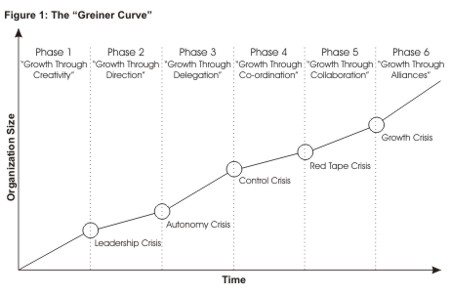
5) Cognitive Biases- why do rational people make irrational choices. Aha! Cognitive Biases Source-https://en.wikipedia.org/wiki/Cognitive_bias


Cognitive biases are tendencies to think in certain ways that can lead to systematic deviations from a standard of rationality or good judgment, and are often studied in psychology and behavioral economics.

Among the “cold” biases,

  • some involve a decision or judgement being affected by irrelevant information (for example the framing effect where the same problem receives different responses depending on how it is described; or the distinction bias where choices presented together have different outcomes than those presented separately)
  • others give excessive weight to an unimportant but salient feature of the problem (e.g., anchoring)

6) Logical Fallacies- To quickly separate signal from human generated noise or arguments, I wish there was a machine learning algorithm to detect logical fallacies  in NLTP.

7) Motivation (from Sanskrit)  source- http://chanakya.brainhungry.com/saam-daam-dand-bhed-chanakya-neeti/

There are four ways of making someone to do a task, stated as “Saam, Daam, Dand & Bhed”. This sutra by Acharya Chanakya is used worldwide. why? It works and is highly practical. It means:

  • Saam: to advice and ask
  • Daam: to offer and buy
  • Dand: to punish
  • Bhed: exploiting the secrets


Apart from these I also use some seven strategy models for actually understanding business . I learnt in Business School- they are here in quasi -graphical easy to understand format

https://decisionstats.com/2013/12/19/business-strategy-models/