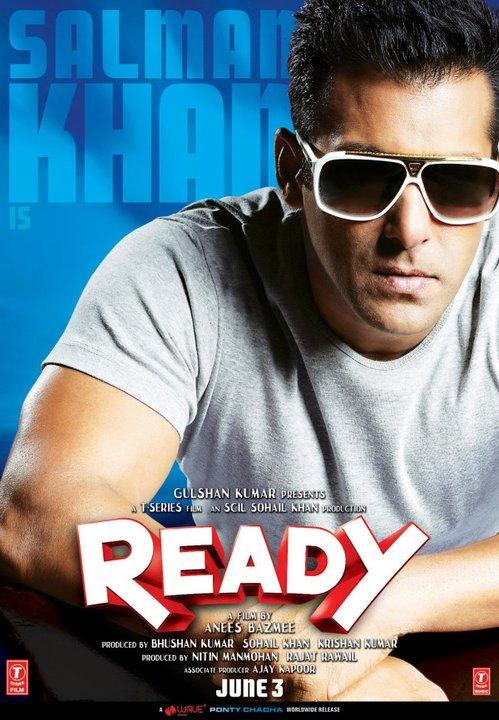
I just saw the Bollywood Movie , Ready (2011) starring Salman Khan and Asin. Salman Khan has been the Charlie Sheen of Indian Cinema for some time now, and the movie plays up to his charm, slapstick humor and slap full action.
Asin is a great actor, and this is not art for the sake of art- it is art to make the people laugh.
Enjoy it but with tempered expectations that you are in for some stupendous Bollywoodish humor.
Jake Gyllenhaal has always been a dear chap from his Donny Darko days. So when you mash some quantum physics (parabolic calculus as per movie), with science fiction to capture terrorists (a very topical topic)- you get Source Code– an investigative and recursive logical thriller. Lead actress Vera Farmiga from the Departed (remember the scene of making love to Comfortably Numb) seems a bit bored today and the tension never crackles. This is a movie for science fiction or action thrillers not geeks- and the name source code is a bit of a misleading title- as it should probably be called Complex Event Processing. It is also a terrible name to search for in Google Image Search- you dont get movie images at all.
The movie is very watchable, but it wont be winning any Hugo awards yet.
My perspective is life is not fair, and if someone offers me 1 mill a year so they make 1 bill a year, I would still take it, especially if it leads to better human beings and better humanity on this planet. Health care isnt toothpaste.
Unless there are even more fine print changes involved- there exist several players in the pharma sector who do build and deploy models internally for denying claims or prospecting medical doctors with freebies, but they might just get caught with the new open data movement
————————————————————————————————–
A note from KDNuggets-
Heritage Health Prizereleased a second set of data on May 4. They also recently modified their ruleswhich now demand complete exclusivity and seem to disallow use of other tools (emphasis mine – Gregory PS)
21. LICENSE
By registering for the Competition, each Entrant (a) grants to Sponsor and its designees a worldwide, exclusive (except with respect to Entrant) , sub-licensable (through multiple tiers), transferable, fully paid-up, royalty-free, perpetual, irrevocable right to use, not use, reproduce, distribute (through multiple tiers), create derivative works of, publicly perform, publicly display, digitally perform, make, have made, sell, offer for sale and import the entry and the algorithm used to produce the entry, as well as any other algorithm, data or other information whatsoever developed or produced at any time using the data provided to Entrant in this Competition (collectively, the “Licensed Materials”), in any media now known or hereafter developed, for any purpose whatsoever, commercial or otherwise, without further approval by or payment to Entrant (the “License”) and
(b) represents that he/she/it has the unrestricted right to grant the License.
Entrant understands and agrees that the License is exclusive except with respect to Entrant: Entrant may use the Licensed Materials solely for his/her/its own patient management and other internal business purposes but may not grant or otherwise transfer to any third party any rights to or interests in the Licensed Materials whatsoever.
This has lead to a call to boycott the competition by Tristan, who also notes that academics cannot publish their results without prior written approval of the Sponsor.
Anthony Goldbloom, CEO of Kaggle, emailed the HHP participants on May 4
HPN have asked me to pass on the following message: “The Heritage Provider Network is sponsoring the Heritage Health Prize to spur innovation and creative thinking in healthcare. HPN, however, is a medical group and must retain an exclusive license to the algorithms created using its data so as to ensure that the algorithms are used responsibly, and are only used to provide better health care to patients and not for improper purposes.
Put simply, while the competition hopes to spur innovation, this is not a competition regarding movie ratings or chess results. We hope that the clarifications we have made to the Rules and the FAQ adequately address your concerns and look forward to your participation in the competition.”
What do you think? Will the exclusive license prevent you from participating?
While sitting in Delhi, India- I sometimes notice that there is one big new worthy gun related incident in the United States every six months (latest incident Gabrielle giffords incident) and the mythical NRA (which seems just as powerful as equally mythical Jewish American or Cuban American lobby ) . As someone who once trained to fire guns (.22 and SLR -rifles actually), comes from a gun friendly culture (namely Punjabi-North Indian), my dad carried a gun sometimes as a police officer during his 30 plus years of service, I dont really like guns (except when they are in a movie). My 3 yr old son likes guns a lot (for some peculiar genetic reason even though we are careful not to show him any violent TV or movie at all).
So to settle the whole guns are good- guns are bad thing I turned to the one resource -Internet
Here are some findings-
1) A lot of hard statistical data on guns is biased by the perspective of the writer- it reminds me of the old saying Lies, True lies and Statistics.
2) There is not a lot of hard data in terms of a universal research which can be quoted- unlike say lung cancer is caused by cigarettes- no broad research which can be definitive in this regards.
3) American , European and Asian attitudes on guns actually seem a function of historical availability , historic crime rates and cultural propensity for guns.
Switzerland and United States are two extreme outlier examples on gun causing violence causal statistics.
4) Lot of old and outdated data quoted selectively.
It seems you can fudge data about guns in the following ways-
1) Use relative per capita numbers vis a vis aggregate numbers
2) Compare and contrast gun numbers with crime numbers selectively
3) Remove drill down of type of firearm- like hand guns, rifles, automatic, semi automatic
Maybe I am being simplistic-but I found it easier to list credible data sources on guns than to summarize all assumptions on guns. Are guns good or bad- i dont know -it depends? Any research you can quote is welcome.
* As of 2009, the United States has a population of 307 million people.[5]
* Based on production data from firearm manufacturers,[6] there are roughly 300 million firearms owned by civilians in the United States as of 2010. Of these, about 100 million are handguns.[7]
* Based upon surveys, the following are estimates of private firearm ownership in the U.S. as of 2010:
DEFINITION: Total recorded intentional homicides committed with a firearm. Crime statistics are often better indicators of prevalence of law enforcement and willingness to report crime, than actual prevalence.
SOURCE: The Eighth United Nations Survey on Crime Trends and the Operations of Criminal Justice Systems (2002) (United Nations Office on Drugs and Crime, Centre for International Crime Prevention)
National or state offense totals are based on data from all reporting agencies and estimates for unreported areas.
* Rates are the number of reported offenses per 100,000 population
United States-Total –
The 168 murder and nonnegligent homicides that occurred as a result of the bombing of the Alfred P. Murrah Federal Building in Oklahoma City in 1995 are included in the national estimate.
The 2,823 murder and nonnegligent homicides that occurred as a result of the events of September 11, 2001, are not included in the national estimates.
Sources:
FBI, Uniform Crime Reports as prepared by the National Archive of Criminal Justice Data






 DECISION STATS