Collobrating in Conferences with Google Wave

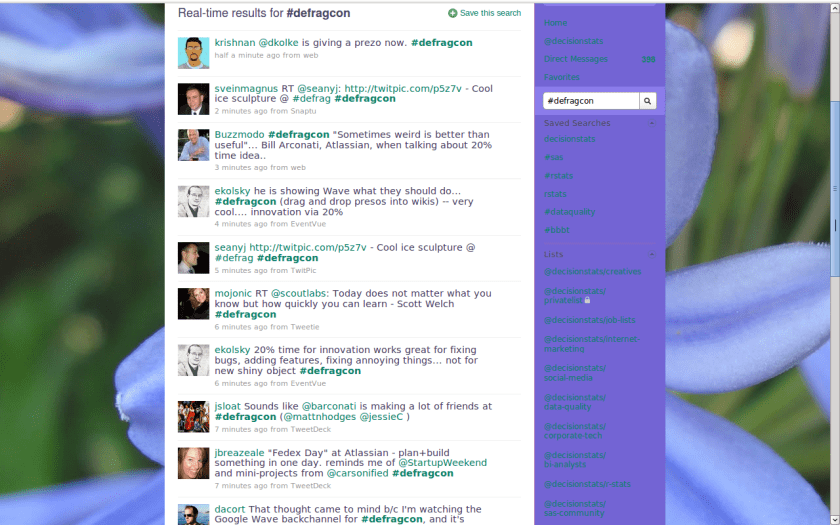
If you have ever followed hash tags on Twitter for conferences and media events the next generation in online discussions

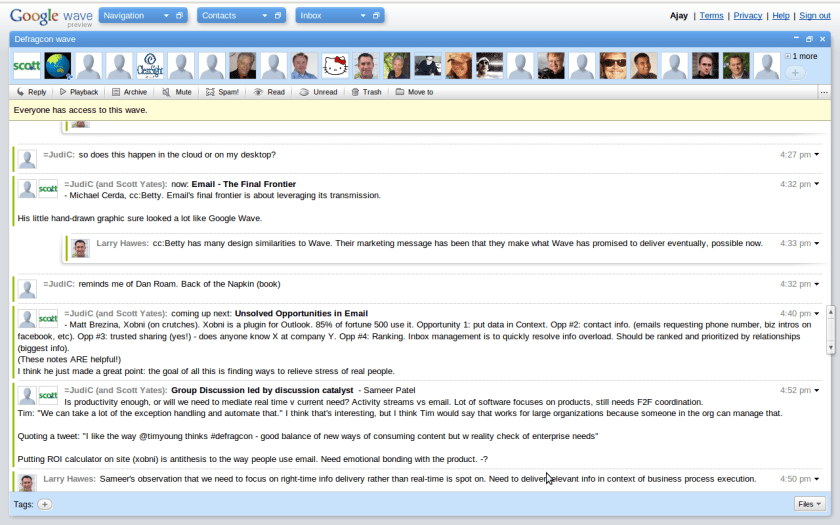
is clearly Google Wave. Here is a screenshot of a lot of people collaborating, discussing and in general having a conversation while events are going on at the DeFrag Con ( http://defragcon.com/2009/DEFRAG09-Home.htm )

The Google Wave collaboration method sure beats the Twitter hash tag method by a big..wave.

Screenshot

Screenshot-1

Who will forecast for the forecasters?

An interesting blog post appeared here at http://www.information-management.com/blogs/business_intelligence_bi_statistics-10016491-1.html basically laying down the competitive landscape for analytical companies.

“-One safe bet is that IBM, with newly-acquired SPSS and Cognos, is gearing up to take on SAS in the high-end enterprise analytics market that features very large data and operational analytics with significant capacity challenges. In this segment, IBM can leverage its hardware, database and consulting strengths to become a formidable SAS competitor.

and

A number of start-up companies promoting competitive SAS language tools at a fraction of SAS prices may begin chipping away at many SAS annuity customers. As I wrote in last week’s blog, WPS from World Programming Systems is an outstanding SAS compiler that can replace expensive SAS licenses in many cases – especially those primarily used for data step programs. Similarly, another competitor, Carolina, from Dulles Research, LLC, converts Base SAS program code to Java, which can then be deployed in a Java run-time environment. Large SAS customer Discover Card is currently evaluating Carolina as a replacement for some its SAS applications.

CITATION-Steve Miller’s blog can also be found at miller.openbi.com.”

I think all companies have hired smart enough people and many of their efforts would cancel each other out in a true game theory manner.

I also find it extremely hypocritical for commercial vendors not to incentive R algorithm developers and treat the 2000 plus packages as essentially free ware.

If used for academics and research, R package creators expect and demand no money. But if used commercially – shouldnt the leading analytical vendors like SAS, SPSS, and even the newly cash infused REVolution create some kind of royalty sharing agreement.

If iTunes can help sell songs for 99 cents per download and really help the Music industry come to the next generation- how much would commercial vendors agree to share their solutions which ARE DEPENDENT on popular R packages like Plier or even Dr Frank’s Hmisc.

Unless you think Britney Spears has a better right to intellectual property than venerable professors and academics.

Even a monthly 10000 USD prize for the best R package created ( that can be used by that specific company’s use for commercial packages) can help speed up the R software movement- just like NetFlix prize.

More importantly – it can free up valuable resources for companies to concentrate on customer solutions like data quality, systems integration and computational environment shift to clouds which even todayis sadly lacking in the whole analytical ecosystem.

One interesting paradigm I find is that who ever masters the new computational requirements of unstructured large amounts of data ( not just row and column numeric data) but text sentiment analysis like data, and can integrate this for a complete customer solution in an easy to understand data visualization enabled system- that specific package,platform  or company would be leading the next decade

( Q -if the 90s were the Nineties will the next decade be the teen years)

Digitization to help education: Blackboard

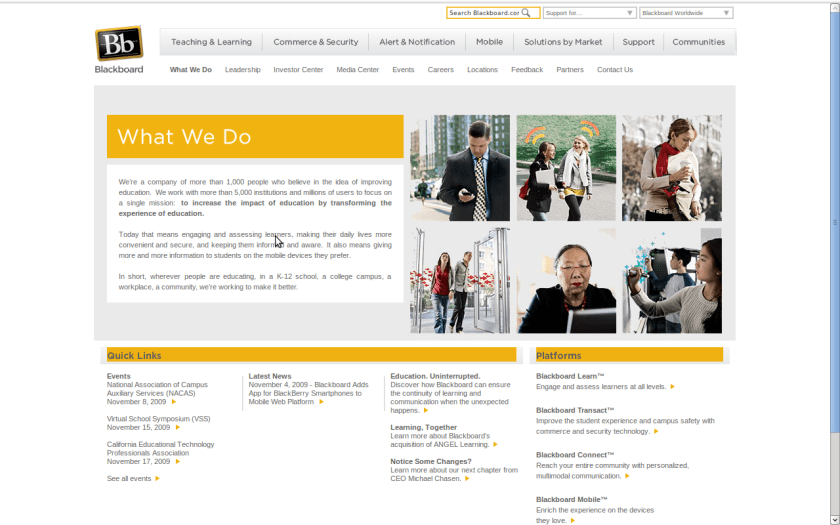
At University of Tennessee, we use a digital solution called BlackBoard. This helps streamline communiction as well as enables us to cut down down on paper usage, besides capturing a lot of data for analysis and course improvement.

Basically it helps capture data for the following-

1) How often and ehen precisely did instructors announce change in syllabus, announcements, homework

2) Grades are posted online and students can see their grade with average and s.d of whole class ( FERPA – A federal law restricts making comparisons between students or telling them another person grades)

3) Lectures are recorded by Video ( and can be seen but not downloaded). Thus good lectures and courses can possibly be offered as digital courses or donated to suitable causes.

4) Instructors can see from analytics ( web) when and how often students referred to the course specific site. This helps them in understanding needs for students who may be lagging behind.

5) It has the facillity for polls to give constant feedback to instuctor during the course.

6) All slides and course material is shared securely without being accessible to outside web thus ensuring intellectual property protection for the course contents ( a policy I disagree with mildly- and sites like StudyBlue now offer students incentives to post the same content back for sharing)

7) Much better version control than lots of email floating with attachments or lots of printouts of slides per lecture. Digitization saves costs AND is good for student.

Eg A high school in Harlem or say in rural East Tennessee lacks good maths teachers. Using Digitization, Online Video and inexpensive solutions- students in far off schools can possibly share video lectures from the best private maths tutors ( at exclusive California or Dc schools). Technology can thus help bridge the technical instructor divide without  rampant labour cost destroying offshoring- and it is heartening to see some companies like SAS Education go for On Demand educational solutions ( though more SAS focussed and not basic maths or stats focussed) Even SAP has a great University partnering program.

bb

The Best of Times: A Disruptive Innovation

It was the best of times, it was the worst of times

Ever felt bad for a website like Yahoo.com or Nytimes.com whom you really liked using but dont know what to do to help it.

Click the ads. Like Fans of a Baseball team clap more, fans of a website should click more ( this site does not use Cost Per Click as I feel Cost per Conversion is a more HONEST statistical measure so try this at somewhere)

Surely the fans of a website like NYTimes.com deserve some say – just as much the Private Equity Funds and Wall Street Honchos and internal investors.

and while you are doing it- confuse Google. AND Bing.

Together.

This is the reverse of the adblock plugin-

click all the ads that you can see .Twice.


Not so AWkward after all: R GUI RKWard

I saw two packages bundled with Ubuntu ( one was R Cmdr) which I have talked about before ( for some reason Rattle continues to give some problem with Ubuntu)

The other R GUI is RKWard.

This one is clearly inspired by SPSS GUI design and though not so nifty and lite as R Cmdr can be used for higher end stuff

The website is here-

http://rkward.sourceforge.net/

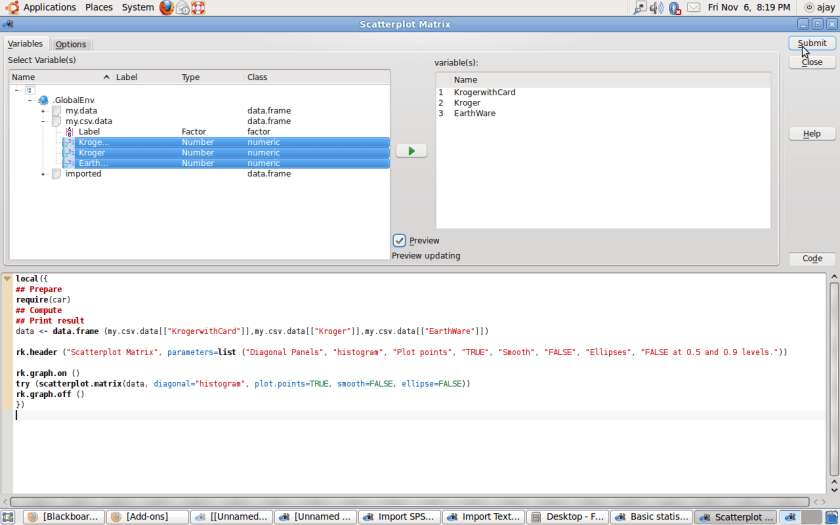
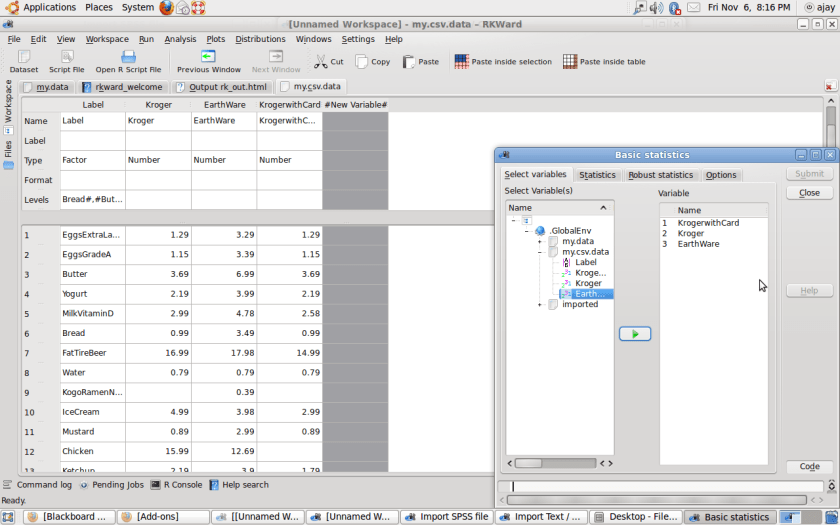
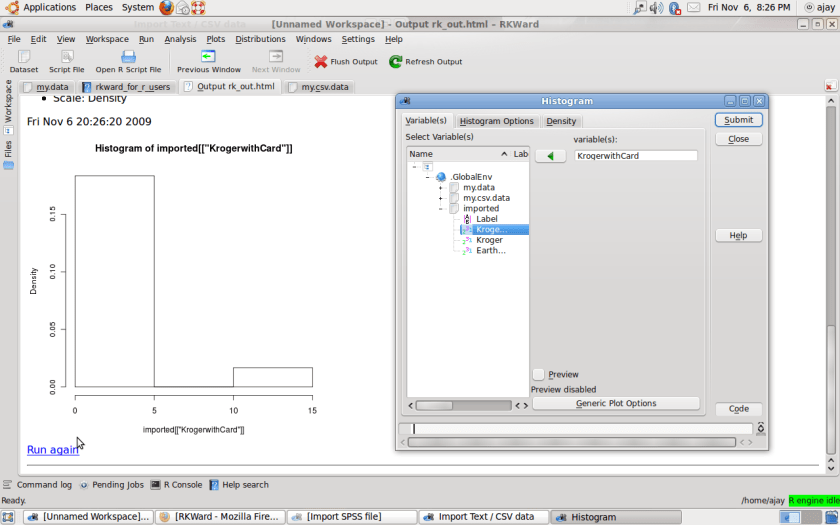
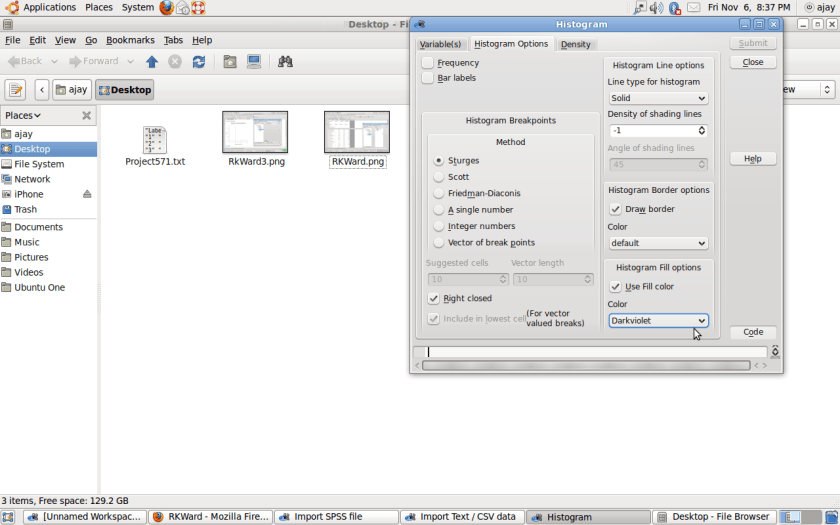
Some screenshots created by me- I swear I only used the mouse while doing this- no keyboard hence a true GUI.

RKward2RKWard

RkWard3

  • New features / improvements in latest version

– Add Stata data file import plugin (by Michael Ash) –

For much better screenshots see-

http://sourceforge.net/apps/mediawiki/rkward/index.php?title=Screenshots

Screenshot


It still could do with more community testing and support and some of the Desktop performance was not that great ( code generated was clunky and reminded me of other GUIs that sit too heavy on command line unlike RCmdr)

Truly impressive is the multiple flexibility offered in details ( like for Plots or for Graphical Analysis)-

and with the help of a Citrix Server on the INTERNET, can POTENTIALLY be offered on Amazon EC2 environment for as low as 2.5 $ per hour for heavy data processing AND stats analysis (with no hardware OR software legacy costs)

.