Social Media Analysis Toolkit

Here is a comprehensive set of tools I see across various social media channels. They include

  1. Video
  2. Blogs
  3. Newsletter
  4. Twitter
  5. Facebook
  6. Documents
  7. Website
  8. Search Engine (Marketing and Optimization)

Note the use of text mining for sentiment analysis is not covered here- though it can be included at a later date. In about five minutes know how to create a free online social media analysis toolkit for your communications.

How to read blogs in Indonesian and Chinese!

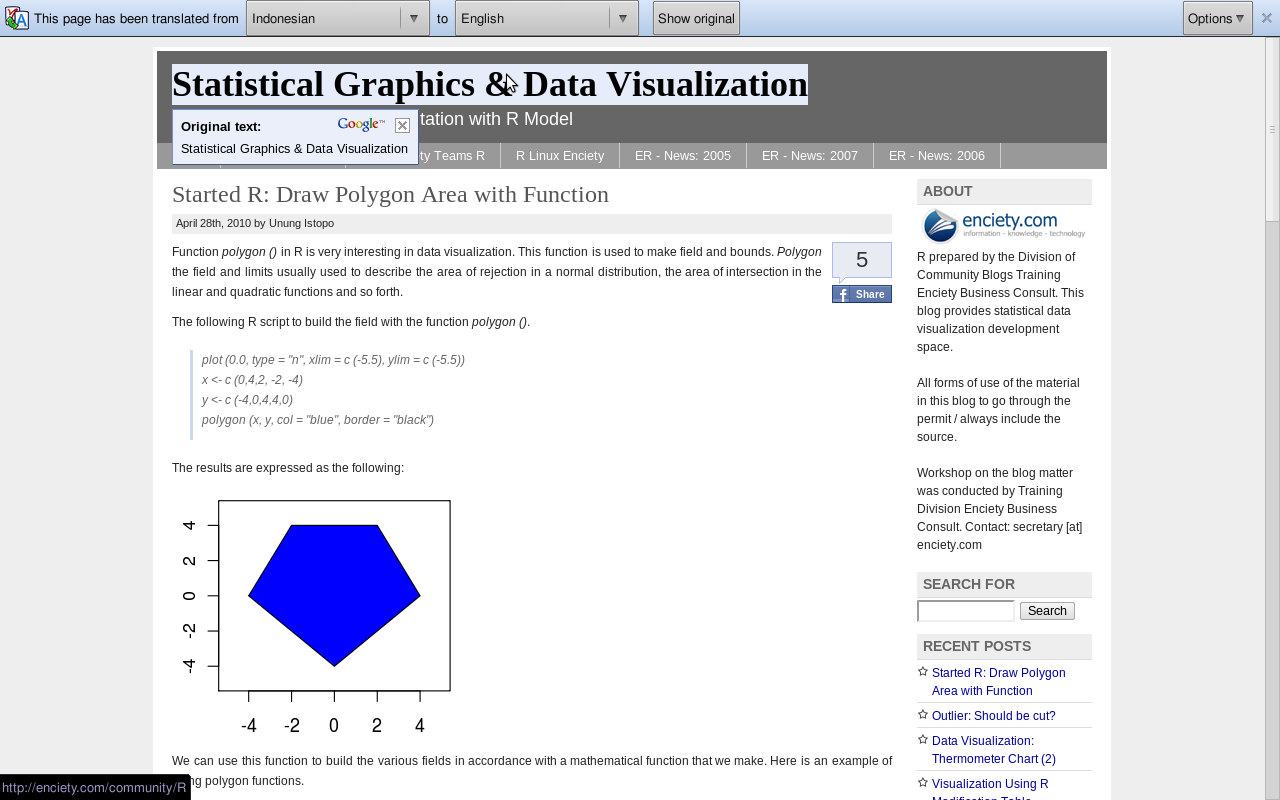
I just discovered the magic of Google Chrome’s Translate tool- it is a one  click operation. So if you want to read blogs in any other language, install Google chrome and tweak the settings accordingly- see below the top of the screenshot ( from the excellent Indonesian R Blog http://enciety.com/community/R/ also available on Twitter at @rcommunity )

Or else if you prefer you old browser you can go to http://translate.google.com/ and copy and paste. Good thing about the Chrome is – even if you dont have admin rights on the machine, it STill installs just fine- and it works faster!

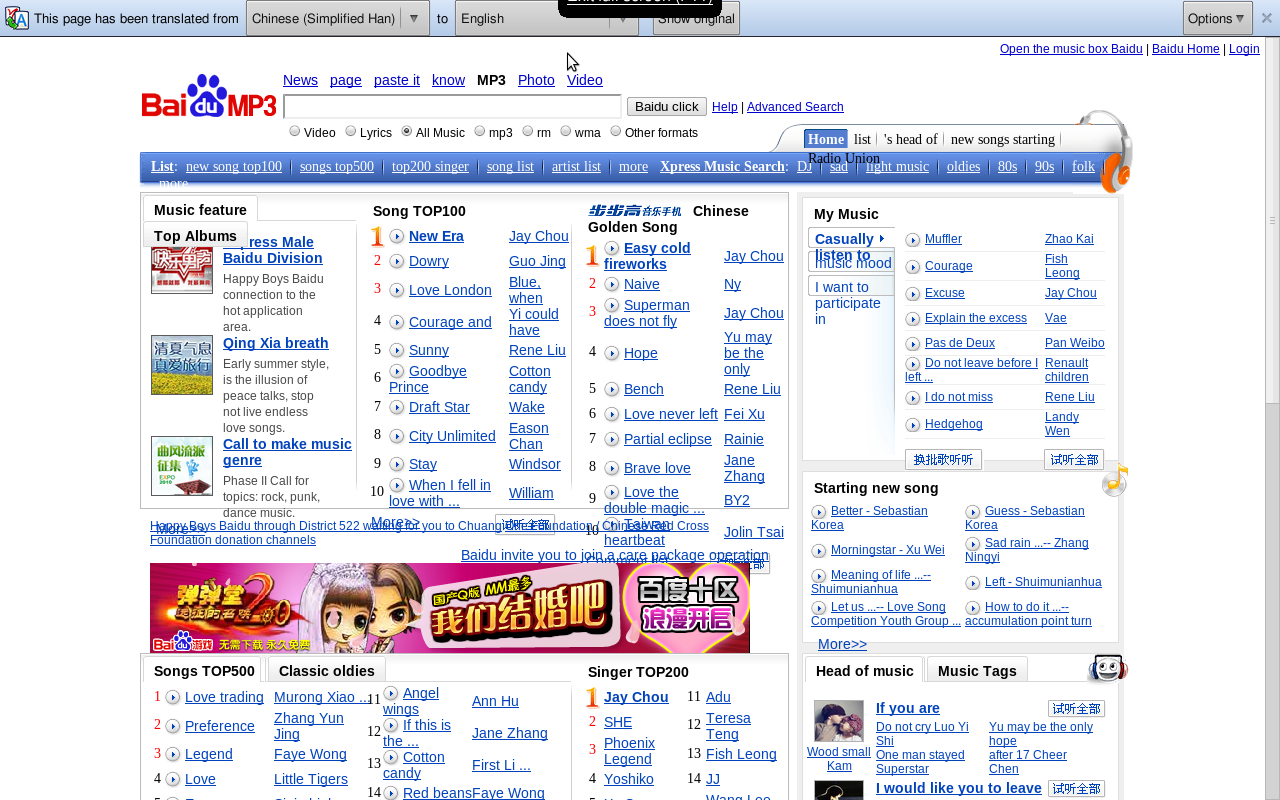
Also see http://mp3.baidu.com/

What do you want to know in data analytics?

I will be posting video responses to the questions asked by you at (using Google Moderator)

http://www.google.com/moderator/#15/e=7217&t=7217.40

So ask and I willl compile the best questions and reply on.

All you want to know in data analytics- What do you want to know in data analytics?

Below-Screenshot of existing questions asked already-

Kill Analytics

I rarely write on Politics- rather I mostly present statistics on poverty, third world, offshoring etc and would rather invite people to draw their own conclusions. But something I read in the New York Times, yes , THAT liberal and well written newspaper causes me to remember a rather obscure branch of analytics- related to defence personnel operations. It’s kill ratios- or the ratio of  number of casualties on each side in a war.

While it is easier to estimate, define and measure kill ratios in conventional warfare, kill ratios can be sometimes misleading as predictors of victory (i.e Tet Offensive was a massive victory for the United States in terms of kill ratios, but the number of US casualties hastened the decision to end that war).

When it comes to Terrorism, kill ratios are even more skewed. 19 Terrorists caused September 11 that killed 3000 people, nearly all civilians. An unmanned drone attack kills 20 people in Pakistan, but causes some people to become car bomb terrorists,thus creating some terrorists and killing some.

An excerpt from the book, ” The Age of the Unthinkable” comes to mind in which the Israeli defence statisticians even came up with a precise number for ratio of innocents killed to terrorists killed, which is acceptable for a military solution. That along with some network analysis in Terror organizations, in which nodes to kill or disrupt for maximum ratio of benefit/cost is a very lucrative and secretive branch , called Security Analysis or what I term as kill analytics. Some of those hitherto secret kill algorithms would be better used in product marketing- however I wish the opposite was true (selling terrorists shampoo and get them hooked on Facebook rather than go with the flow). But thats an ideal world !

How crowded is the neighborhood?

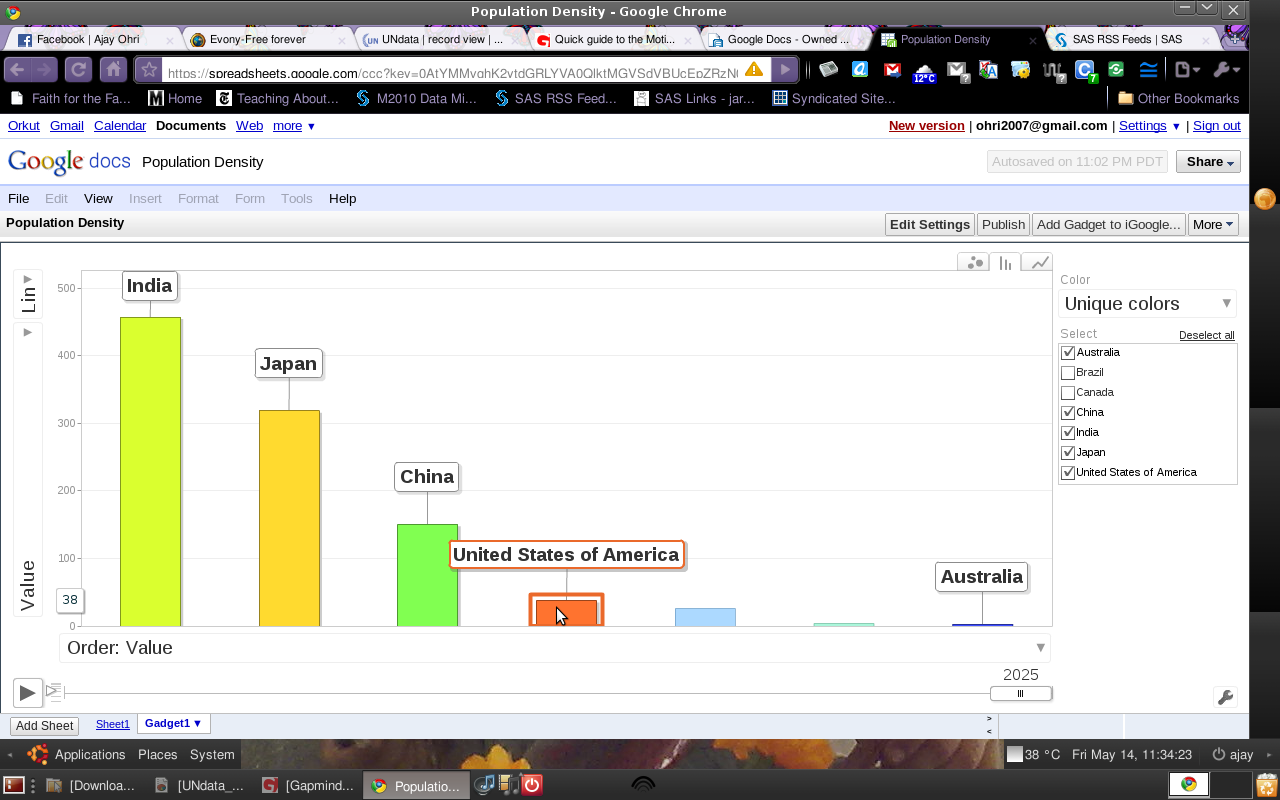
How crowded is India compared to the United States? Around 11 times. Thats based on number of person per square km.

How crowded is India compared to China? Around 2.5 times.

– Based on the following procedure-

  1. Data Sources – http://bit.ly/densityUN . With Pivotable tables, downloaded the CSV file.
  2. Creating a new spreadsheet in Google Docs, I copied and pasted data in the csv file
  3. Using Gadgets- I inserted the Gadget for Motion Chart which is based on Hans Rosling’s famous Gapminder Bubble Chart.

– Some Thoughts

It is not surprising that most immigration (legal and illegal) occurs from high population density countries with stretched resources to lower density countries with higher levels of living. Generally smaller sized countries like Japan, Singapore, Macau (china) have outlier densities as well.

– Also, the Adobe AIR desktop application by Gapminder is quite the best application for this as well. Speaking of which_ I hope other Linux application developers can learn from Adobe AIR’s way of graphics /data visualization.

Creating a Blog Aggregator for free

I discovered an increasing trend of Blog Aggregators ( Blog Lists have been around for a long time). Several sites come in this category- http://bigdatanews.com/ (which is a GreenPlum /AsterData sponsored site on Big Data) , http://mapreduce.org/ (which is a site on MapReduce that has an inbuilt blog aggregator but is more of a community website – I will explain the difference below) , http://www.r-bloggers.com/ (which is an excellent aggregation of 69 R Bloggers sites that is built by Tal and is currently not sponsored/independent) and http://smartdatacollective.com/ which is sponsored by Teradata and uses http://wordframe.com which is a paid software) and some others like http://www.biblogs.com/ (which is Adsense supported 🙂 ) and http://javablogs.com/Welcome.jspa (an aggregator on Java) (or even http://feministblogs.org/).

CMS Based Blog Aggregator
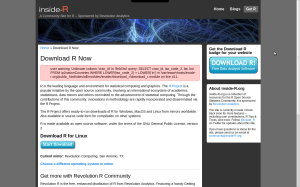
CMS Based Blog Aggregator/ Community Site

CMS Based Community Site with an inbuilt Blog Aggregator feed

I am noting blog aggregator as a distinct website that pulls in automated content from RSS feeds , may or maynot be moderated, and usually revolves around a certain domain or topic. It is slightly different from community websites which have Lists of Blogs as part of many other features, and boutique collection of blogs like http://www.b-eye-network.com/blogs/index.php

and Intelligent Enterprise ( http://intelligent-enterprise.informationweek.com/blog/index.jhtml) as they have selected authors and have more than Blogs as their featured content including News etc. Since community is a buzz word- many websites claim to be community websites while retaining the look and feel of a CMS- Blog Aggregator.

WordPress Enabled Blog Aggregator

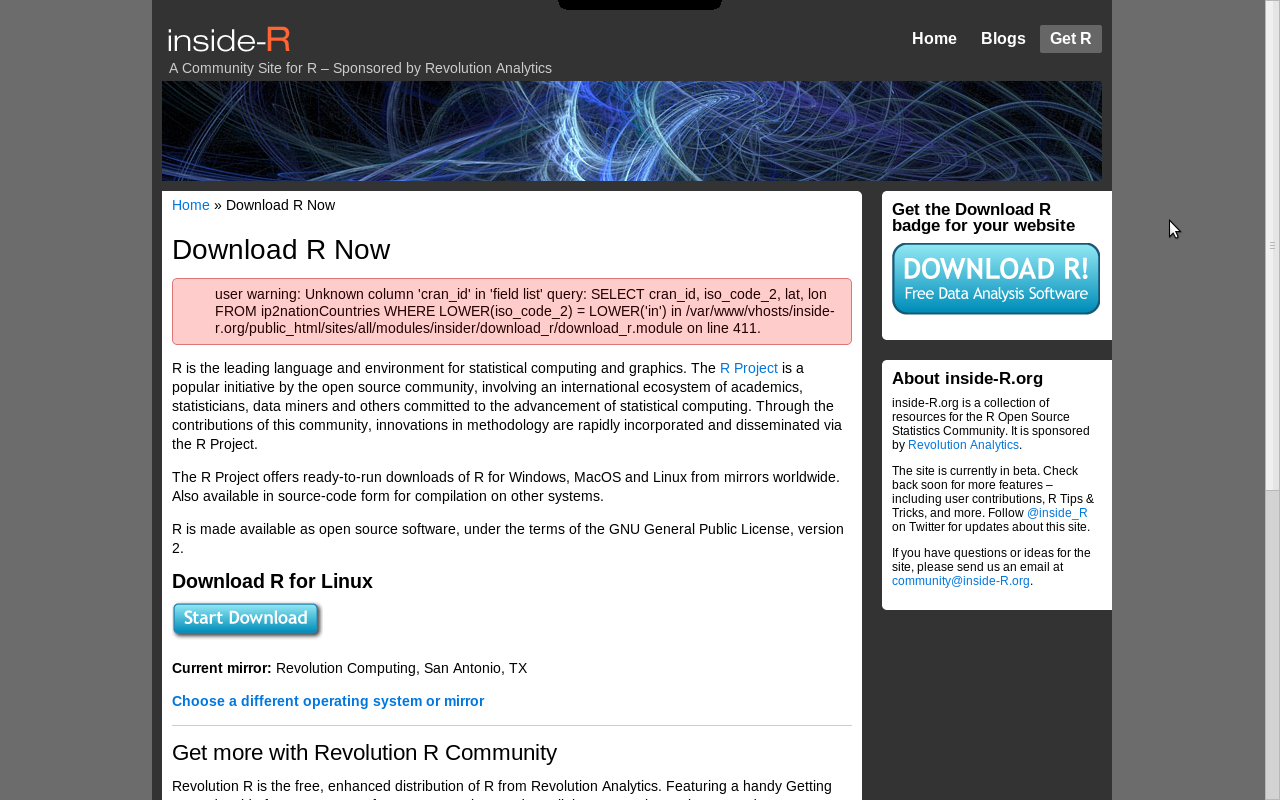
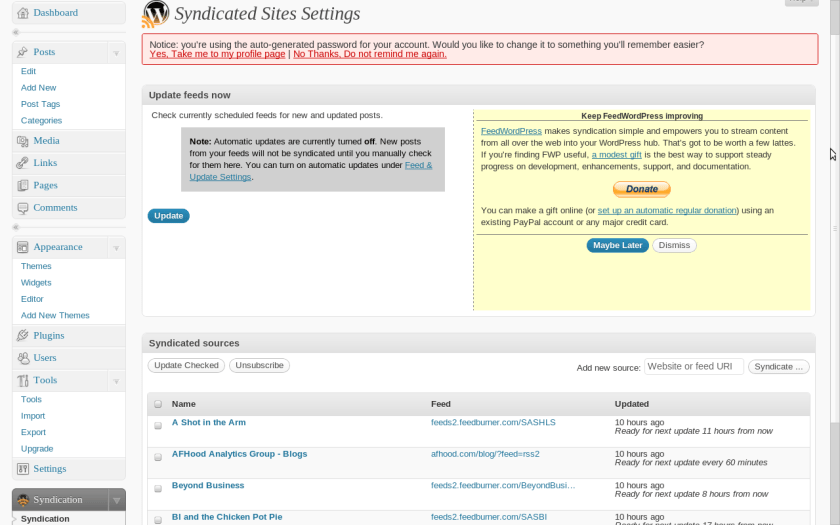
Anyways, if you have a WordPress Installation- you can create a Blog Aggregator for free. Basically there is a wordpress-plugin called FeedWordPress http://wordpress.org/extend/plugins/feedwordpress/

Doing so you can simply addin as many RSS feeds as you like –

(see a screenshot below).
Of course – you can use Twitterfeed to create a Twitter Aggregator/ Fire Hose that simply pulls in Post Titles, and can link them using Facebook-LinkedIn-Twitter apps to your RSS feed of the aggregated website. 🙂

Building a website /content aggregator is just a few clicks away and free for anyone with a website and some passion for a topic. It is really free and painless 🙂

Color of Statistics

A short analysis on the ASA Directory at http://www.amstat.org/membership/directory/search.cfm

and http://www.amstat.org/minorities/index.cfm

There are 15904 Total Members out of which if broken done by Race/Color

  • 172 Minority Statisticians
  • 68 Black
  • 12 Hispanic (this looks too less so I suspect the directory is incomplete)

Even optimistically the color of statisticians is overwhelmingly as follows (assuming that minority data is under counted by 10X- so multiplying the minority data by 10 and then taking percentage)

89 % White

4 % Black and

7% Non Black Minorities (presumably Indian, Chinese, Hispanic).

I tried to find some statistics on fresh maths/stats graduates by race but did not find some. Surely this calls for some thought ? 😉