Here is an interview with Dr Eric Siegel, founding chair of Predictive Analytics Conference and author of the recent bestseller in analytics, Predictive Analytics.
Ajay- What has been the response to your book
Here is an interview with Dr Eric Siegel, founding chair of Predictive Analytics Conference and author of the recent bestseller in analytics, Predictive Analytics.
Ajay- What has been the response to your book
A quick and dirty list….
1) Revolution R – http://www.revolutionanalytics.com/products/revolution-r.php Revolution R Community is Revolution Analytics’ free distribution of the open source R programming language — enhanced for users looking for faster performance and greater stability. It’s perfect for learning R and basic analysis
2) Oracle Enterprise R http://www.oracle.com/us/corporate/features/features-oracle-r-enterprise-498732.html
| Integrates the Open-Source Statistical Environment R with Oracle Database 11g Oracle R Enterprise allows analysts and statisticians to run existing R applications and use the R client directly against data stored in Oracle Database 11g—vastly increasing scalability, performance and security. The combination of Oracle Database 11g and R delivers an enterprise-ready, deeply integrated environment for advanced analytics. Users can also use analytical sandboxes, where they can analyze data and develop R scripts for deployment while results stay managed inside Oracle Database. |
3) Tibco Enterprise Runtime for R
TERR, a key component of Spotfire Predictive Analytics, is an enterprise-grade analytic engine that TIBCO has built from the ground up to be fully compatible with the R language, leveraging our long-time expertise in the closely related S+ analytic engine. This allows customers to continue to develop in open source R, but to then integrate and deploy their R code on a commercially-supported and robust platform—without the need to rewrite their code.
Prototypes are often developed in R, but then typically re-implemented in another language for production purposes because R was not built for enterprise usage. TERR brings enterprise-class scalability and stability to the agile R-language, and enables statisticians to broadly share their analyses through TIBCO Spotfire Statistics Services or by directly embedding the TERR engine.
4) pqR -http://radfordneal.github.io/pqR/ You gotta love Radford Neal’s throwing down the gauntlets to the old sleepy heads! At JSM , Montreal the R Core member announced they have agreed to incorporate his changes, signalling a major departure in the way changes have been signaled at R.
pqR is a new version of the R interpreter. It is based on R-2.15.0, distributed by the R Core Team (at r-project.org), but improves on it in many ways, mostly ways that speed it up, but also by implementing some new features and fixing some bugs.
One notable improvement is that pqR is able to do some numeric computations in parallel with each other, and with other operations of the interpreter, on systems with multiple processors or processor cores.
5) Renjin http://www.renjin.org/ Renjin is a JVM-based interpreter for the R language for statistical computing Renjin is a new implementation of the R language and environment for the Java Virtual Machine (JVM), whose goal is to enable transparent analysis of big data sets and seamless integration with other enterprise systems such as databases and application servers.
Renjin is still under development, with a target of a version “1.0” in late 2013, but in the meantime it is being used in production for a number of our client projects, and supports most CRAN packages, including some with C/Fortran dependencies.
6) Riposte (?) https://github.com/jtalbot/riposte
Riposte, a fast interpreter and JIT for R.
Justin Talbot justintalbot@gmail.com Zach Devito
We only do development on OSX and Linux. It’s unlikely that our JIT will work on Windows.
Planned work for July-December 2013. The first three bullet points are currently in progress on the library branch. Partial work will be integrated to main by the end of July.
SAP , IBM Netezza already have specialized packages for R.
The question is SAS which supports interaction with R through SAS/IML, even Base R, and JMP- can it be willing to go the extra mile for customers and create SAS/R . The fact that they made their products compatible with R shows they acknowledge and respect R’s appeal ( contrary to old sleepyheads who think all SAS is good and all base R is divine)
SAS/ R can be the third major product for the SAS Institute after SAS and JMP platforms. Any takers, ladies and gentlemen?
Background- I wrote this as an accident while trolling on Quora. I was not confident of what I wrote- in fact I wrote it anonymous except people kept asking me why! It was pure serendipity- I wrote it less than 4 minutes and submitted without thinking. Then edited once based on feedback.
Some one clearly more smarter than me made my tips for writing into a picture http://amandaonwriting.tumblr.com/post/54265230509
and it went popular on Tumblr just like it did on Quora!
Apparently if some guy like Wil Wheaton likes your words, it can go viral! It has 41799 notes ( reblogs+hearts) on Tumblr as of now.
http://wilwheaton.tumblr.com/post/54699823961/torteen-great-advice-to-writers
Words . Reposted by a member of STAR TREK:NG. I can now die a happy Geek! The Internet is a funny thing!
Thank you everyone! Now if only Google learnt to include OCR for Images as part of text search!
But overall, just write more to get better.
1887+ votes on Quora!! 🙂 Probably my most viewed content ever- !
Also it got a mention here-
Now I think I should take some of my own advice and get back to writing
The ifelse function is simple and powerful and can help in data manipulation within R. Here I create a categoric variable from specific values in a numeric variable
> data(iris)
> iris$Type=ifelse(iris$Sepal.Length<5.8,”Small Flower”,”Big Flower”)
> table(iris$Type)
Big Flower Small Flower
77 73
The parameters of ifelse is quite simple
Usage
ifelse(test, yes, no)
Arguments
test
an object which can be coerced to logical mode.
yes
return values for true elements of test.
no
return values for false elements of tes
Some of the things I like to read to stay sharp as I grow old.
For example this paper says how foreign born PHDs do location choices.
Graduates with stronger academic ability, measured by whether they received university support for a research or a teaching assistantship, had a 6.8 percent higher stay rate. Assistantships were the primary means of support for 52 percent of the sample; 11 percent of the sample was supported by a university fellowship or scholarship, which was associated with a 2.7 percent higher stay rate. Students supported by foreign funding, 4 percent of the sample, had an intent to stay that was 26.7 points lower.
As one would expect, ties to the United States are also important. Foreign-born U.S. citizens have a 19.5 percent higher stay rate; green card holders have a 15.3 percent higher stay rate; and U.S. college graduates have a 3.6 percent higher stay rate.
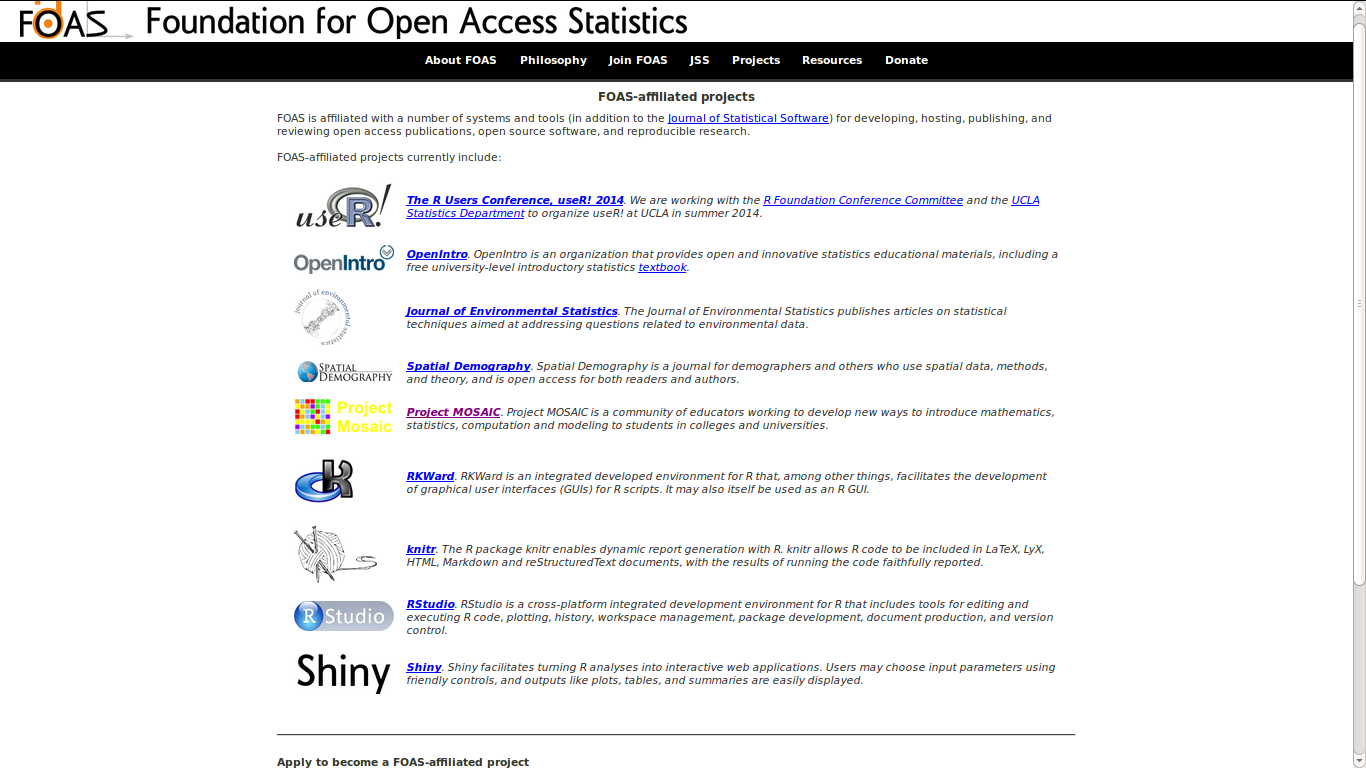
Within a short time FOAS has lined up an interesting list of projects for Data Science statups and projects for open access and open source. FOAS accreditation provides the ultimate halmark of open in word and spirit for data science projects.
See it yourself at http://www.foastat.org/projects.html