Data Privacy and OECD

I really liked revisiting these privacy principles at http://oecdprivacy.org/

I wonder if the internet uses them??

The OECD Privacy Principles are part of the OECD Guidelines on the Protection of Privacy and Transborder Flows of Personal Data, which was developed in the late 1970s and adopted in 1980.

1. Collection Limitation Principle

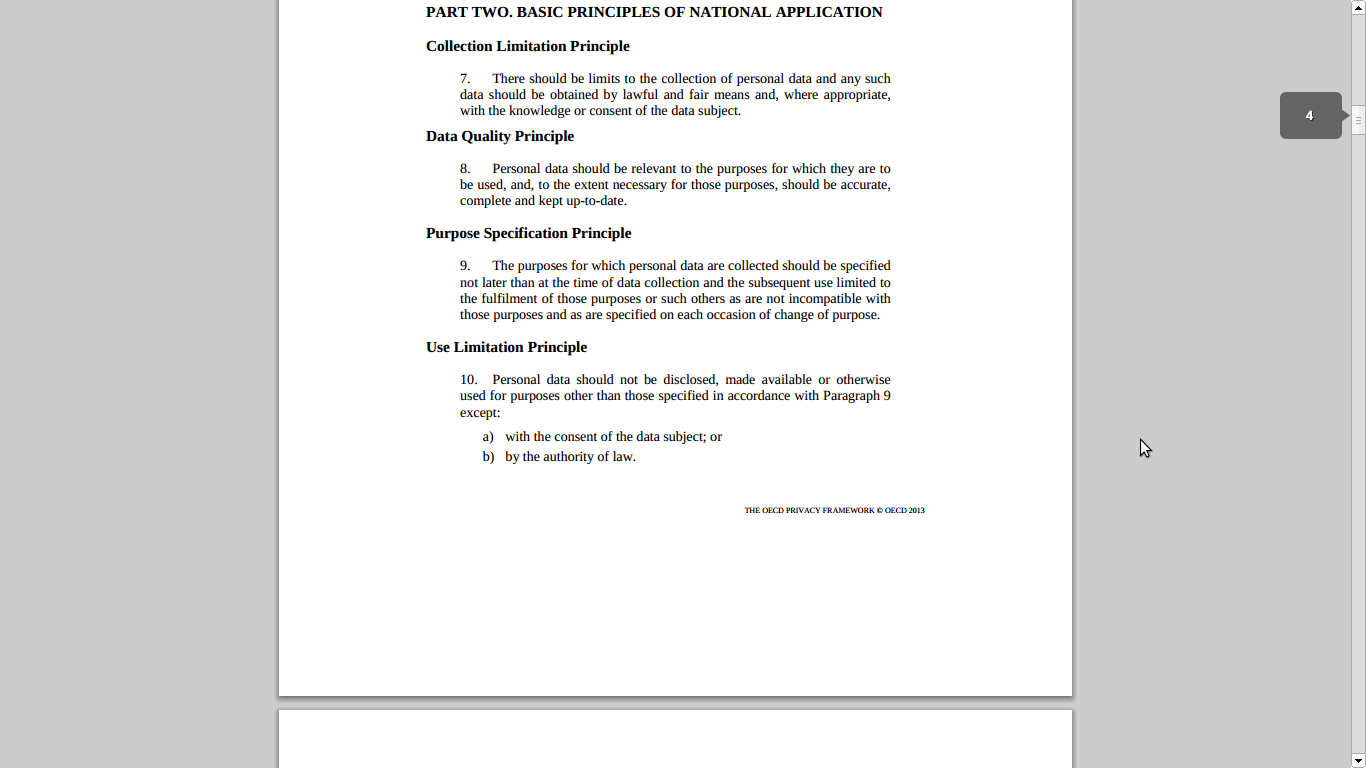
There should be limits to the collection of personal data and any such data should be obtained by lawful and fair means and, where appropriate, with the knowledge or consent of the data subject.

2. Data Quality Principle

Personal data should be relevant to the purposes for which they are to be used, and, to the extent necessary for those purposes, should be accurate, complete and kept up-to-date.

3. Purpose Specification Principle

The purposes for which personal data are collected should be specified not later than at the time of data collection and the subsequent use limited to the fulfilment of those purposes or such others as are not incompatible with those purposes and as are specified on each occasion of change of purpose.

4. Use Limitation Principle

Personal data should not be disclosed, made available or otherwise used for purposes other than those specified in accordance with Paragraph 9 except:

a) with the consent of the data subject; or

b) by the authority of law.

5. Security Safeguards Principle

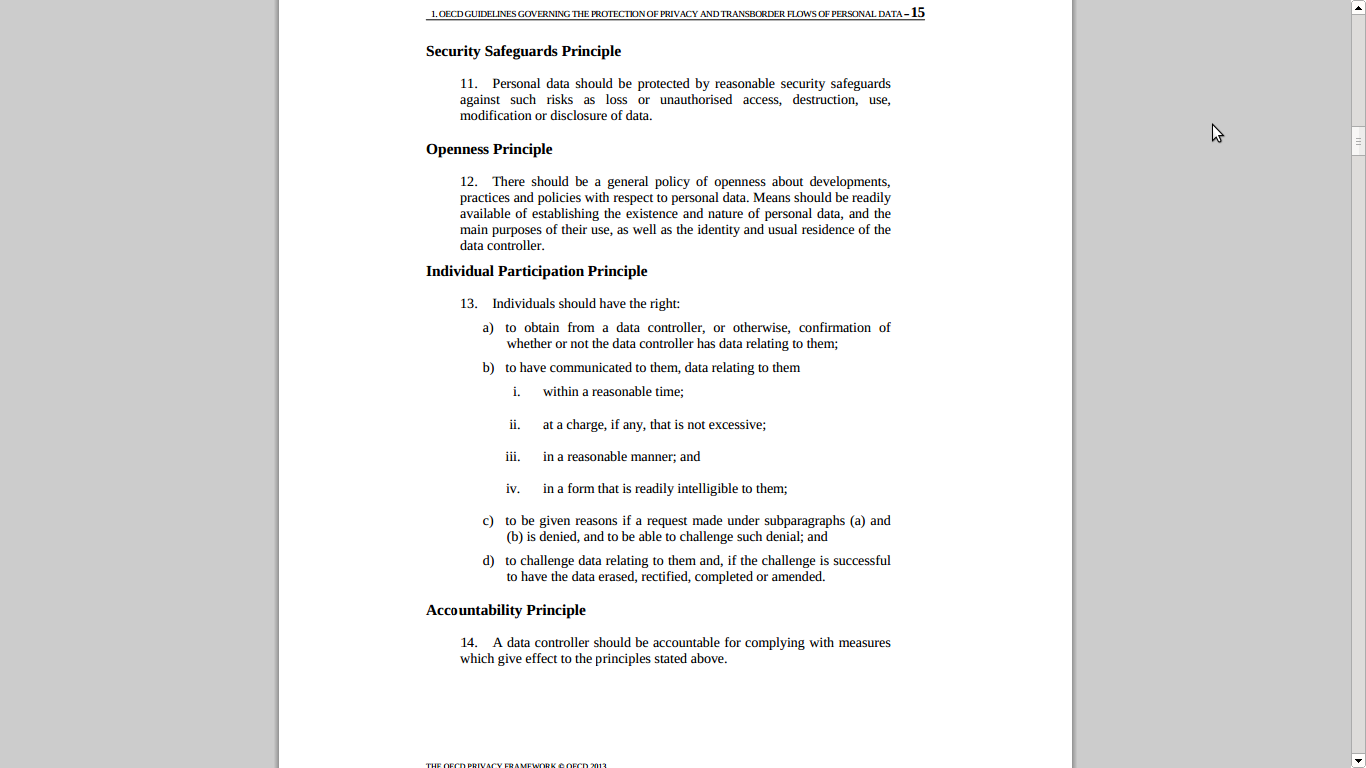
Personal data should be protected by reasonable security safeguards against such risks as loss or unauthorised access, destruction, use, modification or disclosure of data.

6. Openness Principle

There should be a general policy of openness about developments, practices and policies with respect to personal data. Means should be readily available of establishing the existence and nature of personal data, and the main purposes of their use, as well as the identity and usual residence of the data controller.

7. Individual Participation Principle

An individual should have the right:

a) to obtain from a data controller, or otherwise, confirmation of whether or not the data controller has data relating to him;

b) to have communicated to him, data relating to him

i) within a reasonable time;
ii) at a charge, if any, that is not excessive;
iii) in a reasonable manner; and
iv) in a form that is readily intelligible to him;

c) to be given reasons if a request made under subparagraphs (a) and (b) is denied, and to be able to challenge such denial; and

d) to challenge data relating to him and, if the challenge is successful to have the data erased, rectified, completed or amended.

8. Accountability Principle

A data controller should be accountable for complying with measures which give effect to the principles stated above.

News

Other Privacy Frameworks

APEC Privacy Framework

The Asia-Pacific Economic Cooperation (APEC) Privacy Framework overlaps with other frameworks; however, it concentrates on actual or potential harm as a result of disclosing information, rather than individuals’ rights pertaining to their information

The Internet Economy on the Rise:
Progress since the Seoul Declaration

Published in September 2013, this book reviews progress made since the 2008 OECD Seoul Declaration for the Future of the Internet Economy and identifies areas for future work.
Overall, the review shows that the Internet economy has become a new source of growth, with the potential to boost the whole economy, to foster innovation, competitiveness and user participation, and to contribute effectively to the prosperity of society as a whole.

The OECD Policy Guidance for Protecting and Empowering Consumers in Communication Services (Annex B) addresses some of the key issues currently facing consumers in this market.
The guidance advocates:

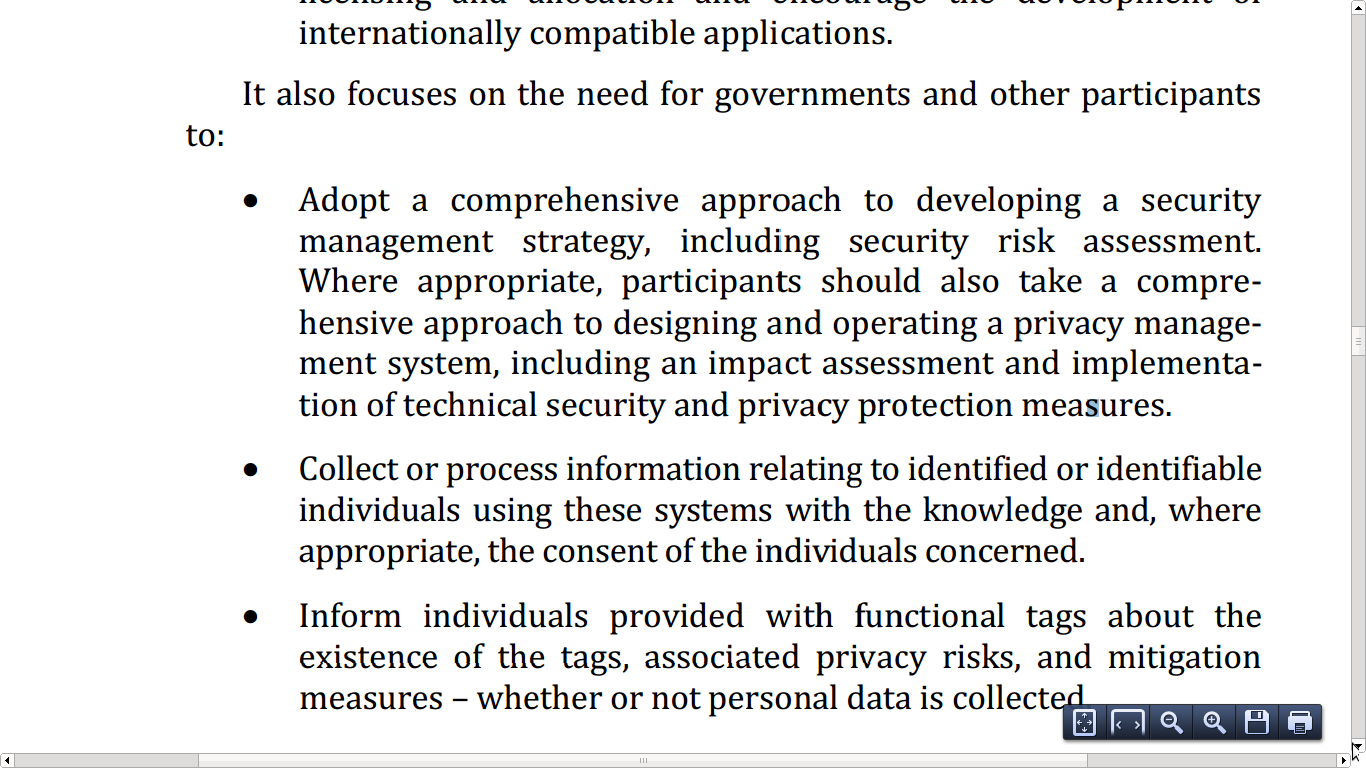
 Informing consumers about potential security and privacy risks  in using communication services and available measures to limit these risks.

The OECD Policy Guidance on Radio Frequency Identification (Annex C) encourages research on the economic and social impacts of such technologies  The guidance points out the need to prevent and mitigate security risks and to address privacy concerns arising when information relating to an identified or identifiable individual is collected or processed. Screenshot from 2013-10-27 03:59:24
 

AJAY- So the guidelines are there. But who all are following them and who aren’t?

Revised Principles-

http://www.oecd.org/sti/ieconomy/2013-oecd-privacy-guidelines.pdf
Screenshot from 2013-10-27 04:06:56Screenshot from 2013-10-27 04:06:38


rPython – R Interface to Python

a nice package rPython. http://cran.r-project.org/web/packages/rPython/index.html This package permits calls to Python from R
Not to be confused with Restricted Python (RPython at http://doc.pypy.org/en/latest/coding-guide.html#id1)

statcompute's avatarYet Another Blog in Statistical Computing

View original post

Game Review : Google Ingress

  1. Android Only Game
  2. Uses GIS or Google Maps API/ for geo-caching game
  3. Healthy for you- makes players walk from portals to another. You have to be within 40 m of a portal to recharge,capture of attack it.  Makes you really walk a lot.
  4. Addictive and Immersive with impressive follow up media story.
  5. Can be used as base template for other games , and social experimentation
  6. Uses Points, Badges, Leaderboard of gamification
  7. Encourages direct face to face social interaction
  8. Has in game chat facility
  9. Zero in game currency . So no coiners or cheaters here

http://media.tumblr.com/tumblr_meuh4lKkH61rax78x.png

Top Ten Ways to Kill The NSA

  1. Everybody write email or ip voice call in Navajo
  2. Pass messages in .gifs on Google Plus  wikipedia. But use visual cryptography
  3. Create social network analysis of NSA guys , and their families. Include Senate Staffers on the appropriate committees. Hunt the hunters to guard the guardians. Start with the Snowden ex-girlfriend
  4. Everyone start using Tor. Overwhelm the NSA’s budget. Kill the Budget  and you kill the NSA
  5. Teach terrorists how to haiku and send messages in Navajo poetry. Use Poem Code
  6. Click on ALL google ads. or DO NOT Click on ALL Facebook ads by all people revealed to have been cooperating with the NSA. Hit the corporations the only place they feel anything- the pocket books and the balance sheets. Use Anti Ad software to dry up these data gathering monsters!
  7. Revive projects like Waste Again. Embed them in Browser Plugins like Mafia Fire.
  8. Maybe An Open Translate Project for  a language like Anti- Double Speak (from 1984). Truthspeak. To automatically encode using a Browser Plugin. Like Google Translate automatically translates Hebrew into English.
  9. Everyone understand the concept of random noise and introduce it in your blogs , your communication. Use snowden for the seed keywords.
  10. Big Deficit huh. Govt shutdown huh. Call your Congressman now to decrease NSA budget by atleast 17.33 % . Use this (usa.gov) unzip

From the First Rule 

and

Zeroth Law-

0. A robot may not harm humanity, or, by inaction, allow humanity to come to harm.

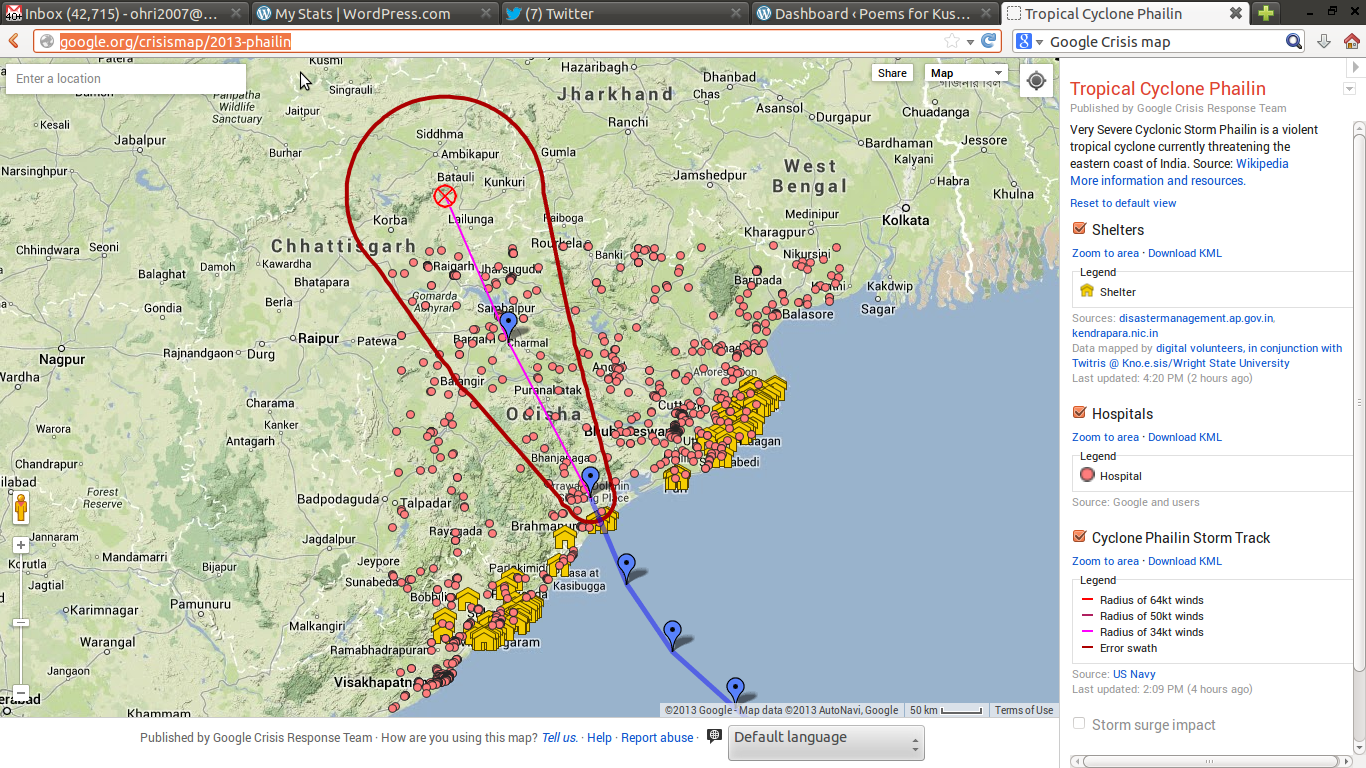
Google Crisis Map and India’s Cyclone -a great application of GIS /Spatial Data

Google Crisis Map is a good example of how technology can be used for the good of making people live, even though it originally was derived from other applications.

http://google.org/crisismap/2013-phailin

Screenshot from 2013-10-12 18:22:55

Mandatory Screenshot

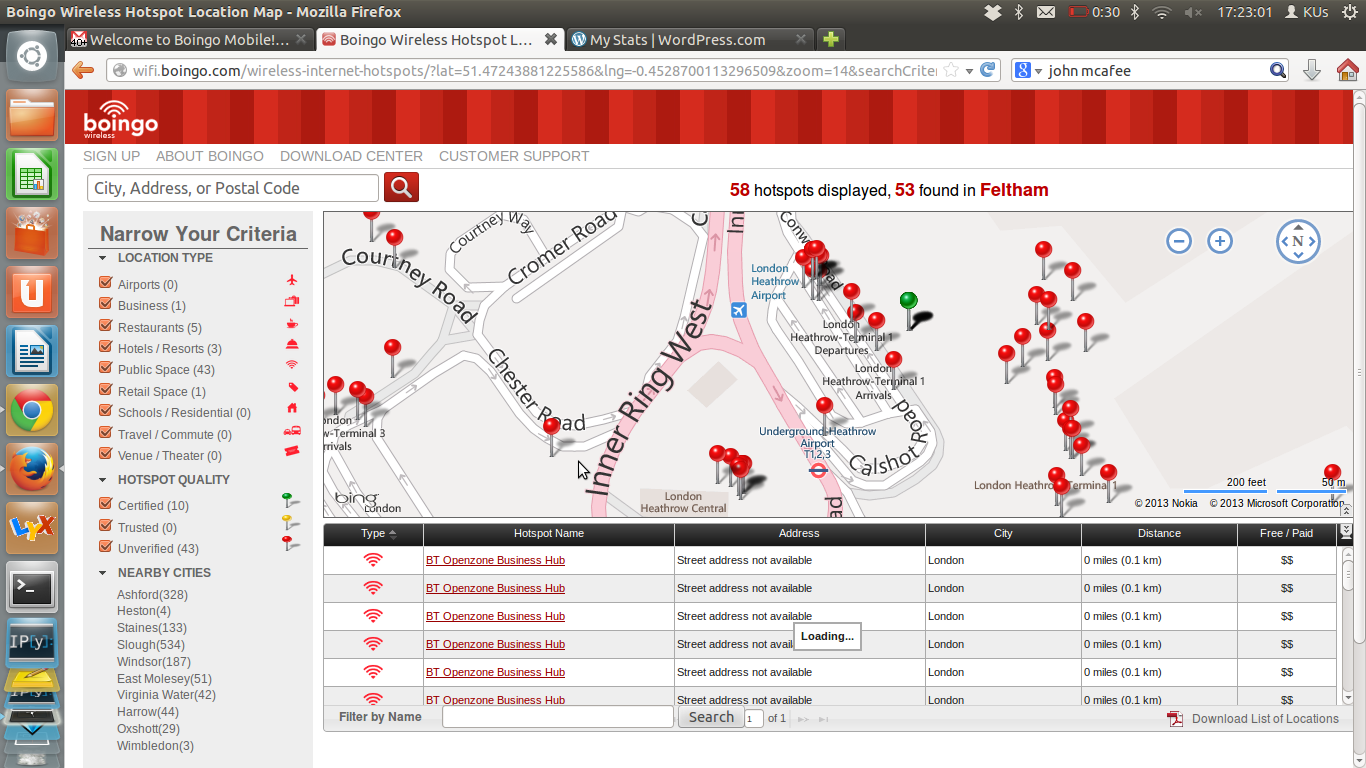
Screenshot from 2013-10-12 17:23:01Boingo Mobile’s Hotspot locator is a great example of a way of making GIS make money without being evil.


Google releases new R package for Big Data #rstats

From the Google Open Source Blog

HistogramTools is a new R package I have released that uses RProtoBuf to read in a compact protocol buffer representation of binned data and includes a number of helpful functions for manipulating, plotting, and measuring the statistical information loss due to the binning. In addition to protocol buffers, it also supports importing aggregate performance data directly from DTrace output.

AND
We rely on several open source tools to make our work easier. The most common tool we use for statistical analysis of the performance, availability, and resource needs of our internal systems is the R programming language.

Nice job!

Screenshot from 2013-10-10 21:28:17
With  Revolution Analytics being supported and funded by Microsoft and Intel and RStudio being founded by an ex-Microsoftie, I think Google does need to step up their R game though. They take and take from the open source community yet barely fund the minimum back to projects like FOAS or R-Core (http://www.r-project.org/foundation/memberlist.html)
Come on Google – share more  stuff with open source R than you do with the NSA!!!
1)  https://decisionstats.com/2009/05/29/interview-david-smith-revolution-computing/

Ajay- What are the major alliances that REvolution has in the industry.

David- We have a number of industry partners. Microsoft and Intel, in particular, provide financial and technical support allowing us to really strengthen and optimize R on Windows, a platform that has been somewhat underserved by the open-source community.

2) http://en.wikipedia.org/wiki/Joseph_J._Allaire
After the sale of his company, Allaire became frustrated at the difficulty of keeping track of research he was doing using Google. To address this problem, he co-founded Onfolio in 2004 with Adam Berrey, former Allaire co-founder and VP of Marketing at Macromedia.
On March 8, 2006, Onfolio was acquired by Microsoft where many of the features of the original product are being incorporated into the Windows Live Toolbar.On August 13, 2006, Microsoft released the public beta of a new desktop blogging client called Windows Live Writer that was created by Allaire's team at Microsoft.