Interview Anne Milley JMP

 An interview with noted analytics thought leader Anne Milley from JMP. Anne talks of statistics, cloud computing, culture of JMP, globalization and analytics in general.

DecisionStats(DS) How was 2013 as a year for statistics in general and JMP in particular?  

Anne Milley-  (AM) I’d say the first-ever  International Year of Statistics (Statistics2013) was a great success! We hope to carry some of that momentum into 2014. We are fans of the UK’s 10-year GetStats campaign—they are in the third year, and it seems to be going really well. JMP had a very good year as well, with worldwide double-digit growth again. We are pleased to have launched version 11 of JMP and JMP Pro last year at our annual Discovery Summit user conference.

DS-  Any cloud computing plans for JMP?

AM- We are exploring options, but with memory and storage still so incredibly cheap on the desktop, the responsiveness of local, in-memory computing on Macs or Windows operating systems remains compelling. John Sall said it best in a blog post he wrote in December.  It is our intention to have a public cloud offering in 2014.

DS- Describe the company culture and environment in the JMP division. Any global plans?

AM- John Sall’s passion to bring interactive, intuitive data visualization and analysis on the desktop continues. There is a strong commitment in the JMP division to speeding the statistical discovery process and making it fun. It’s a powerfully motivating factor to work in an environment where that passion and purpose are shared, and where we get to interact with customers who are also passionate users of JMP, many of whom use JMP and SAS together.

While a majority of JMP personnel are in Cary, North Carolina, almost half the staff are contributing from other states and countries. JMP is sold everywhere we have SAS offices (in 59 countries). JMP has localized versions in seven languages, and we keep getting requests for more.

DS- You have been a SAS Institute veteran for 15 years now. What are some of the ups and downs you remember as milestones in the field of analytics?

AM- The most exciting milestone is that analytics has been getting more attention in the last few years, thanks to a combination of factors. Analytics is a very inclusive term (statistics, optimization, data mining, machine learning, data science, etc.), but statistics is the main discipline we draw on when we are trying to make informed decisions in the face of uncertainty. In the early days of data mining, there was a tension between statisticians and data miners/machine learners, but we now have a richer set of methods (with more solid theoretic underpinnings) with which to analyze data and make better decisions. We have better ways to automate parts of the model-building process as well, which is important with ever-wider data. In the early days of data mining, I remember many reacting with “Why spend so much time dredging through opportunistically collected data, when statistics has so much more to offer, like design of experiments?” There is still some merit to that, and maybe we will see the pendulum swing back to doing more with information-rich data.

DS- What are your top three forecasts for analytics technology in 2014?

AM- My perspective may be different than others on what’s trending in analytics technology, but as we try to do more with more data, here are my top three picks:

  • We will continue to innovate new ways to visualize data and statistical output to capitalize on our high visual bandwidth. (Examples of some of our recent innovations can be found on the JMP Blog.)

  • We will continue to see innovative ways to create more analytic bandwidth and democratize analytics—for example, more quickly build and deploy analytic applications and interactive visualizations for others to use.

  • We will see more integration with commonly used analytical tools and infrastructure to help analysts be more productive.

DS-  How do you maintain work-life balance?

AM- I enjoy what I do and the great people I work with; that is part of what motivates me each day and is added to the long list of things for which I’m grateful. Outside of work, I enjoy spending time with family, regular exercise, organic gardening and other creative pursuits.

DS-As a senior technology management person working for the past 15 years, do you think technology is a better employer for women employees than it was in the 1990s? What steps can be done to increase this?

AM- I certainly see more support for women in technology with various women-in-technology organizations and programs around the world. And I also see more encouragement for girls and young women to get more exposure to science, technology, engineering, math, and statistics and consider the career options knowledge of these areas could bring. But there is more to do. I would like to add statistics to the STEM list explicitly since many still consider statistics a branch of math and don’t appreciate that statistics is the science/language of science. (Florence Nightingale said that statistics is “the most important science in the whole world.”) This year, we will see the first Women in Statistics Conference “enticing, elevating, and empowering careers of women in statistics.” There are several organizations and programs out there advocating for women in science, engineering, statistics and math, which is great. The resources such organizations provide for networking, mentoring, career development and making role models more visible are important in raising awareness on what the impediments are and how to overcome them. We should all read Sheryl Sandberg’s re-release of Lean In for Graduates (due out in April). Thank you for asking this question!

 AboutAnne Milley   SR DIRECTOR, ANALYTIC STRATEGY, JMP

Anne oversees product management and analytic strategy in JMP Product Marketing. She is a contributing faculty member for the International Institute of Analytics.

The Seven C’s of Viral Content -What makes content viral online?

Viral-

Definition-(of an image, video, piece of information, etc.) circulated rapidly and widely from one Internet user to another.

  1. Channels– Some content goes viral on some particular channels (like 4chan, or Tumblr) while gets ignored on other social media channels
  2. Content  – the type of content should match the audience type (technical or non technical) and channel used for dissemination (like Pinterest or Tumble for images)
  3. Celebrity– Getting a celebrity (say with high enough influence score) endorsement greatly helps viral content to reach beyond initial network
  4. Credibility   or Network Effects- People find it easier to like or share content which is already proved to be a viral content or beyond a certain threshold.  Some people would like the content if it already is very successful.
  5.   Customers  -Content consumers can be influencers, sharers, innovators, or passive. It is critical to meet a certain threshold of certain customer types to hit viral counts.
  6. Context– One man’s viral content is another man’s spam.
  7.  Circulation – How easy is it to circulate the content? to share it or show appreciation? to add customized comments? This affects viral nature- though it is mostly a function of hosting website than the content itself

\bonus the 8th C – Cuteness and Catiness – On the internet cute babies and cats rule in a duo-poly

charlie-bit-my-finger-image

2013 in review

The WordPress.com stats helper monkeys prepared a 2013 annual report for this blog.

Here’s an excerpt:

The Louvre Museum has 8.5 million visitors per year. This blog was viewed about 150,000 times in 2013. If it were an exhibit at the Louvre Museum, it would take about 6 days for that many people to see it.

Click here to see the complete report.

2013 Thank You Note

I would like to write a thank you note to  some of the people who helped make Decisionstats.com possible . We had a total of 150,644 views this year.For that, I have to thank you dear readers for putting up with me- it is now our seventh year.

Jan Feb Mar Apr May Jun Jul Aug Sep Oct Nov Dec Total
13,940 12,153 12,948 13,371 12,778  12,085  12,894  11,934  9,914  14,764  12,907  10,956  150,644

I would like to thank Chris  (of Mashape) for helping me with some of the interviews I wrote here .I did 26 interviews this year for Programmable Web and a total of 30+ articles including the interviews in 2013.

Of course- we have now reached 116 excellent interviews on Decisionstats.com alone ( see http://goo.gl/V6UsCG )I would like to thank each one of the interviewees who took precious time to fill out the questions.

Sponsors- I would like to thank Dr Eric Siegel ( individually as an author and as founder chair of www.pawcon.com ) , Nadja and Ingo (for Rapid-Miner) , Dr Jonathan ( for Datamind) , Chris M (for Statace.com ) , Gergely ( Author) and many more during all these six years who have kept us afloat and the servers warm in these days of cold reflection, including Gregory (of KDNuggets.com) and erstwhile AsterData founders.

Training Partners- I would like to thank Lovleen Bhatia ( of Edureka  for giving me the opportunity to make http://www.edureka.in/r-for-analytics which now has 1721 learners as per http://www.edureka.in/)

I would also specially say Thank you to Jigsaw Academy for giving me the opportunity to create
the first affordable and quality R course in Asia http://analyticstraining.com/2013/jigsaw-completes-training-of-300-students-on-r/

These training courses including those by Datamind and Coursera remain a formidable and affordable alternative to many others catching up in the analytics education game in India ( an issue I wrote here)

Each and Everyone of my students (past and present) and Everyone in the #rstats  and SAS-L community, including people who may have been left out.

Thank you sir, for helping me and Decisionstats.com !

Wish each one of you a very happy and Joyous Happy New Year and a great and prosperous 2014!

Desi Movie Review- Dhoom 3

This is Bollywood’s take and tribute to Christopher Nolan. With the finest acting ensemble of Aamir Khan and Bachhan Jr, a plot borrowed half from The Prestige , The Dark Knight and a whole lot of buddy cop- biker gangsta bromance- I loved this movie! That ‘s how nicely they mix the masala together and make it all magically real . When East meets West- magic can happen especially in the movies ( and quite literally in the case of the dancing of  Anglo-Indian actress Katrina Kaif)

Go watch it- it’s a splendid year ending movie to watch with your family

d_1380528739_540x540

Karl Rexer Interview on the state of Analytics

To cap off a wonderful year, we have decided to interview Karl Rexer , founder of http://www.rexeranalytics.com/ and of the data mining survey that is considered the Industry benchmark for the state of the industry in analytics.

Ajay: Describe the history behind doing the survey , how you came up with the idea and what all players do you think survey the data mining and statistical software market apart from you

 Karl: Since the early 2000s I’ve been involved on the organizing and review committees for several data mining conferences and workshops. Early in the 2000s, in the hallways at these conferences I heard many analytic practitioners discussing and comparing their algorithms, data sources, challenges, tools, etc. Since we were already conducting online surveys for several of our clients, and my network of data miners is pretty large, I realized that we could easily do a survey of data miners, and share the results with the data mining community. I saw that the gap was there (and the interest), and we could help fill it. It was a way to give back to the data mining community, and also to raise awareness in the marketplace for my company, Rexer Analytics. So in 2007 we launched the first Data Miner Survey. In the first year, 314 data miners participated, and it’s just grown from there. In each of the last two surveys, over 1200 people participated. The interest we’ve seen in our research summary reports has also been astounding – we get thousands of requests for the summary reports each year. Overall, this just confirms what we originally thought: both inside the industry and beyond, people are hungry for information about data mining.

Are there other surveys and reviews of analytic professionals and the analytic marketplace? Sure. And there’s room for a variety of methodologies and perspectives. Forester and Gartner produce several reports that cover the analytic marketplace – they largely focus on software evaluations and IT trends. There are also surveys of CIOs and IT professionals that sometimes cover analytic topics. James Taylor (Decision Management Solutions) conducted an interesting study this year of Predictive Analytics in the Cloud. And of course, there are also the KDnuggets single-question polls that provide a pulse on people’s views of topical issues.

Ajay: Over the years- what broad trends have you seen in the survey in terms of paradigms- name your top 5 insights over these years

Karl: Well, I can’t think of a fifth one, but I’ve got four key findings and trends we’ve seen over the years we’ve been doing the Data Miner Surveys:

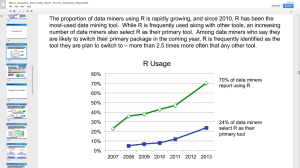
  1. The dramatic rise of open-source data mining tools, especially R. Since 2010, R has been the most-used data mining tool. And in 2013, 70% of data miners report using R. R is frequently used along with other tools, but we also see an increasing number of data miners selecting R as their primary tool.
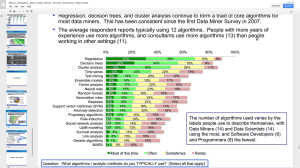
  2. Data miners consistently report that regression, decision trees, and cluster analysis are the key algorithms they turn to. Each of the surveys, from 2007 through 2013, has shown this same core triad of algorithms.
  3. The challenges data miners face are also consistent: Across multiple years, the #1 challenge data miners report has been “dirty data.”. The other top challenges are “explaining data mining to others” and “difficult access to data”. In response to the 2010 survey, data miners described their best practices in overcoming these three key challenges. A summary of their ideas is available on our website here: http://www.rexeranalytics.com/Overcoming_Challenges.html. And three linked “challenge” pages contain almost 200 verbatim best practice ideas collected from survey respondents.
  4. We also see that there is excitement among analytic professionals, high job satisfaction, and room for more and better analytics. People report that the number of analytic projects is increasing, and the size of analytic teams is increasing too. But still there’s room for much wider and more sophisticated use of analytics – only a minority of data miners consider their companies to be analytically sophisticated.

 Ajay: What percentage of people are now doing analytics on the cloud, on mobile, tablet , versus desktop

Karl: In the past few years we’ve seen a doubling in the percent of people who report doing some of their analytics using cloud environments. It’s still the minority of data miners, but it’s grown from 7% in 2010 to 10% in 2011, and 19% reporting using cloud environments in 2013.

Ajay:Your survey is free. How does it help your consulting practice?

Karl: Our main motivation for doing the Data Miner Survey is to contribute to the data mining community. We don’t want to charge a fee for the summary reports, because we want to get the information into as many people’s hands as possible. And we want people to feel free to send the report on to their friends and colleagues.

However, the Data Miner Survey does also help Rexer Analytics. It helps to raise the visibility of our company. It increases the traffic and links to our website, and therefore helps our Google rankings. And it is a great conversation starter.

Ajay: Name some statistics on how popular your survey has become over time- in terms of people filling the survey , and people reading the survey

Karl: In 2007 when we launched the first Data Miner Survey, 314 data miners participated, and it’s grown nicely from there. In each of the last two surveys, over 1200 people participated. The interest we’ve seen in our research summary reports has also been growing at a dramatic rate – recently we’ve been getting thousands of requests for the summary reports each year. Additionally, we have been unveiling the highlights of the surveys with a presentation at the Fall Predictive Analytics World conferences, and it is always a popular talk.

But the most gratifying aspects about the expanded interest in our Data Miner Survey are two things:

  1. The great conversations that the Data Miner Survey has initiated. I have wonderful conversations with people by phone, email and at conferences and at colleges about the findings, the trends, and about all the great ideas people have for new and exciting ways that they want to apply analytics in their domains – everything from human resource planning to cancer research, and customer retention to fraud detection. And many people have contributed ideas for new questions or topics that we have incorporated into the survey.
  2. Seeing that people in the data mining community find the survey results useful. Many students and young people entering the field have told us the summary reports provide a great overview of the field and emerging trends. And many software vendors have told us that the survey helps them better understand the needs and preferences of hands-on data mining practitioners. I’m often surprised to see new people and places that are reading and appreciating our survey. We get emails from all corners of the globe, asking questions about the survey, or asking to share it with others. Sometime last year after receiving a question from an academic researcher in Asia, I decided to check Google Scholar to see who is citing the Data Miner Survey in their books and published papers. The list was long. And the list of online news stories, blogs and other mentions of the Data Miner Survey was even longer. I started a list of citations, with links back to the places that are citing the Data Miner Survey – you can look at the list here: http://www.rexeranalytics.com/Data_Miner_Survey_Citations.html – there are over 100 places citing our research, and the list includes 15 languages. But even more surprising was finding that someone had created a Wikipedia entry about the Data Miner Surveys. I made a couple small edits, but then I stopped. The accepted rule in the Wikipedia community is to not edit things that one has a personal interest in. However, I want to encourage any Wikipedia authors out there to go and help update https://en.wikipedia.org/wiki/Rexer%27s_Annual_Data_Miner_Survey.

 Ajay -What do you think are the top 3 insightful charts from your 2013 Report

Karl-  OK, it’s tough for me to pick only 3.  I think that you should pick the three that you think are the most insightful, and then blog about them and the reasons you think they’re important.

 But if you want me to pick 3, then here are three good ones:
— R Usage graph on page 16 
Screenshot from 2013-12-26 06:37:34
— Algorithm graph on page 36  
Screenshot from 2013-12-26 06:39:10
— The pair of graphs on page 19 that show that there’s still a lot of room for improvement
Happy new year!
(Ajay- You can see the wonderful report at http://www.rexeranalytics.com/ especially  the collection of links in the top right corner of the  home page that cite this survey)

Misconceptions and Fallacies in Analytics Education in India

  1.  Teaching a software and labeling it as analytics education- Some examples are Teaching Analytics with MS Excel (a spreadsheet software) , or Teaching a Statistics or Optimization syllabus and tagging it as Business Analytics.
  2. Promise to teach language X but use cheaper software Y– Examples can be offering to teach SPSS language but using the open source equivalent PSPP
  3. Overcharge for a day or two’s workshop- Albert Einstein could not learn a computer language in 3 days he could just get the basics. Anything priced above 500 $ and less than 4 days training is a simple effort to fool you you are getting your much more than your money’s worth.
  4. Extend training to more than 2 months and then overcharge– This is a failure unless done by an accredited college
  5. Freebies– There is no free lunch. Overcharging and giving a discount is a standard marketing malpractice.
  6. Brand Associations– Brand X is well known but has no credentials in Analytics. So it ties up with a couple of analytics consultants and launches a certificate or certification or diploma program in analytics. Unfortunately this extends to the very very best of Indian education.
  7. Hidden costs also known as We are cheap because we are in India-  Analytics software costs almost the same through out the world ( I did propose a PPP method for pricing software differently). Anyone offering discount because of geography is selling you a bridge in Nigeria or a million dollars in Iraq.
  8. Self Paced Learning-Learn Online for Fee- or Free- No, learning needs interaction and instructors- otherwise all universities in the worlds would have moved the professors to research (?) and offered videos to the students for self learning
  9. Better Much Better Support- Some analytics providers aim to distinguish themselves by saying we give better support. Yet their support team is hidden and mostly the instructor giving support. The best solution is to publish members of support team names as is done in support services industry.

These are personal observations and may or may not be true to every organization. All opinions are mine only.