Geeks for Privacy: Play Color Cipher and Visual Cryptography

Maybe the guys in Anonymous or Wikileaks can now use visual cryptography while using Snapchat to fool the NSA or CIA

Personally I think a browser with inbuilt backdoors to Tor Relays and data transfer by Bit Torrrents could be worthy a project too.

Quit the bullshit, Google- you are as evil as The Russian Communist Empire

I was just reading up on my weekly to-read list and came across this interesting method. It is called Play Color Cipher-

Each Character ( Capital, Small letters, Numbers (0-9), Symbols on the keyboard ) in the plain text is substituted with a color block from the available 18 Decillions of colors in the world [11][12][13] and at the receiving end the cipher text block (in color) is decrypted in to plain text block. It overcomes the problems like “Meet in the middle attack, Birthday attack and Brute force attacks [1]”.
It also reduces the size of the plain text when it is encrypted in to cipher text by 4 times, with out any loss of content. Cipher text occupies very less buffer space; hence transmitting through channel is very fast. With this the transportation cost through channel comes down.

ColorCipherBlocks

Reference-

http://www.ijcaonline.org/journal/number28/pxc387832.pdf

Visual Cryptography is indeed an interesting topic-

Visual cryptography, an emerging cryptography technology, uses the characteristics of human vision to decrypt encrypted
images. It needs neither cryptography knowledge nor complex computation. For security concerns, it also ensures that hackers
cannot perceive any clues about a secret image from individual cover images. Since Naor and Shamir proposed the basic
model of visual cryptography, researchers have published many related studies.

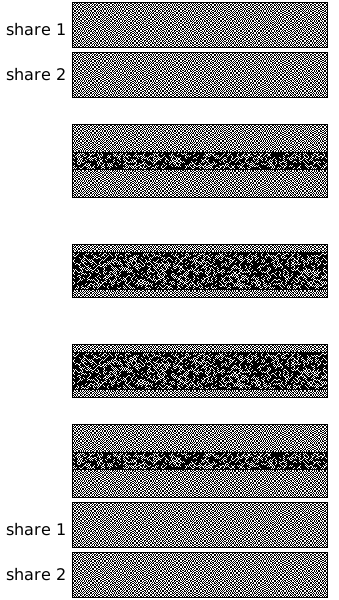
Visual_crypto_animation_demo

Visual cryptography (VC) schemes hide the secret image into two or more images which are called
shares. The secret image can be recovered simply by stacking the shares together without any complex
computation involved. The shares are very safe because separately they reveal nothing about the secret image.

Visual Cryptography provides one of the secure ways to transfer images on the Internet. The advantage
of visual cryptography is that it exploits human eyes to decrypt secret images .

ESPECIALLY SEE |THIS AND THIS

http://cacr.uwaterloo.ca/~dstinson/VCS-flag.html

and

http://cacr.uwaterloo.ca/~dstinson/VCS-pi.html

Even more fun—– visual cryptography using a series of bar codes – leaving the man in middle guessing how many sub images are there and which if at all is the real message


vispixel

References-

Color Visual Cryptography Scheme Using Meaningful Shares

http://csis.bits-pilani.ac.in/faculty/murali/netsec-10/seminar/refs/muralikrishna4.pdf

Visual cryptography for color images

http://csis.bits-pilani.ac.in/faculty/murali/netsec-10/seminar/refs/muralikrishna3.pdf

Other Resources

  1. http://users.telenet.be/d.rijmenants/en/visualcrypto.htm
  2. Visual Crypto – One-time Image Create two secure images from one by Robert Hansen
  3. Visual Crypto Java Applet at the University of Regensburg
  4. Visual Cryptography Kit Software to create image layers
  5. On-line Visual Crypto Applet by Leemon Baird
  6. Extended Visual Cryptography (pdf) by Mizuho Nakajima and Yasushi Yamaguchi
  7. Visual Cryptography Paper by Moni Noar and Adi Shamir
  8. Visual Crypto Talk (pdf) by Frederik Vercauteren ESAT Leuven
  9. http://cacr.uwaterloo.ca/~dstinson/visual.html
  10. t the University of Salerno web page on visual cryptogrpahy.
  11. Visual Crypto Page by Doug Stinson
  12. Simple implementation of the visual cryptography scheme based on Moni Naor and Adi Shamir, Visual Cryptography, EUROCRYPT 1994, pp1–12. This technique allows visual information like pictures to be encrypted so that decryption can be done visually.The code outputs two files. Try printing them on two separate transparencies and putting them one on top of the other to see the hidden message. http://algorito.com/algorithm/visual-cryptography

Visual Cryptography 

Ajay- I think a combination of sharing and color ciphers would prove more helpful to secure Internet Communication than existing algorithms. It also levels the playing field from computationally rich players to creative coders.
#Rstats continues its march in data mining

From the famous KARL REXER ANNUAL DATA MINING SURVEY

HIGHLIGHTS from the 2013 Data Miner Survey:
  • SURVEY & PARTICIPANTS:  68-item survey conducted online in 2013.  Participants: 1,259 analytic professionals from 75 countries.  This is the 6th Data Miner Survey.
  • FOCUS ON CRM:  In the past few years, there has been an increase among data miners in the already substantial area of customer-focused analytics.  Respondents are looking for a better understanding of customers and seeking to improve the customer experience.  This can be seen in their goals, analyses, big data endeavors, and in the focus of their text mining.
  • BIG DATA:  Many in the field are talking about the phenomena of Big Data.  There are clearly some areas in which the volume and sources of data have grown.  However it is unclear how much Big Data has impacted the typical data miner.  While data miners believe that the size of their datasets have increased over the past year, data from previous surveys indicate that the size of datasets have been fairly consistent over time.
  • THE ASCENDANCE OF R:  The proportion of data miners using R is rapidly growing, and since 2010, R has been the most-used data mining tool.  While R is frequently used along with other tools, an increasing number of data miners also select R as their primary tool.
  • CHALLENGES IN THE USE OF ANALYTICS:  Data miners continue to report challenges at each level of the analytic process.  Companies often are not using analytics to their fullest and have continuing issues in the areas of deployment and performance measurement.
  • ENGAGEMENT & JOB SATISFACTION:  The Data Miners in our survey are highly engaged with the analytic community: consuming and producing content, entering competitions and searching for education and growth within their jobs.  All of these activities lead to high job satisfaction, which has been increasing over time.
  • ANALYTIC SOFTWARE:  Data miners are a diverse group who are looking for different things from their data mining tools.  Ease-of-use and cost are two distinguishing dimensions.  Software packages vary in their strengths and features.  STATISTICA, KNIME, SAS JMP and IBM SPSS Modeler all receive high satisfaction ratings.
  • OTHER FINDINGS include the labels analytic professionals use to describe themselves (Data Scientist is #1), the algorithms being used (regression, decision trees, and cluster analysis continue to be the triad of core algorithms), and computing environments (cloud computing is increasing).

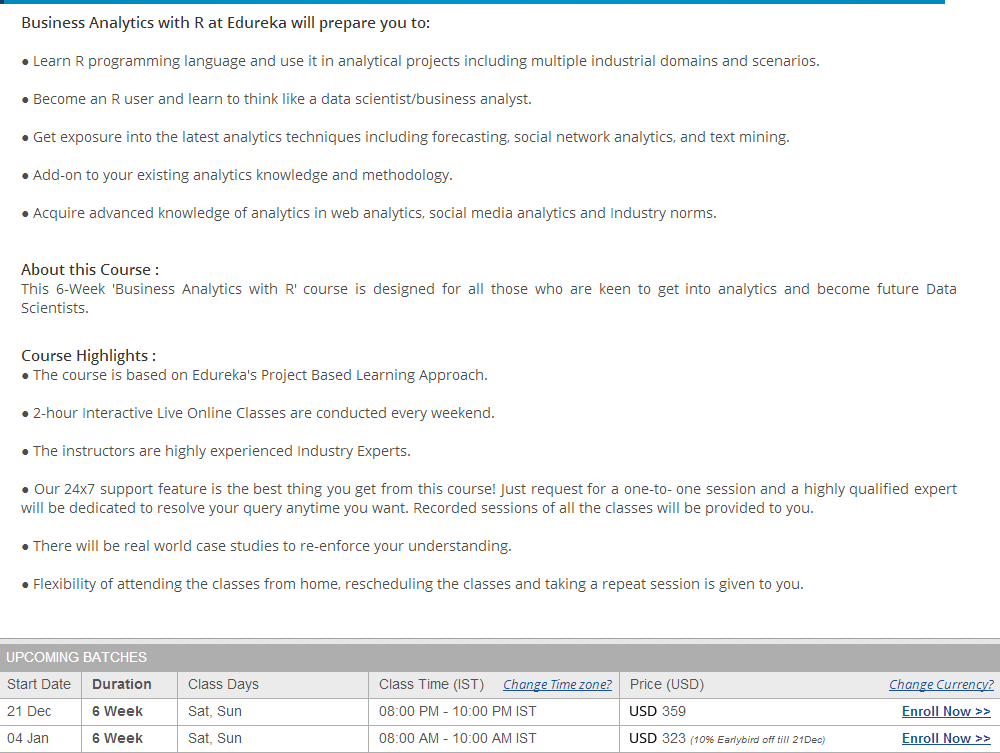
Teaching R in India #rstats $323 for 6 week course

I submitted a poster to User2013 that was accepted on Teaching R in India- but I could not attend since I was in Canada visiting family at that time

These were some of the experiences I wanted to talk about- but I think I will elaborate on them later

Anyways- I have been able to design a SECOND R course in Bangalore for Edureka-
What happened to the FIRST course I designed in India. Enough said!

But Edureka were different and they work mostly with open source like teaching Hadoop, Android, Cassandra and R- and they are truly world class in their ways (except video editing and websites and social media blogs )
Edureka has worked much more honestly with both students and instructors. I was also able to convince them of the value of limited open access by giving some slides and videos free .
here is the slides for the first class.

The landing page is at
By pricing a 6 week, 24 hour course using Go2Meeting at just $323 ———-
edr
What we are trying to do is disrupt the market for training in two ways-
1) Give better customization and instructor attention than the MOOCs
2) Avoid  obscenely expensive workshops priced above 900$ per 8 hours etc…. from corporates.
The youtube video has got almost 6338 views and the model works best for developing countries like India for spreading R (though we do have an occasional overseas student ). We are currently updating the quality of the video even more as we collect automated response at end of each 2 hour class.
 All slides  and all videos are made free to download forever to the student.
 Got 323$  to learn R in six weeks? Sign up here  http://www.edureka.in/r-for-analytics

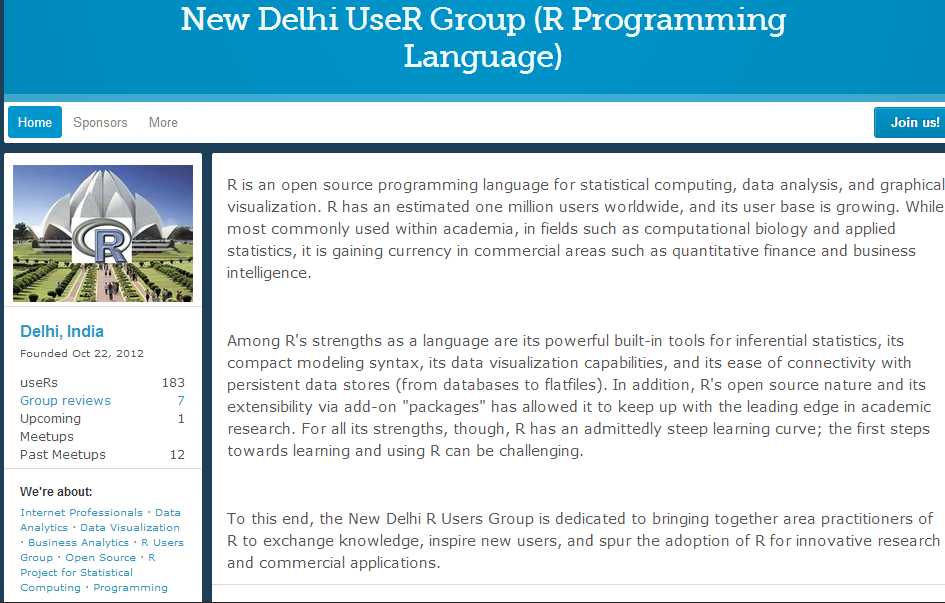
New Delhi R Users Group- Noida Chapter Begins

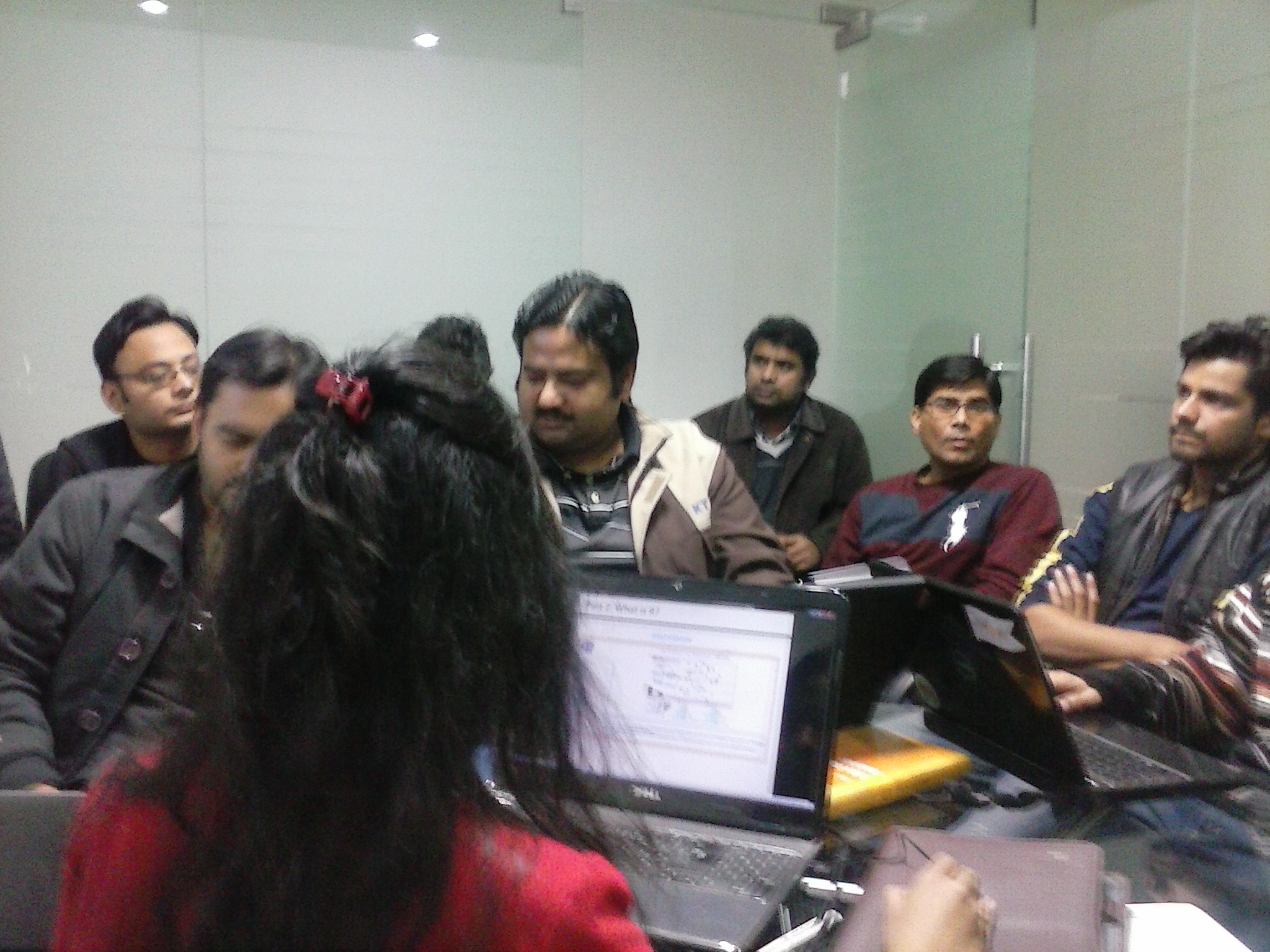
I founded the New Delhi R Users group almost a year ago. It now has 183 members, and we recently held our first Noida Chapter meeting ( Delhi is a huge area, with Noida and Gurgaon as two adjoining suburban hubs). The response was terrific many people attended. ndr

The sessions were divided in two- for beginners and advanced users

This was the agenda

We invite you on the R learning session at Apsidata Solutions on 7th Dec 2013 from 2:30PM-5:00PM.

Our purpose is to cover up the basics of R and its current market and business scope.

We have divided the session in 2 parts-

(PART – I) Introduction and basics graphs of R (by Su  from 2:30PM – 3:30PM)

CAM00187

·         Basic Introduction

·         Introduction of Statistical Analysis

·         Installation of R

·         What is Package and how to install and use it.

·         R-commander

·         Importing Data in R

·         Hands-on inbuilt functions

·         Graphs

Half an hour break for discussion and queries (from 3:30PM -4:00PM)

(PART – II) – What’s new in R and its market (by Ajay Ohri from 4:00PM – 5:00PM)

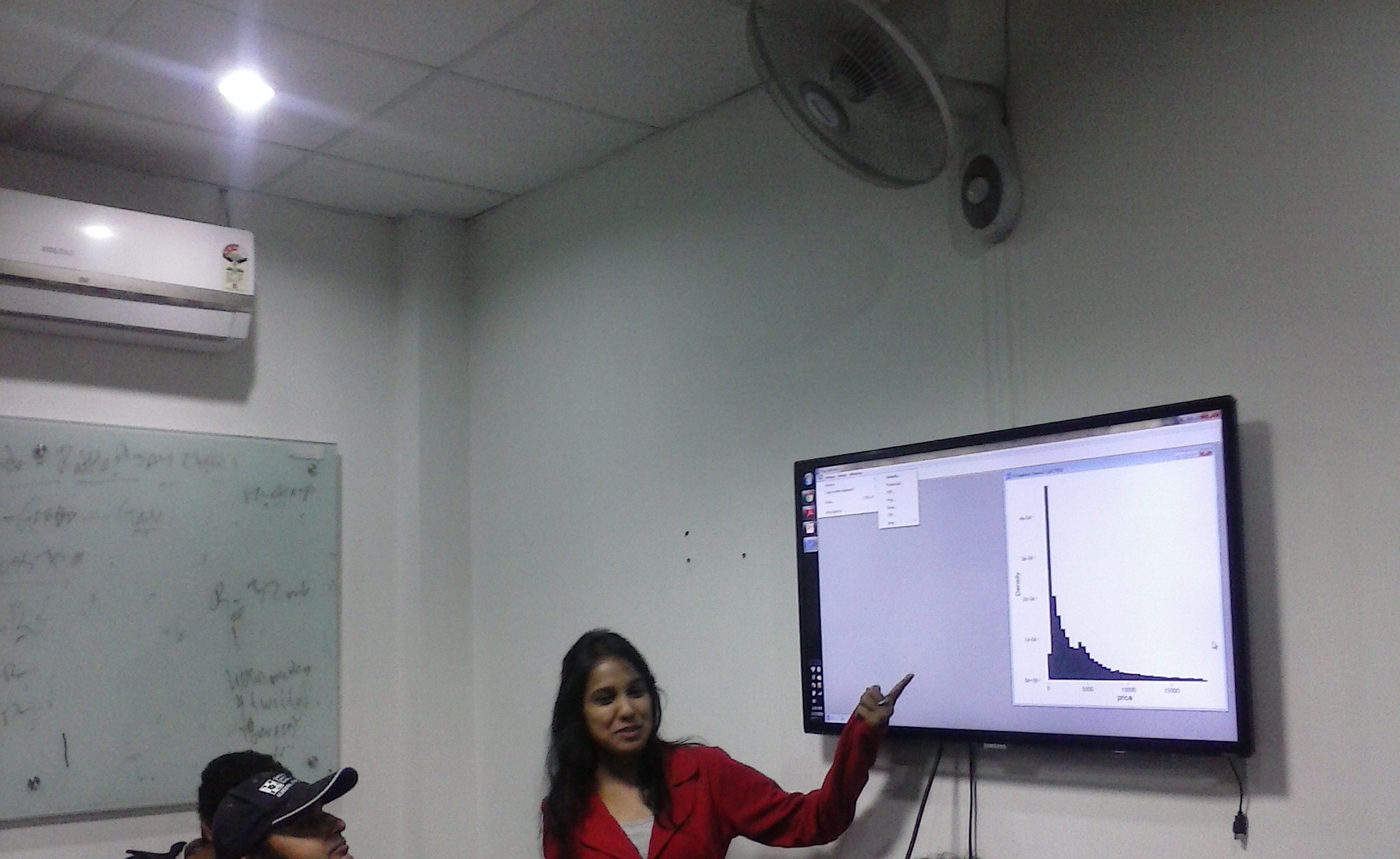
CAM00186

·         Rattle-Data mining

·         R-Studio Sever

·         R-Fiddle

·         Statace


First part for beginners was taken by Su, my student from Edureka 

These were the slides

Part 1

Part 2


Overall, we trying hard to develop the R ecosystem in a Microsoft ruled country 🙂

Mathematical .Gifs

Credit- Wikipedia and Google Plus Maths Community

https://plus.google.com/u/0/communities/100568607954673744130


Click on .gif for seeing motion esp if from mobile or on low bandwidth

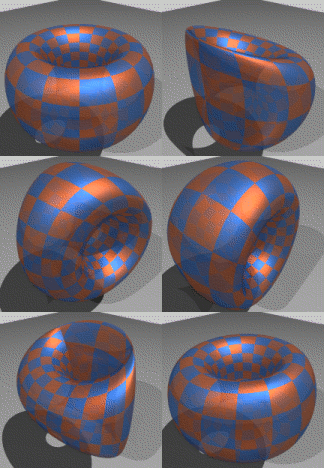
Mobius

mobius


The road to Carnegie Hall

Párhuzamos randevú


Illusion- Each of the dots are actually moving in straight line -Also used for Christmas Lights

Düz hareket eden noktalar


Sine and Cosine

V0mCw


Tesseracts (not from Asgard)

8-cell-simple


Tesseract


Toruses

Clifford-torus


240px-Torus_from_rectangle


Duocylinder_ridge_animated


1spiraltorusknot2gj0


Pythagoras Theorem- Greek Math

Pythagoras-2a


Dodecahedron

9h16m


Villarceau_circles


Villarceau_circles


Hypotrochoid

HypotrochoidOutThreeFifths

Simple Way to Teach Pi

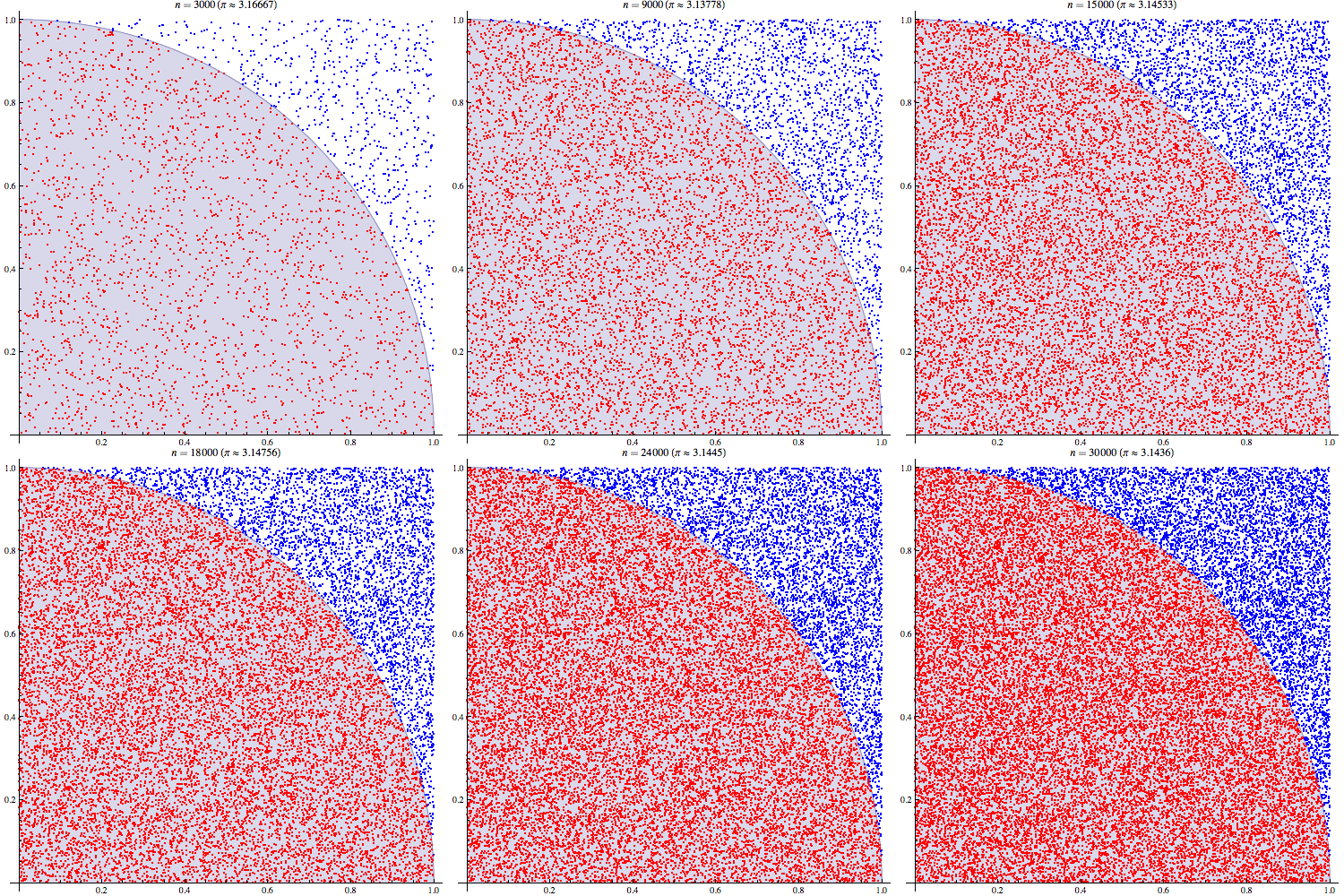
Pi-unrolled-720


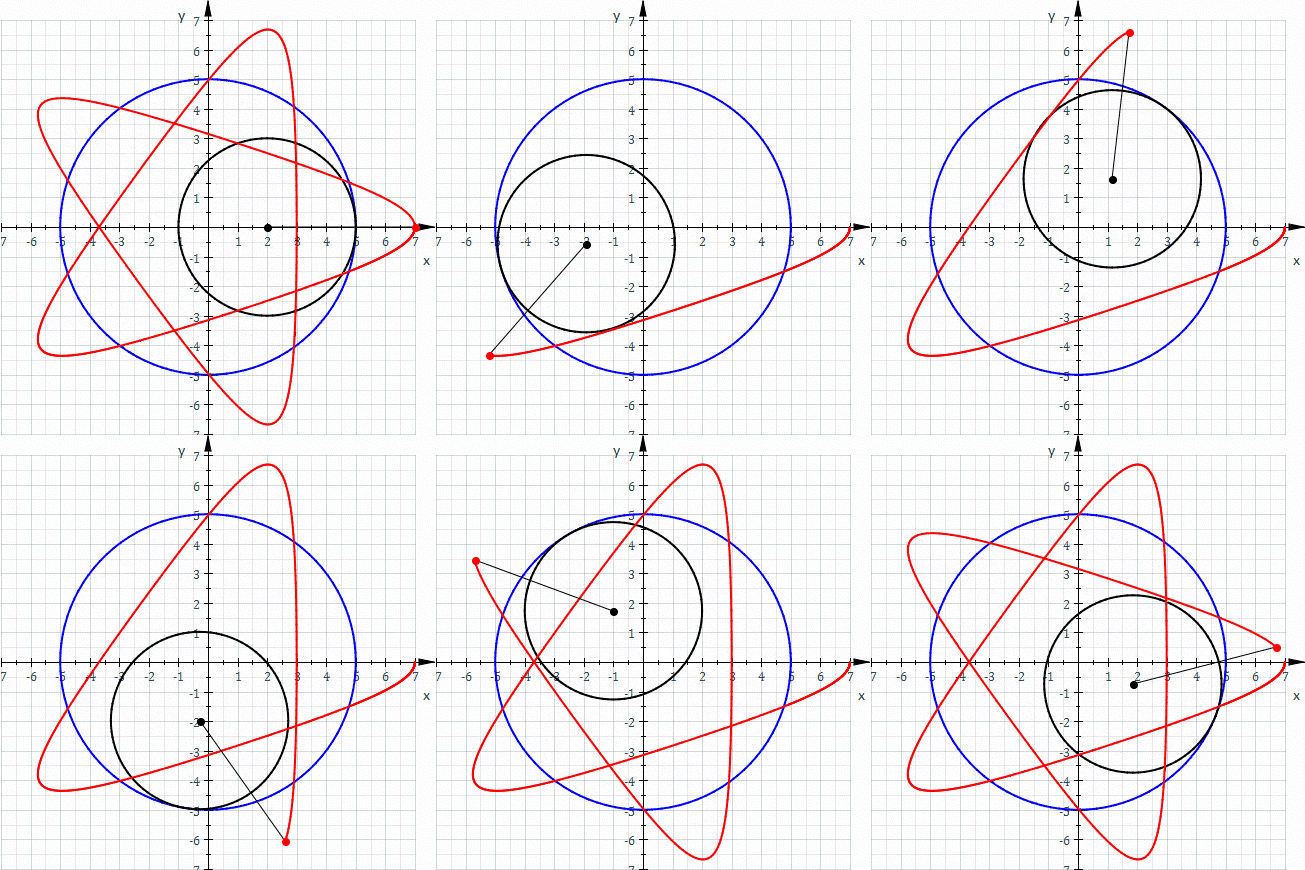
Monte Carlo to Estimate Pi

Pi_30K


Top Fourteen Interfaces in Social Media and Web Analytics on the Internet

Gurus like  this   and  this should me but I think something is rotten in the state of analytics data visualizations on the web.

  • Facebook Page Insights- Cool Viz- Blue Line Graphsfacebook page insights
  • WordPress prefers bar plots and spatial analysis (if only minimal)
    wp viz
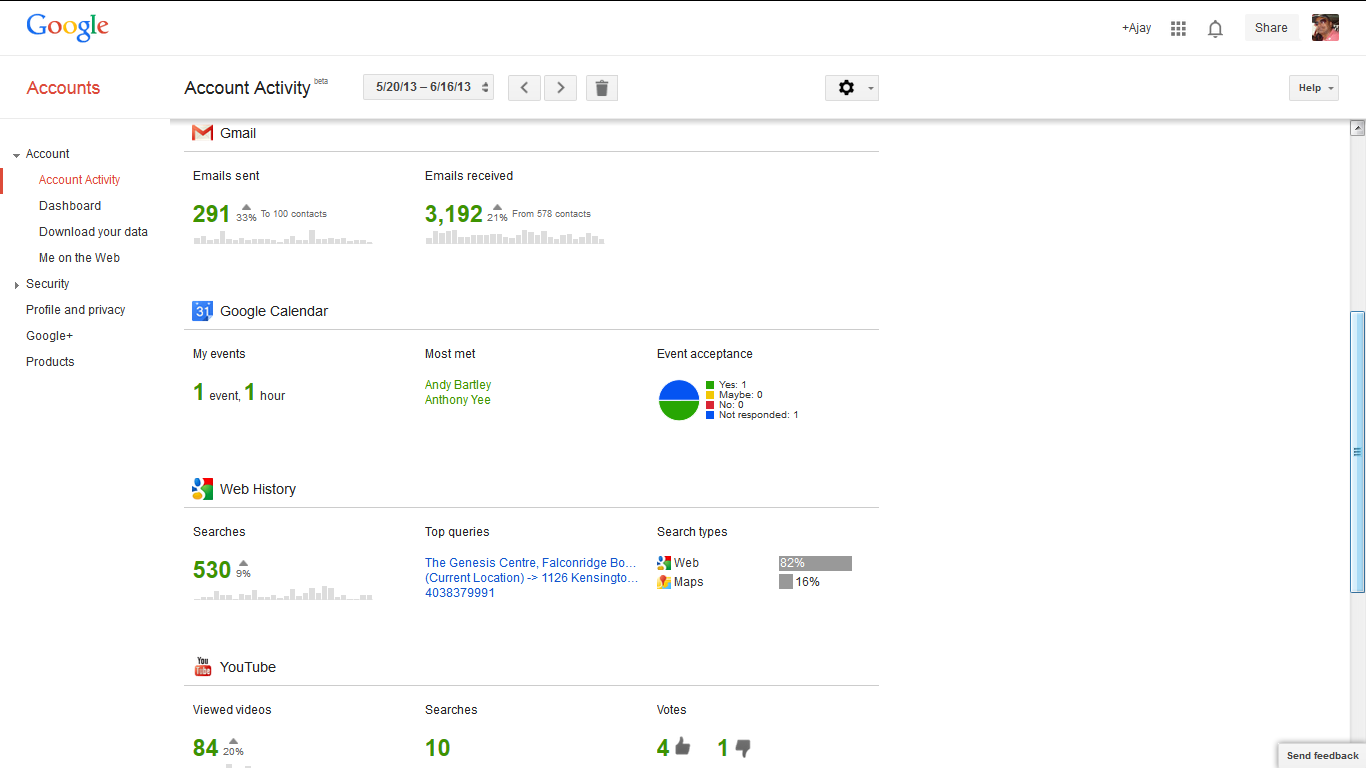
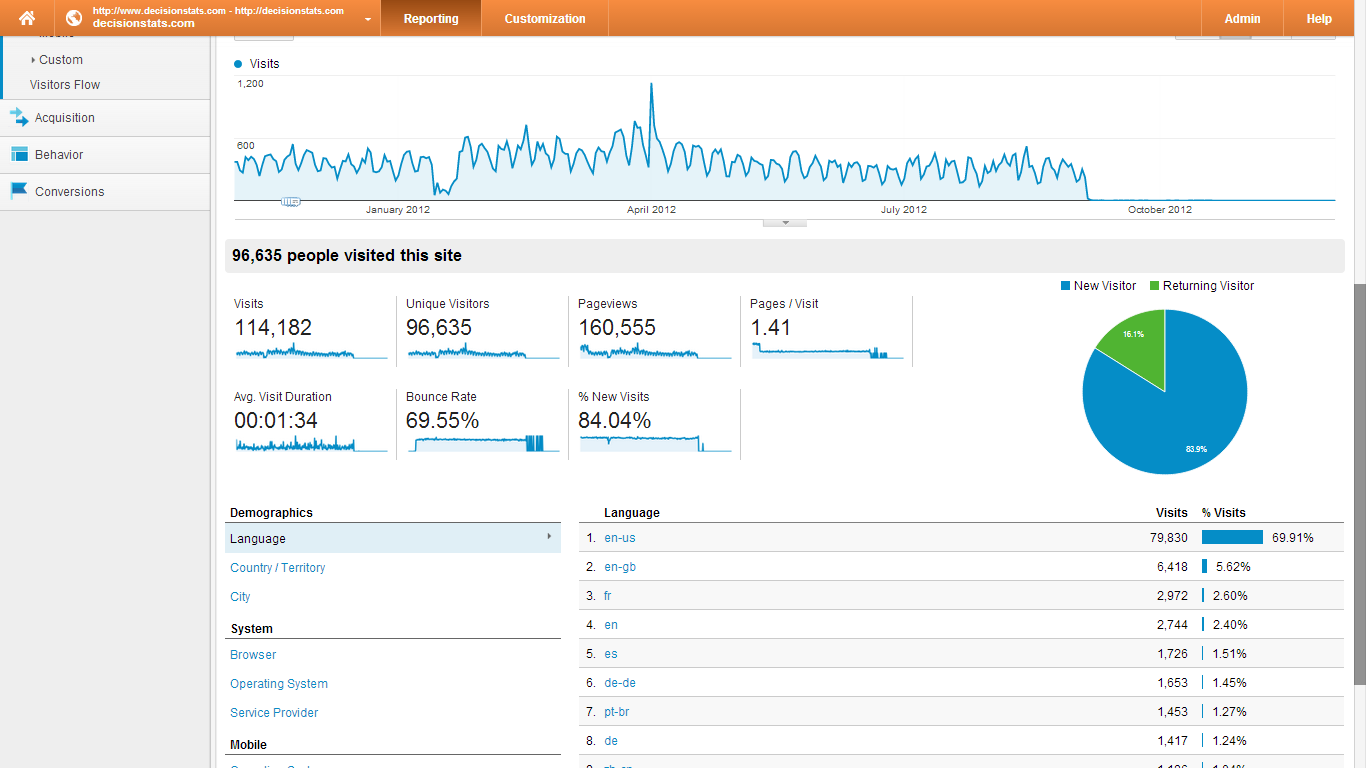
  •  Google Activity Dashboard prefers Tufte (?) . No it just shows fonts, and even a (gasp) pie chart.
    google stats
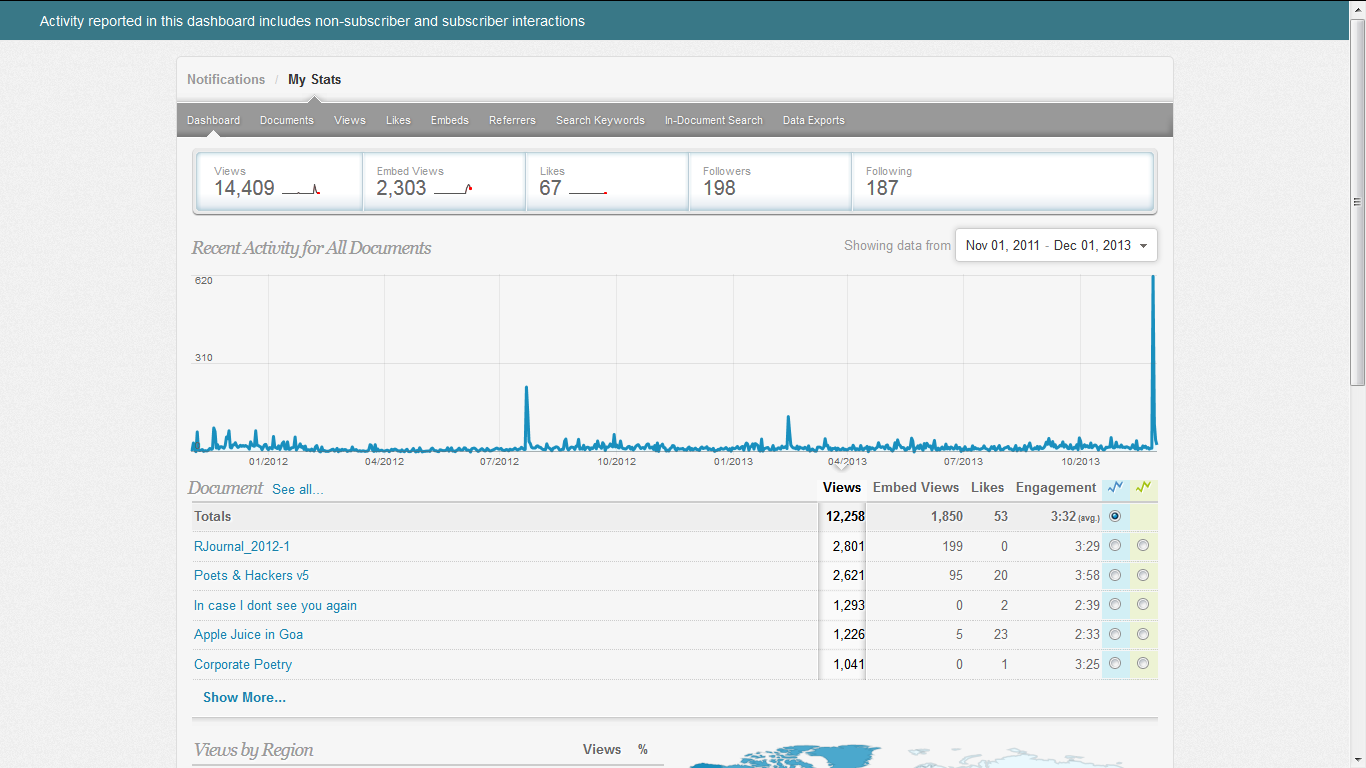
  • Scribd prefers  —yes tables and line graphs rule
    scribd stats
  • Slideshare Stats are a pro feature (!) . Free features are a table– sigh
    slideshare analytics
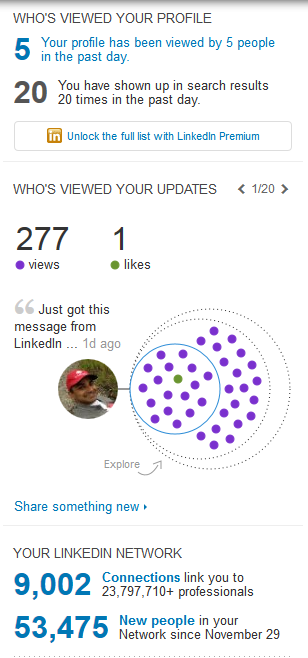
  • LinkedIn – was a pioneer but now  

li stats 1

  • Linkedin Groups viz
    li stats groups
  • Quora Stats – hmm
    quora stats
  • My Anti Virus still likes doughnuts
    pie
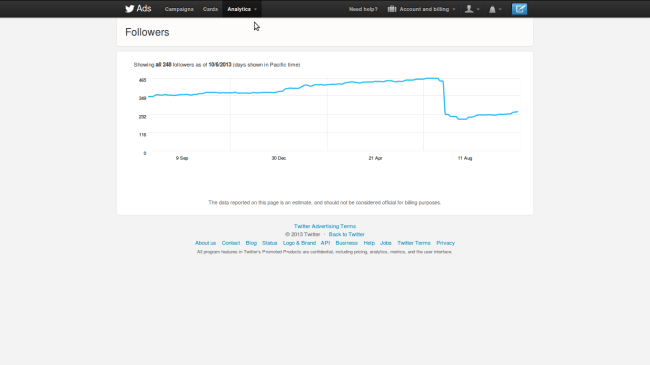
  • OFFICIAL Twitter Analytics

source – https://decisionstats.com/2013/10/07/ads-and-analytics-on-twitter-is-a-lovely-platform-ads-twitter-ipo-analytics-socialmedia/

ga1


Google Compute Engine pricing much more honest than AWS and Azure Pricing

Google compute is priced like a Taxi- 10 minutes and then in blocks of 1 minute .

The web page is clear and simple and does not confuse

Google Compute Engine Pricing is more honest in its GA

Microsoft dazzles but hides pricing between layers of pages, while Amazon does it with dropdowns and contact us baits. IBM is impossible  to get an upfront honest price from and I am still trying to figure out Oracle Cloud

Hopefully GCE uptime will be better than Gmail Uptime!!!

——————————————————————————————————————————-

From

https://cloud.google.com/products/compute-engine/

Pricing

All machine types are charged a minimum of 10 minutes. For example, if you run your instance for 2 minutes, you will be billed for 10 minutes of usage. After 10 minutes, instances are charged in 1 minute increments, rounded up to the nearest minute. For example, an instance that lives for 11.25 minutes will be charged for 12 minutes of usage.

If you would like to discuss pricing for long-term commitments, please contact sales

Machine Type Pricing

Standard

Instance type Virtual Cores Memory Price (US$)/Hour
(US hosted)
Price (US$)/Hour
(Europe hosted)
n1-standard-1 1 3.75GB * $0.104 $0.114
n1-standard-2 2 7.5GB $0.207 $0.228
n1-standard-4 4 15GB * $0.415 $0.456
n1-standard-8 8 30GB $0.829 $0.912
n1-standard-16 16 60GB $1.659 $1.825

High Memory

Machines for tasks that require more memory relative to virtual cores

Instance type Virtual Cores Memory Price (US$)/Hour
(US hosted)
Price (US$)/Hour
(Europe hosted)
n1-highmem-2 2 13GB $0.244 $0.275
n1-highmem-4 4 26GB $0.488 $0.549
n1-highmem-8 8 52GB $0.975 $1.098
n1-highmem-16 16 104GB $1.951 $2.196

High CPU

Machines for tasks that require more virtual cores relative to memory

Instance type Virtual Cores Memory Price (US$)/Hour
(US hosted)
Price (US$)/Hour
(Europe hosted)
n1-highcpu-2 2 1.80GB $0.131 $0.146
n1-highcpu-4 4 3.60GB $0.261 $0.292
n1-highcpu-8 8 7.20GB $0.522 $0.584
n1-highcpu-16 16 14.40GB $1.044 $1.167

Shared Core

Machines for tasks that don’t require a lot of resources but do have to remain online for long periods of time.

Instance type Virtual Cores Memory Price (US$)/Hour
(US hosted)
Price (US$)/Hour
(Europe hosted)
f1-micro 1 0.60GB $0.019 $0.021
g1-small 1 1.70GB $0.054 $0.059

Network Pricing

Ingress Free
Egress to the same Zone. Free
Egress to a different Cloud service within the same Region. Free
Egress to a different Zone in the same Region (per GB) $0.01
Egress to a different Region within the US $0.01 ***
Inter-continental Egress At Internet Egress Rate
Internet Egress (Americas/EMEA destination) per GB
0-1 TB in a month $0.12
1-10 TB $0.11
10+ TB $0.08
Internet Egress (APAC destination) per GB
0-1 TB in a month $0.21
1-10 TB $0.18
10+ TB $0.15

Persistent Disk Pricing

Provisioned space $0.04 GB / month
Snapshot storage $0.125 GB / month
IO operations No additional charge

Image Storage

Image storage $0.085 GB / month

IP Address Pricing

Static IP address (assigned but unused) $0.01 / hour
Static IP address (assigned and in use) Free
Ephemeral IP address (attached to instance) Free

VERSUS

http://aws.amazon.com/ec2/pricing/

Pricing is per instance-hour consumed for each instance, from the time an instance is launched until it is terminated or stopped. Each partial instance-hour consumed will be billed as a full hour.

On-Demand Instance Prices

Region:US East (N. Virginia)US West (Oregon)US West (Northern California)EU (Ireland)Asia Pacific (Singapore)Asia Pacific (Tokyo)Asia Pacific (Sydney)South America (Sao Paulo)
$  US Dollar
Linux/UNIX Usage
General Purpose – Current Generation
m3.xlarge $0.450 per Hour
m3.2xlarge $0.900 per Hour
General Purpose – Previous Generation
m1.small $0.060 per Hour
m1.medium $0.120 per Hour
m1.large $0.240 per Hour
m1.xlarge $0.480 per Hour
Compute Optimized – Current Generation
c3.large $0.150 per Hour
c3.xlarge $0.300 per Hour
c3.2xlarge $0.600 per Hour
c3.4xlarge $1.200 per Hour
c3.8xlarge $2.400 per Hour
Compute Optimized – Previous Generation
c1.medium $0.145 per Hour
c1.xlarge $0.580 per Hour
cc2.8xlarge $2.400 per Hour
GPU Instances – Current Generation
g2.2xlarge $0.650 per Hour
GPU Instances – Previous Generation
cg1.4xlarge $2.100 per Hour
Memory Optimized – Current Generation
m2.xlarge $0.410 per Hour
m2.2xlarge $0.820 per Hour
m2.4xlarge $1.640 per Hour
cr1.8xlarge $3.500 per Hour
Storage Optimized – Current Generation
hi1.4xlarge $3.100 per Hour
hs1.8xlarge $4.600 per Hour
Micro Instances
t1.micro $0.020 per Hour

Pricing is per instance-hour consumed for each instance, from the time an instance is launched until it is terminated or stopped. Each partial instance-hour consumed will be billed as a full hour.

Reserved Instances

Reserved Instances give you the option to make a low, one-time payment for each instance you want to reserve and in turn receive a significant discount on the hourly charge for that instance. There are three Reserved Instance types (Light, Medium, and Heavy Utilization Reserved Instances) that enable you to balance the amount you pay upfront with your effective hourly price.

The following tables display the Reserved Instance Prices available directly from AWS. In addition to Reserved Instances for Linux/UNIX and Windows operating systems specified below, we also offer Reserved Instances forAmazon EC2 running SUSE Linux Enterprise ServerAmazon EC2 running Red Hat Enterprise Linux, and Amazon EC2 running Microsoft SQL Server. Dedicated Reserved Instances are also available.

Light Utilization Reserved Instances

Region:US East (N. Virginia)US West (Northern California)US West (Oregon)EU (Ireland)Asia Pacific (Singapore)Asia Pacific (Tokyo)Asia Pacific (Sydney)South America (Sao Paulo)
$  US Dollar
1 yr Term 3 yr Term
Upfront Hourly Upfront Hourly
General Purpose – Current Generation
m3.xlarge $439 $0.254 per Hour $686 $0.201 per Hour
m3.2xlarge $879 $0.508 per Hour $1372 $0.401 per Hour
General Purpose – Previous Generation
m1.small $61 $0.034 per Hour $96 $0.027 per Hour
m1.medium $122 $0.068 per Hour $192 $0.054 per Hour
m1.large $243 $0.136 per Hour $384 $0.108 per Hour
m1.xlarge $486 $0.271 per Hour $768 $0.215 per Hour
Compute Optimized – Current Generation
c3.large $167 $0.093 per Hour $252 $0.082 per Hour
c3.xlarge $333 $0.186 per Hour $503 $0.164 per Hour
c3.2xlarge $667 $0.373 per Hour $1006 $0.327 per Hour
c3.4xlarge $1333 $0.745 per Hour $2012 $0.654 per Hour
c3.8xlarge $2666 $1.49 per Hour $4024 $1.308 per Hour
Compute Optimized – Previous Generation
c1.medium $161 $0.09 per Hour $243 $0.079 per Hour
c1.xlarge $644 $0.36 per Hour $972 $0.316 per Hour
cc2.8xlarge $1762 $0.904 per Hour $2710 $0.904 per Hour
GPU Instances – Current Generation
g2.2xlarge $772 $0.499 per Hour $1143 $0.392 per Hour
Memory Optimized – Current Generation
m2.xlarge $272 $0.169 per Hour $398 $0.136 per Hour
m2.2xlarge $544 $0.338 per Hour $796 $0.272 per Hour
m2.4xlarge $1088 $0.676 per Hour $1592 $0.544 per Hour
cr1.8xlarge $2474 $1.54 per Hour $3846 $1.225 per Hour
Storage Optimized – Current Generation
hs1.8xlarge $3968 $2.24 per Hour $5997 $1.81 per Hour
hi1.4xlarge $2576 $1.477 per Hour $3884 $1.15 per Hour
Micro Instances
t1.micro $23 $0.012 per Hour $35 $0.012 per Hour

Medium Utilization Reserved Instances

Region:US East (N. Virginia)US West (Northern California)US West (Oregon)EU (Ireland)Asia Pacific (Singapore)Asia Pacific (Tokyo)Asia Pacific (Sydney)South America (Sao Paulo)
$  US Dollar
1 yr Term 3 yr Term
Upfront Hourly Upfront Hourly
General Purpose – Current Generation
m3.xlarge $1034 $0.156 per Hour $1631 $0.123 per Hour
m3.2xlarge $2069 $0.313 per Hour $3262 $0.247 per Hour
General Purpose – Previous Generation
m1.small $139 $0.021 per Hour $215 $0.017 per Hour
m1.medium $277 $0.042 per Hour $430 $0.033 per Hour
m1.large $554 $0.084 per Hour $860 $0.067 per Hour
m1.xlarge $1108 $0.168 per Hour $1720 $0.133 per Hour
Compute Optimized – Current Generation
c3.large $383 $0.056 per Hour $591 $0.049 per Hour
c3.xlarge $766 $0.112 per Hour $1182 $0.097 per Hour
c3.2xlarge $1532 $0.224 per Hour $2364 $0.195 per Hour
c3.4xlarge $3064 $0.447 per Hour $4728 $0.389 per Hour
c3.8xlarge $6127 $0.894 per Hour $9456 $0.778 per Hour
Compute Optimized – Previous Generation
c1.medium $370 $0.054 per Hour $571 $0.047 per Hour
c1.xlarge $1480 $0.216 per Hour $2284 $0.188 per Hour
cc2.8xlarge $4146 $0.54 per Hour $6378 $0.54 per Hour
GPU Instances – Current Generation
g2.2xlarge $1987 $0.34 per Hour $3311 $0.294 per Hour
Memory Optimized – Current Generation
m2.xlarge $651 $0.103 per Hour $992 $0.08 per Hour
m2.2xlarge $1302 $0.206 per Hour $1984 $0.16 per Hour
m2.4xlarge $2604 $0.412 per Hour $3968 $0.32 per Hour
cr1.8xlarge $5958 $0.93 per Hour $9006 $0.735 per Hour
Storage Optimized – Current Generation
hs1.8xlarge $9200 $1.38 per Hour $14103 $1.11 per Hour
hi1.4xlarge $5973 $0.909 per Hour $9133 $0.705 per Hour
Micro Instances
t1.micro $54 $0.007 per Hour $82 $0.007 per Hour

Heavy Utilization Reserved Instances

Loading pricing data…

Reserved Instances can be purchased directly from AWS for 1 or 3 year terms. Using the Reserved Instance Marketplace, you have the flexibility to purchase Reserved Instances from AWS Reserved Instance Marketplace Sellers for terms ranging between 1 month to 36 months (depending on available selection). In either case, the one-time fee per instance is non-refundable. If your needs change, you can also request to move your Reserved Instance to another Availability Zone within the same region, change its Network Platform, or, for Linux/UNIX and Windows RIs, modify the instance type of your reservation to another type in the same instance family at no additional cost.

Light and Medium Utilization Reserved Instances also are billed by the instance-hour for the time that instances are in a running state; if you do not run the instance in an hour, there is zero usage charge. Partial instance-hours consumed are billed as full hours. Heavy Utilization Reserved Instances are billed for every hour during the entire Reserved Instance term (which means you’re charged the hourly fee regardless of whether any usage has occurred during an hour).

If Microsoft or Red Hat chooses to increase the license fees that it charges for Windows or Red Hat Enterprise Linux, we may correspondingly increase the per-hour usage rate for previously purchased Reserved Instances with Windows or Red Hat Enterprise Linux. The initial one-time payment for a Reserved Instance will be unaffected in this situation. Any such changes for Windows would be made between Dec 1 – Jan 31, and with at least 30 days’ notice. Any such changes for Red Hat Enterprise Linux would be made at least 30 days’ notice. If the per-hour usage rate does increase, you may continue to use your Reserved Instance with Windows or Red Hat Enterprise Linux with the new per-hour usage rate, convert your Reserved Instance with Windows or Red Hat Enterprise Linux to a Reserved Instance with Linux/UNIX, or request a pro rata refund of the upfront fee you paid for the Reserved Instance with Windows or Red Hat Enterprise Linux.

Reserved Instances are available for Linux/UNIX, Windows, Red Hat Enterprise Linux, and SUSE Linux Enterprise operating systems. You can also optionally reserve instances in Amazon VPC at the same prices as shown above.Click here to learn more about Reserved Instances.

Reserved Instance Volume Discounts

When you have purchased a sufficient number of Reserved Instances in an AWS Region, you will automatically receive discounts on your upfront fees and usage fees for future purchases of Reserved Instances in that AWS Region. Reserved Instance Tiers are determined based on the total list price (non-discounted price) of upfront fees for the active Reserved Instances you have per AWS Region. It is important to note that Reserved Instance Tiers do not apply to Reserved Instances purchased from the Reserved Instance Marketplace. A complete list of the Reserved Instance Tiers is shown below:

Reserved Instance Volume Discounts

Total Reserved Instances

Upfront Discount

Hourly Discount
Less than $250,000
0%
0%
$250,000 to $2,000,000
10%
10%
$2,000,000 to $5,000,000
20%
20%
More than $5,000,000

http://www.windowsazure.com/EN-US/pricing/overview/

Up to 29.5% savings vs.
Pay as You Go plan
Starting at $500/month

PURCHASE

SUPPORT OPTIONSCustomizable support options to provide the best available expertise for your needs.PURCHASE

Purchase plans

* Comparisons based on the pay-as-you-go plan.

Monthly
Committed Spend

  • $500 TO $14,999
  • $15,000 TO $39,999
  • $40,000 AND ABOVE

6-Month
Monthly Pay

  • discount *
  • 20%
  • 23%
  • 27%

VIEW DETAILS | BUY

12-Month
Monthly Pay

  • discount *
  • 22.5%
  • 25.5%
  • 29.5%

VIEW DETAILS | BUY

6-Month
Pre-Pay

  • discount *
  • 22.5%
  • 25.5%
  • 29.5%

VIEW DETAILS | BUY

12-Month
Pre-Pay

  • discount *
  • 25%
  • 28%
  • 32%

VIEW DETAILS | BUY

http://www.windowsazure.com/en-us/offers/commitment-plans

Usage Quotas

The following monthly usage quotas are applied. If you need more than these limits, please contact customer service at any time so that we can understand your needs and adjust these limits appropriately.

Cloud Services and Virtual Machines

The standard quota is 20 concurrent Standard Small (A1) compute instances or an equivalent number of other types or sizes of compute instances as determined by using the compute instance quota conversion table below.

1 COMPUTE INSTANCE IN THE FOLLOWING NUMBER OF EQUIVALENT STANDARD SMALL (A1) INSTANCES
Extra Small (A0) 1
Small (A1) 1
Medium (A2) 2
Large (A3) or A6 4
Extra Large (A4)  or A7 8

Storage

  • 5 concurrent storage accounts

Active Directory

  • 150,000 objects

Also see

http://www.ibm.com/cloud-computing/social/us/en/planspricing/

https://cloud.oracle.com/mycloud/f?p=service:java_pricing:0:::::


Java S1

$249 / MonthBuy Now- S1

  • 1

    Oracle WebLogic Server 1

  • 1.5 GB

    RAM for Java Heap 2

  • 5 GB

    File Storage 3

  • 50 GB

    Data Transfer 4

Java S2

$499 / MonthBuy Now- S2

  • 2

    Oracle WebLogic Servers 1

  • 3 GB

    RAM for Java Heap 2

  • 10 GB

    File Storage 3

  • 250 GB

    Data Transfer 4

Java S4

$1,499 / MonthBuy Now- S4

  • 4

    Oracle WebLogic Servers 1

  • 6 GB

    RAM for Java Heap 2

  • 25 GB

    File Storage 3

  • 500 GB

    Data Transfer 4