Interview Skipper Seabold Statsmodels #python #rstats

As part of my research for Python for R Users: A Data Science Approach (Wiley 2016) Here is an interview with Skipper Seabold, creator of statsmodels, Python package. Statsmodels is a Python module that allows users to explore data, estimate statistical models, and perform statistical tests. Since I have been playing actively with this package, I have added some screenshots to show it is a viable way to build regression models.

sseabold-e596b56c5e7119b013e4f21c2a7db642

Ajay (A)- What prompted you to create Stats Models package?
 
Skipper (S) I was casting about for an open source project that I could take on to help further my programming skills during my graduate studies. I asked one of my professors who is involved in the Python community for advice. He urged that I look into the Google Summer of Code program under the SciPy project. One of the potential projects was resurrecting some code that used to be in scipy as scipy.stats.models. Getting involved in this project was a great way to strengthen my understanding of econometrics and statistics during my graduate studies. I raised the issue on the scipy mailing list, found a mentor in my co-lead developer Josef Perktold, and we started working in earnest on the project in 2009.
A- What has been the feedback from users so far?
 
S- Feedback has generally been pretty good. I think people now see that Python is a not only viable but also compelling alternative to R for doing statistics and econometric research as well as applied work.
A- What is your roadmap for Stats Models going forward ?
 
S- Our roadmap going forward is not much more than continuing to merge good code contributions, working through our current backlog of pull requests, and contuing to work on consistency of naming and API in the package for a better overall user experience. Each developer mainly works on their own research interests for new functionality, such as state-space modeling, survival modeling, statistical testing, high dimensional models, and models for big data.
There has been some expressed interest in developing a kind of plugin system such that community contributions are easier, a more regular release cycle, and merging some long-standing, large pull requests such as exponential smoothing and panel data models.
A-  How do you think statsmodels compares with R packages like car and others from https://cran.r-project.org/web/views/Econometrics.html . What are the advantages if any of using Python for building the model than R
 
S- You could use statsmodels for pretty much any level of applied or pure econometrics research at the moment. We have implementations of discrete choice models, generalized linear models, time-series and state-space models, generalized method of moments, generalized estimating equations, nonparametric models, and support for instrumental variables regression just to pick a few areas of overlap. We provide most of the core components that you are going to find in R. Some of these components may still be more on the experimental side or may be less polished than their R counterparts. Newer functionality could use more user feedback and API design though given that some of these R packages have seen more use, but the implementations are mostly there.
One of the main advantages I see to doing statistical modeling in Python over R are in terms of the community and the experience gained. There’s a huge diversity of backgrounds in the Python community from web developers to computer science researchers to engineers and statisticians. Those doing statistics in Python are able to benefit from this larger Python community. I often see more of a focus on unit testing, API design, and writing maintainable, readable code in Python rather than R. I would also venture to say that the Python community is a little friendlier to those new to programming in terms of the people and the language. While the former isn’t strictly true now that we have stack overflow, the R mailing lists have the reputation of being very unforgiving places. As far as the latter, things like the prevalent generic-function object-oriented style and features like non-standard evaluation are really nice for an experienced R user, but they can be a little opaque and daunting for beginners in my opinion.
That said, I don’t really see R and Python as competitors. I’m an R user and think that the R language provides a wonderful environment for doing interactive statistical computing. There are also some awesome tools like RStudio and Shiny. When it comes down to it both R and Python are most often wrappers around C, C++, and Fortran code and the interactive computing language that you use is largely a matter of personal preference.
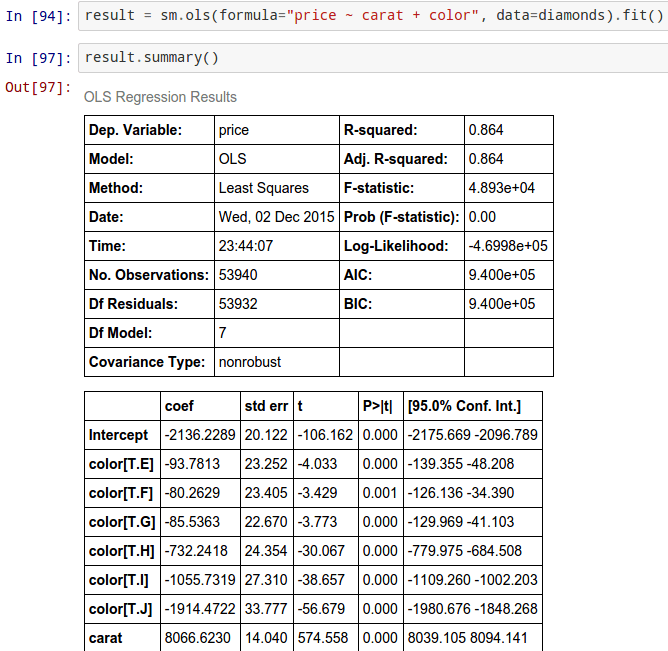
Selection_025
Example 1 – Statsmodels in action on diamonds dataset 
 
A- How well is statsmodels integrated with Pandas, sci-kit learn and other Python Packages?
 
S- Like any scientific computing package in Python, statsmodels relies heavily on numpy and scipy to implement most of the core statistical computations.
Statsmodels integrates well with pandas. I was both an early user and contributor to the pandas project. We have had for years a system for statsmodels such that if a user supplies data structures from pandas to statsmodels, then all relevant information will be preserved and users will get back pandas data structures as results.
Statsmodels also leverages the patsy project to provide a formula framework inspired by that of S and R.
Statsmodels is also used by other projects such as seaborn to provide the number-crunching for the statistical visualizations provided.
As far as scikit-learn, though I am a heavy user of the package, so far statsmodels has not integrated well with it out of the box. We do not implement the scikit-learn API, though I have some proof of concept code that turns the statistical estimators in statsmodels into scikit-learn estimators.
We are certainly open to hearing about use cases that tighter integration would enable, but the packages often have different focuses. Scikit-learn focuses more on things like feature selection and prediction. Statsmodels is more focused on model inference and statistical tests. We are interested in continuing to explore possible integrations with the scikit-learn developers.
A- How effective is Stats Models for creating propensity models, or say logit models for financial industry or others. Which industry do you see using Pythonic statistical modeling the most.
 
S- I have used statsmodels to do propensity score matching and we have some utility code for this, but it hasn’t been a major focus for the project. Much of the driving force for statsmodels has been the research needs of the developers given our time constraints. This is an area we’d be happy to have contributions in.
All of the core, traditional classification algorithms are implemented in statsmodels with proper post-estimation results that you would expect from a statistical package.
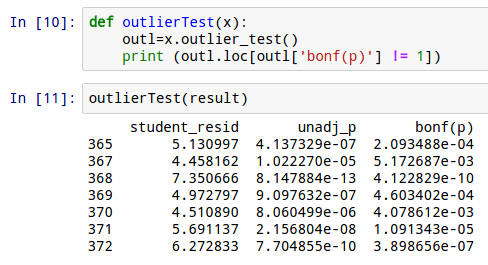
Selection_024
Example 2 – Statsmodels in action on Boston dataset outliers
As far as particular industries, it’s not often clear where the project is being used outside of academics. Most of our core contributors are from academia, as far as I know. I think there is certainly some use of the time-series modeling capabilities in finance, and I know people are using logistic regression for classification and inference. I work as a data scientist, and I see many data scientists using the package in a variety of projects from marketing to churn modeling and forecasting. We’re always interested to hear from people in industry about how they’re using statsmodels or looking for contributions that could make the project work better for their use cases.
About-
Skipper Seabold is a data scientist at Civis Analytics.
Before joining Civis, Skipper was a software engineer and data scientist at DataPad, Inc. He is in the final stages of a PhD in economics from American University in Washington, DC . He is the creator of statsmodels package in Python.

Install wxPython in Ubuntu

wxPython is a GUI toolkit for the Python programming language. It allows Python programmers to create programs with a robust, highly functional graphical user interface, simply and easily. It is implemented as a Python extension module (native code) that wraps the popular wxWidgets cross platform GUI library, which is written in C++.

At a terminal, enter “lsb_release -a” to print what version of Ubuntu you have.

$ lsb_release -a
No LSB modules are available.
Distributor ID: Ubuntu
Description: Ubuntu 12.04.5 LTS
Release: 12.04
Codename: precise

$ lsb_release -sc
precise

Add key
sudo apt-key adv --fetch-keys http://repos.codelite.org/CodeLite.asc

  • Then add the source:

sudo gedit /etc/apt/sources.list

deb http://repos.codelite.org/wx3.0.2/ubuntu/   precise  universe 

sudo apt-get update

  • Now install wxPython

sudo apt-get install python-wxgtk2.8 python-wxtools wx2.8-i18n


sudo apt-get install python-wxgtk2.8 python-wxtools wx2.8-i18n libwxgtk2.8-dev libgtk2.0-dev


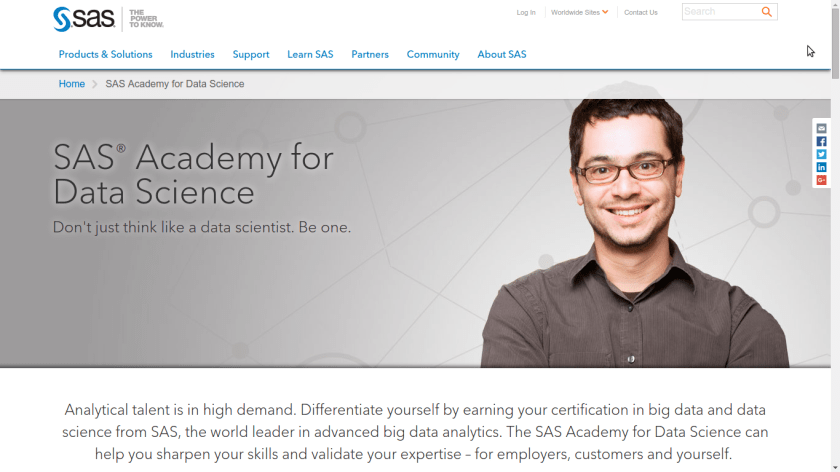
SAS launches Academy for Data Science

http://www.sas.com/en_us/learn/academy-data-science.html

SAS just launched a very nicely stacked set of two courses for its new data science program. It’s a trifle premium priced and as of now dependent only on it’s own SAS platform but the curriculum and the teaching sound very good. SAS has been around for some time, and no one ever had to worry about a job after getting trained in SAS language.

They are two six week instructor-led courses and it seems they are just tweaking details with a soft launch but it is promising for things to come. Perhaps companies like IBM and SAP et al will follow up on this initiative to CREATE more data scientists as well as UPDATE software in data science 😉

Build on your basic programming knowledge by learning to gather and analyze big data in SAS. This intensive six-week, level-one bootcamp focuses on big data management, data quality and visual data exploration for advanced analytics, and prepares you for the big data certification exams.*

Expand your big data certification skill set in our six-week data science bootcamp. This level-two program focuses on analytical modeling, machine learning, model deployment and automation, and critical communication skills. It also prepares you for the data science certification exams.*

Screenshot from 2015-12-17 21:55:29


Code

I read a chapter from How to Win Friends and Influence People as part of my Holiday reading. It is a remarkably well written book and I am trying to summarize a few key early learnings.

  1. Use lucid examples that people can relate to while writing a book.
  2. Base a book based on what works or does not work in real life.
  3. Do not criticize people (Chapter 1)

Since I criticize a lot, that is my new year resolution. To stop changing other people by criticism.

I also started re-reading from one of my favorite authors. Hemigway lived, died and wrote by a code of his own. Some learnings from him

  1. Keep words simple and sentences short
  2. Write a lot
  3. Be passionate
  4. Be honorable

Honor and self respect seems to be the underlying code for Hemingway.

To cap off , I watched this documentary Code I was really horrified how we hackers have been so busy trying to change the world we forgot to address some issues in the hacker culture

  1. We need more ethnic diversity
  2. We need more gender diversity
  3. Diversity brings better creative mix and stable teams

In addition I learnt that balancing funding with creative creation is essential to survival. Well funded creative projects will be better produced than less funded. What is shown more, sells more. (Jo Dikhta hain woh bikta hain)

Well thats all the code. But yes the movie convinced me to try and lift a  finger to help bring more women and African-Hispanic coders in my small way. I hope you try something like that too.

The compromises we make

What if the life you were meant to live never existed except as a figment or your own imagination? What if asking yourself rhetorical questions was the only life you were meant to live. Had I not got a pain in my neck precipitating my getting up and rubbing ointment in it, and writing this post as an exercise in insomniac purging- where would these thoughts go. What if the best ideas that humanity got – individually and in toto were flushed down the toilet everyday because we were too busy compromising for five more minutes of sleep. for five more dollars per hour. for five more years with the unhappy relationship. What if I supposed to write movie scripts that moved millions to laughs and tears instead of writing books a few hundred would read and posts for a few thousand more.

Ever think about the jobs you took for money. You compromised with your own self your own satisfaction and your own conscience. Think about the jobs you took for satisfaction turning down the money. You compromised with your brain, sense of logic the little voice in your head saying  hey dumb arse, stop being so egoistic. The girl you saw at the cafe whom you felt was your divine soul but never said hello to because you were afraid to making a fool of yourself.

The compromises we make are the unhappiness we chose to live with. The comprises are the choices.

What if this was all there was to it.

Interview Domino Data Lab #datascience

Here is an interview with Eduardo Ariño de la Rubia, VP of Product & Data Scientist in Residence at Domino Data Lab Here Eduardo weighs in on issues concerning data science and his experiences.

ed

Ajay (A) How does Domino Data Lab give a data scientist an advantage ?

Eduardo (E) – Domino Data Lab’s enterprise data science platform makes data scientists more productive and helps teams collaborate better. For individual data scientists, Domino is a feature rich platform which helps them manage the analytics environment, provides scalable compute resources to run complex and multiple tasks in parallel, and makes it easy to share and productize analytic models.   For teams, the Domino platform supports substantially better collaboration by making all the work people are doing viewable and reproducible.  Domino provides a central analytics hub where all work is saved and hosted. The result is faster progress for individuals, and better results from teams.


A- What languages and platforms do your currently support?

 E- Domino is an open platform that runs on Mac, Windows, or Linux.   We’ll run any code that can be run on a Linux system. We have first class support for R, Python, Matlab, SaS, and Julia.
A-  How does Domino compare to Python Anywhere , Google Cloud Data Lab (https://cloud.google.com/datalab/) or other hosted Python solutions?
 E- Domino was designed from the ground up to be an enterprise collaboration and data science platform.  It’s a full featured platform in use at some of the largest research organizations in the world today.
  .
A- What is your experience of Python versus other languages in the field of data science
E- That’s the opening salvo of a religious war, and though I should know better than to involve myself, I will try to navigate it. First and foremost, I think it’s important to note that the two “most common” open source languages used by data scientists today, Python and R, have fundamentally hit feature parity in their maturity. While it’s true that for some particular algorithm, for some poorly trod use-case, one language and environment may have an edge over the other, I believe that for the average data scientist, language comes down to choice.
That being said, my personal experience is slightly more nuanced. My background is primarily computer science and as such, having spent many years about programming first and data analysis second, this has formed the way I approach a problem. I find that if I am doing the “exploratory analysis” or “feature engineering” phase of a data science project, and I am using a language which has roots in “typical programming”, often times this will make me approach the solution of the problem less like a data scientist, and more like a programmer. When I should be thinking in terms of set or vectorized operations, when I should be thinking about whether I’m violating some constraint, instead I’m building a data structure to make an operation O(n log n) so that I can use a for loop when I shouldn’t.
This isn’t an indictment of any language, not is it a statement that there’s a fundamental benefit to thinking one way or another about a problem. It is however a testament to the fact that often when challenged, people will fall back to their most familiar skill set, and begin to treat every problem as a nail to be hammered. If I had come to Python *as* a data scientist first, it is possible this nuance wouldn’t have ever surfaced, however I learned Python before pandas, scikit-learn, and the DS revolution. So those neurons are quite trained up. However, I learned R purely as an endeavor in data science, and as such I don’t find myself falling back on “programmer’s habits” when I hit a wall in R, I take a step back and usually find a way to work around it within the idiomatic approaches.
To summarize, my experience is that language wars accomplish very little, and that most of the modern data science languages are up to the task. Just beware of the mental baggage that you bring with you on the journey.
 .
A- What do you feel about polyglots ( multiple languages ) in data science  (like R, Python, Julia) and software like Beaker and Jupyter that enable multiple languages?
E- Data science is a polyglot endeavor. At the very least, you usually have some data manipulation language (such as SQL) and some language for your analysis (R or Python.) Often times you have many more languages, for the data engineering pipeline I often reach for perl (it’s still an amazing language for the transformation of text data), sometimes I have a bit of code that must run very quickly, and I reach for C or C++, etc… I think that multiple languages are a reality. Domino supports, out of the box, fundamentally every language that will run on Linux. If your feature pipeline involves some sed/awk, we understand. If you need a bit of Rcpp, we’re right there with you. If you want to output some amazing d3.js visualizations to summarize the data, we’re happy to provide the framework for you to host it on. Real world data is messy, and being a polyglot is a natural adaptation to that reality.
 .
About-
Eduardo Ariño de la Rubia is VP of Product & Data Scientist in Residence at Domino Data Lab
Domino makes data scientists more productive and facilitates collaborative, reproducible, reusable analysis. The platform runs on Premise or in the Cloud. Its customers come from a wide range of industries, including government, insurance, advanced manufacturing, and pharmaceuticals. It is backed by Zetta Venture Partners, Bloomberg Beta, and In-Q-Tel.
domino-data-lab-logo
You can have a look at their very interesting data science platform at Domino Data Lab
Related-

Interview ScrapingHub #python #webcrawling

Here is an interview with the team behind ScrapingHub.com Scrapinghub is created by the same team as that created Scrapy, a python based open source framework for extracting  data   from websites.

scph


 Ajay (A) Describe your journey with Python and Scraping Web Pages.

Shane Evans (Director and Co-founder): I started commercial python development around 15 years ago and loved it from the start. My first significant experience web scraping with python was in 2007, when I was building a vertical search engine. Initially, my team started writing python scripts, but that got problematic very quickly. I wrote a framework to make the job easier, promoting best practises for scraping and avoiding common mistakes. That framework went on to be released as Scrapy. About a year later, in an attempt to improve the efficiency of our Spider development, I lead the development of a visual scraping tool, which we called autoscraping. That tool was the basis of Portia, Scrapinghub’s visual scraping tool.

In addition to python scraping frameworks, I have written many crawlers for specific websites and a lot of web crawling infrastructure, including much of our scrapy cloud product,  nearly entirely in python.

A- How does Scrapy compare with Beautifulsoup. What are the other technologies that you have used for Web scraping?

Denis de Bernardy (Head of Marketing): Scrapy is a web scraping framework; Beautifulsoup is an HTML parser. That is, Scrapy takes care of details such as request throttling, concurrency, retrying urls that fail, caching locally for development, detecting correct page encoding, etc. It also offers a shell utility that comes in handy when you need to step through a crawl to debug what’s going on.You won’t necessarily run into all of these issues in your first project if you try using Requests and BeautifulSoup. But you will run into them eventually. Scrapy takes care of this all for you so you can focus on extraction logic instead.

In some sense, Greenspun’s tenth rule comes to mind: “Any sufficiently complicated C or Fortran program contains an ad hoc, informally-specified, bug-ridden, slow implementation of half of Common Lisp.” The same could be said about a lot of web scraping projects and how they relate to Scrapy.

Other technologies are very diverse. To name only a few

  • Frontera. It allows multiple spiders to share the same crawl frontier – that is, the list of URLs that are slated to get crawled next. We’ve two experimental variations of it to boot. One that dispatches huge crawls across multiple servers, and another that enables you to prioritize crawls and re-crawls so you can go straight for the jugular when you’re looking for something specific – e.g. infosec-related data when you’re monitoring security exploits.
  • Splash. There’s no shortage of websites that require javascript for a reason or another. For instance because they’re single-page applications or because countermeasures are in place to ensure that bots are not, well, crawling your website – it’s a cat and mouse type of game, really. Splash is a headless browser that supports JavaScript to work around all of these. It also allows to take screenshots as you crawl.
  • Crawlera. It’s our smart proxy provider. It works around bot countermeasures by spreading requests across a large pool of IPs. What more, it throttles requests through IPs so they don’t get used too often, to avoid that they get blacklisted, and which IPs are actually banned so you don’t bother trying them to begin with. Crawlera is what allows us and our customers to crawl complex sites with robust bot countermeasures in place.
  • Portia: It’s a visual scraping tool based on Scrapy. It is an open source project that allows users to build web spiders without needing to know any Python or coding at all. The users only need to visually annotate the elements that they want to extract from a web page and then Portia generates the spider code and delivers a working spider ready to be deployed.

A- How does Python compare say with R ( or RCurl et al) for scraping websites?

Valdir Stumm (Developer Evangelist): If you are just scraping some simple web pages, they are not that different, as both work with networking (R: rCurl, Python: Requests, urllib) and with HTML/XML processing libraries (R: rVest, Python: BeautifulSoup, lxml).

However, while simple web scraping might be easy with R, web crawling might be not. Tools like rCurl are useful to retrieve some web pages. If you need to crawl a large collection of URLs (which may be unknown when starting), it may turn out difficult to do it in a timely manner.

Python, in contrast, has a vast ecosystem with libraries and frameworks to do high performance asynchronous networking and multiprocessing. And, of course, there are frameworks like Scrapy that take care of most of the dirty work like scheduling URLs, handling networking responses, character sets, etc.

A- What are some of the drawbacks of using Python?

Shane Evans: Scrapy takes care of a lot of the lower level async programming, which is required to get good performance. This code is awkward to write, hard to understand, and a nightmare to debug (say compared to how nicely you can do it in erlang).

Performance is an often mentioned drawback, and by that people usually mean raw compute power compared to, say, Java. However, in practise this is less of a problem for common scraping tasks due to the reliance on libraries written in C. See my Quora answer about fast open source scrapers.

A- How is web scraping useful as a data input source even for traditional companies like banks, telecom, etc.?

Denis de Bernardy: Scraped data gets used in all sorts of useful ways. To name a few:

  • A slew of companies use data to monitor product information. Think price comparison apps for consumers, spotting price changes by your competitors so you can adjust your own prices faster, monitoring that your resellers are not offering your product for a lower price than agreed, sentiment analysis across end-user forums, and so forth.
  • HR departments and companies are more interested in profiles. There’s a wealth of information you can collect across the web that can help you decide if a candidate will be a good fit for the job you’re offering or not. Or which candidates you should be head hunting to begin with.
  • Legal departments and companies use data to gather documents for discovery or due diligence purposes. Think staying up to date with legal developments in your industry or mining laws and jurisprudence that may relate to your legal case.
  • Yet another good example is marketing companies. There’s a slew of startups out there that are trying to automate lead generation and outbound sales. Data helps them pinpoint the right people in the right companies while providing context and sometimes contact details to boot.
  • A last set worth mentioning is governments. National statistics offices, for instance, are seeking to automate computing consumer price indexes. And law enforcement agencies are scraping the dark web to locate and monitor criminals. To great effect, we dare add: not a month goes by without busting a human trafficking ring in the US, and we’re very proud to be providing some of the tools that enables this.

A-  With the rise of social media and consumer generated content, does web scraping offer a privacy dilemma? What are some of the ways we can ensure content is free and fairly open for both developers as well as people?

Denis de Bernardy: An important point to highlight here is that we normally stick to scraping publicly available information.

There are a few exceptions. For instance if a lawyer needs to log in to download detailed legal data information on a poorly designed government site. This is something they or a clerk would normally do manually each day. We just make it simpler. But they’re the exception.

The reasons are practical: if you excessively scrape something that requires you to be logged in or to use an API key, you get detected and shut down rather quickly. The reasons are also legal: if you’re logged in, you’ve de facto accepted terms of services – and they likely disallow automated crawls to begin with.

Another important point is that we honor robots.txt files as a rule of thumb. In practical terms this means that if Google can crawl it, so can we. The difference between what Google does and what we do is, well, we structure the data. Rather than searching across unstructured web pages for a piece of information, you search across profile names, bios, birthdays, etc.

With this out of the way, does web scraping offer a privacy dilemma? Kind of. But is it specific to web scraping to begin with? Web scraping helps you automate collecting this information. You could hire an army of workers on Amazon Turk and achieve the same result. Would you? No. But the fact is, this information is all online. No one would be collecting it if it was not.

Adding to this, the privacy issue raised is not new to web scraping. Or the internet. Or even the past century. Jeremy Bentham was describing the idea of Panopticons in the late 18th century. Michel Foucault was re-popularizing the term in the late 1970s – at least in France. Jacques Attali was worrying about a coming period of hyper-surveillance in a 2006 best-seller. The list could go on. Modern society has a heavy trend towards transparency. Your health insurance company, like it or not, would like to see the data in your wearables. It’s just a matter of time before someone popularizes the idea of publishing that data. And yes, it’ll get picked up – indeed, scraped – on the spot when that happens.

While we’re on the topic, note the data play as an aside. There are only so many ways you can lay out a user’s profile on a web page. With enough examples, you can train an AI to scrape them automatically on any site. Rinse and repeat for company profiles, comments, news articles, and what have you. Then connect the dots: if you leave your blog’s url around when you leave comments online, it will get tied back to you. Automate that too and – yes – online privacy basically flies out the window.

In the end, if it’s publicly available online it’s not exactly private…

On that note, Eric Schmidt’s controversial comment from 2009 might make a lot more sense than meets the eye. It was: “If you have something that you don’t want anyone to know, maybe you shouldn’t be doing it in the first place.” Perhaps you won’t broadcast it on the internet yourself; but someone else might. It may give you shivers, but it might hold true.
The main issue that got raised back then, from my standpoint at least, revolved around how to deal with false or dubious information and claims. We’ve privacy laws and consumer protection laws for those – or at least we do in the European Union. And recent developments on enforcing a right to be forgotten. Those types of laws and developments, if anything, are the proper ways to deal with privacy issues in my opinion. But they also introduce heaps of not-so-simple territoriality problems. For instance, should a random court in Iran be able to ask a US-based company to take a web page offline on privacy grounds? It’s thorny.

About-

Scrapinghub was created by the team behind the Scrapy Web Crawling framework. It provides web crawling and data processing solutions.  Some of it’s products are

  • Scrapy Cloud is a bit like Heroku for web scraping.
  • Portia , a visual crawler editor, lets you create and run crawlers without touching a line of code.
  • Frontera is a Crawl Frontier framework.
  • Crawlera a smart proxy rotator rotates IPs to deal with IP bans and proxy management
  • Splash is a headless browser that executes JavaScript for people crawling websites

Users of this platform  crawl over 2 billion web pages per month.