Orbot- going Anonymous on your mobile internet

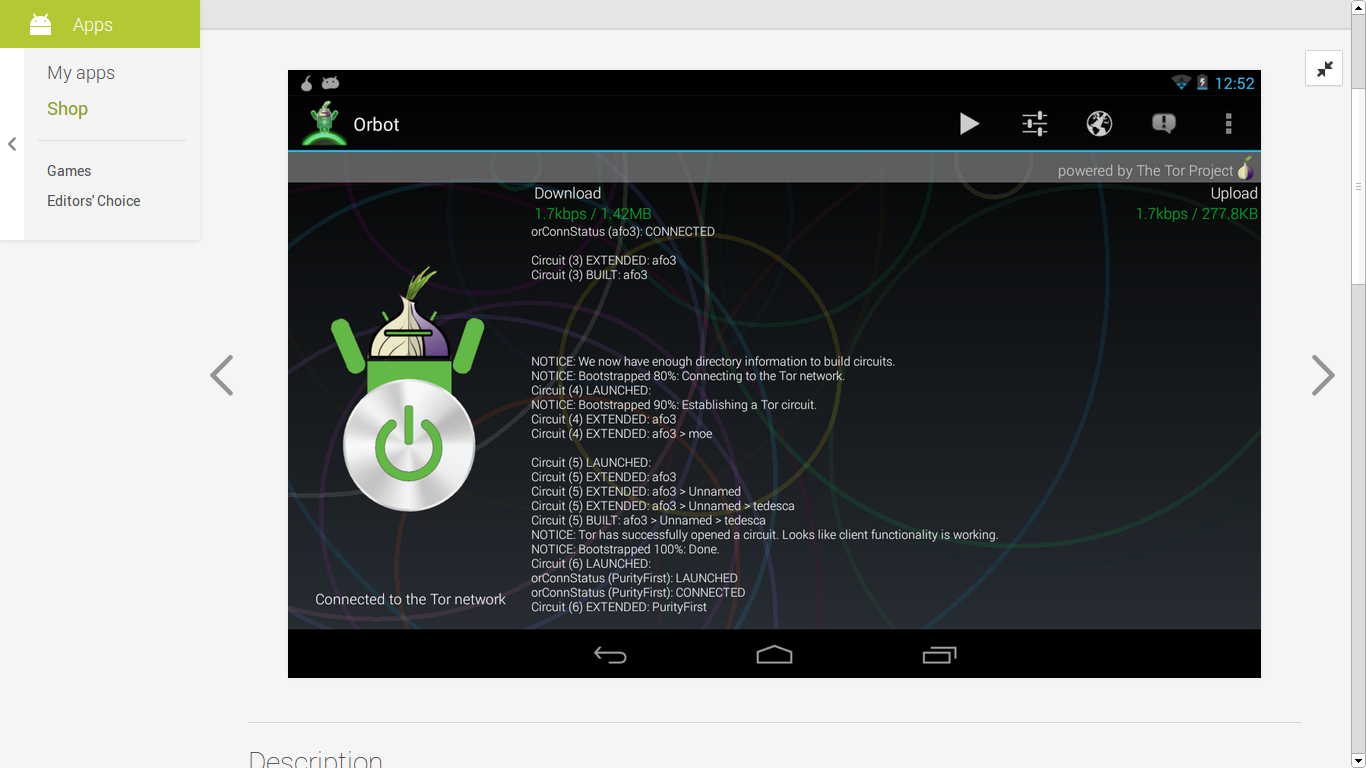
I really liked the professional design and interface behind Orbot- it is basically Tor for your Android. Add some rooting- and add some crowd sharing love to donate idle bandwidth in your data plan ( or limitation features for usage per period within a certain connection)- and the Tor network can grow even faster.

Also add some pseudo-random interval based auto-switching mechanism rather than wait for user to do it on his own

Screenshot from 2013-10-29 20:58:31

https://play.google.com/store/apps/details?id=org.torproject.android

Description

Orbot is a free proxy app that empowers other apps to use the internet more securely. Orbot uses Tor to encrypt your Internet traffic and then hides it by bouncing through a series of computers around the world. Tor is free software and an open network that helps you defend against a form of network surveillance that threatens personal freedom and privacy, confidential business activities and relationships, and state security known as traffic analysis.Orbot is the only app that creates a truly private internet connection. As the New York Times writes, “when a communication arrives from Tor, you can never know where or whom it’s from.” Tor won the 2012 Electronic Frontier Foundation (EFF) Pioneer Award.

Data Privacy and OECD

I really liked revisiting these privacy principles at http://oecdprivacy.org/

I wonder if the internet uses them??

The OECD Privacy Principles are part of the OECD Guidelines on the Protection of Privacy and Transborder Flows of Personal Data, which was developed in the late 1970s and adopted in 1980.

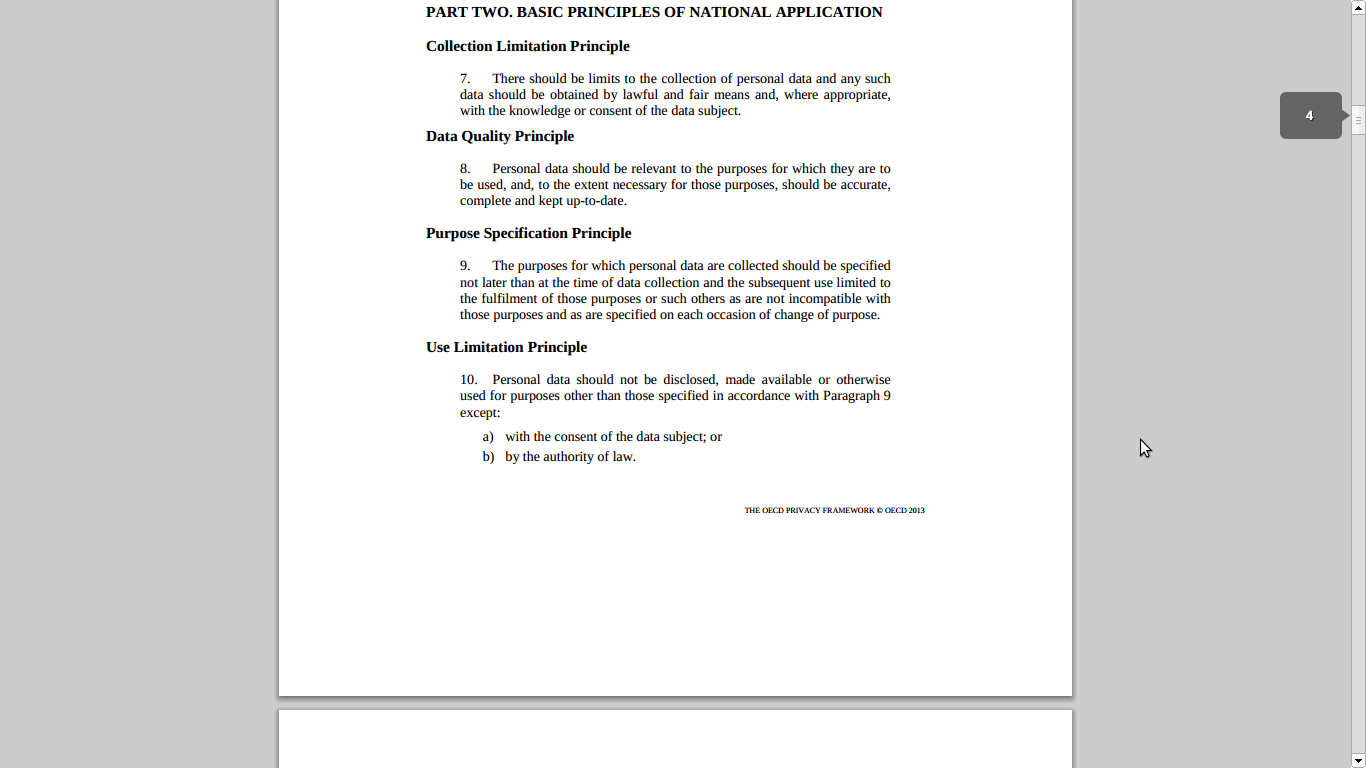
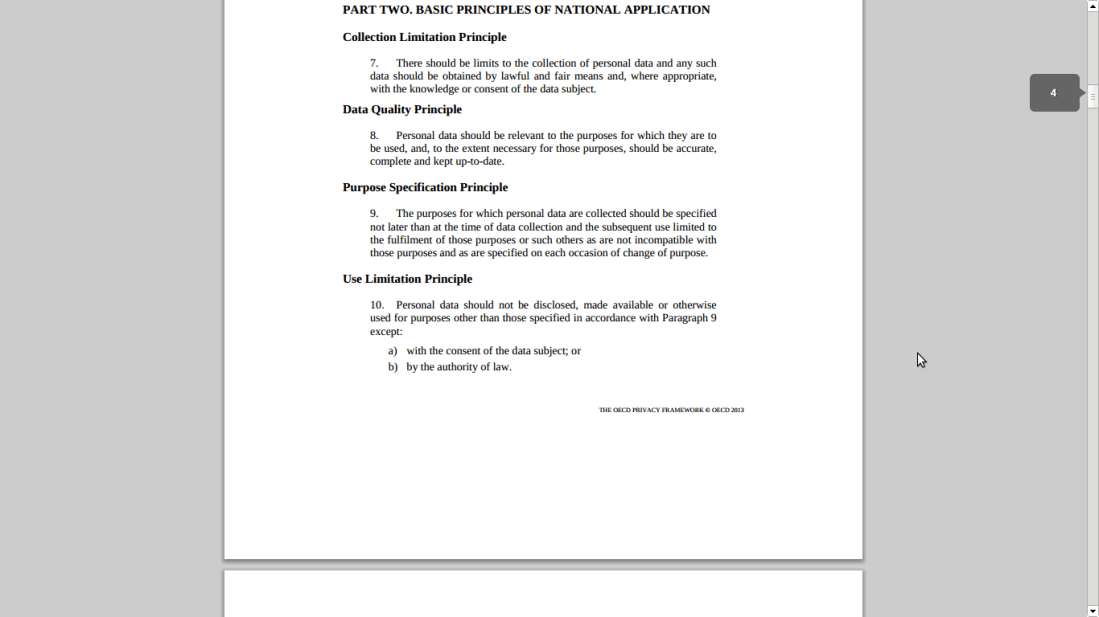
1. Collection Limitation Principle

There should be limits to the collection of personal data and any such data should be obtained by lawful and fair means and, where appropriate, with the knowledge or consent of the data subject.

2. Data Quality Principle

Personal data should be relevant to the purposes for which they are to be used, and, to the extent necessary for those purposes, should be accurate, complete and kept up-to-date.

3. Purpose Specification Principle

The purposes for which personal data are collected should be specified not later than at the time of data collection and the subsequent use limited to the fulfilment of those purposes or such others as are not incompatible with those purposes and as are specified on each occasion of change of purpose.

4. Use Limitation Principle

Personal data should not be disclosed, made available or otherwise used for purposes other than those specified in accordance with Paragraph 9 except:

a) with the consent of the data subject; or

b) by the authority of law.

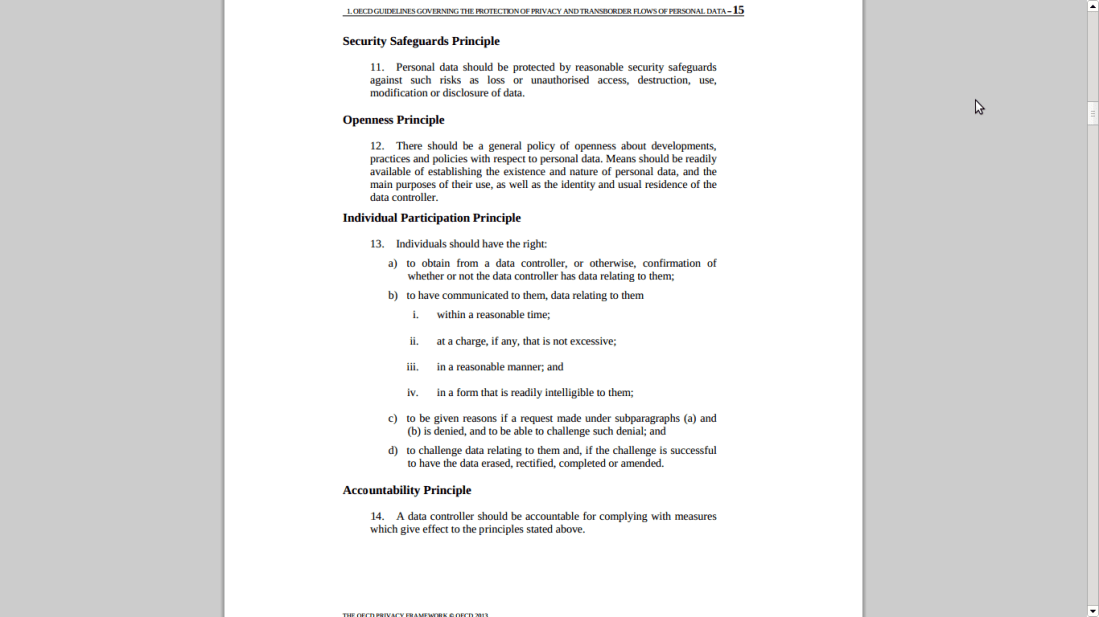
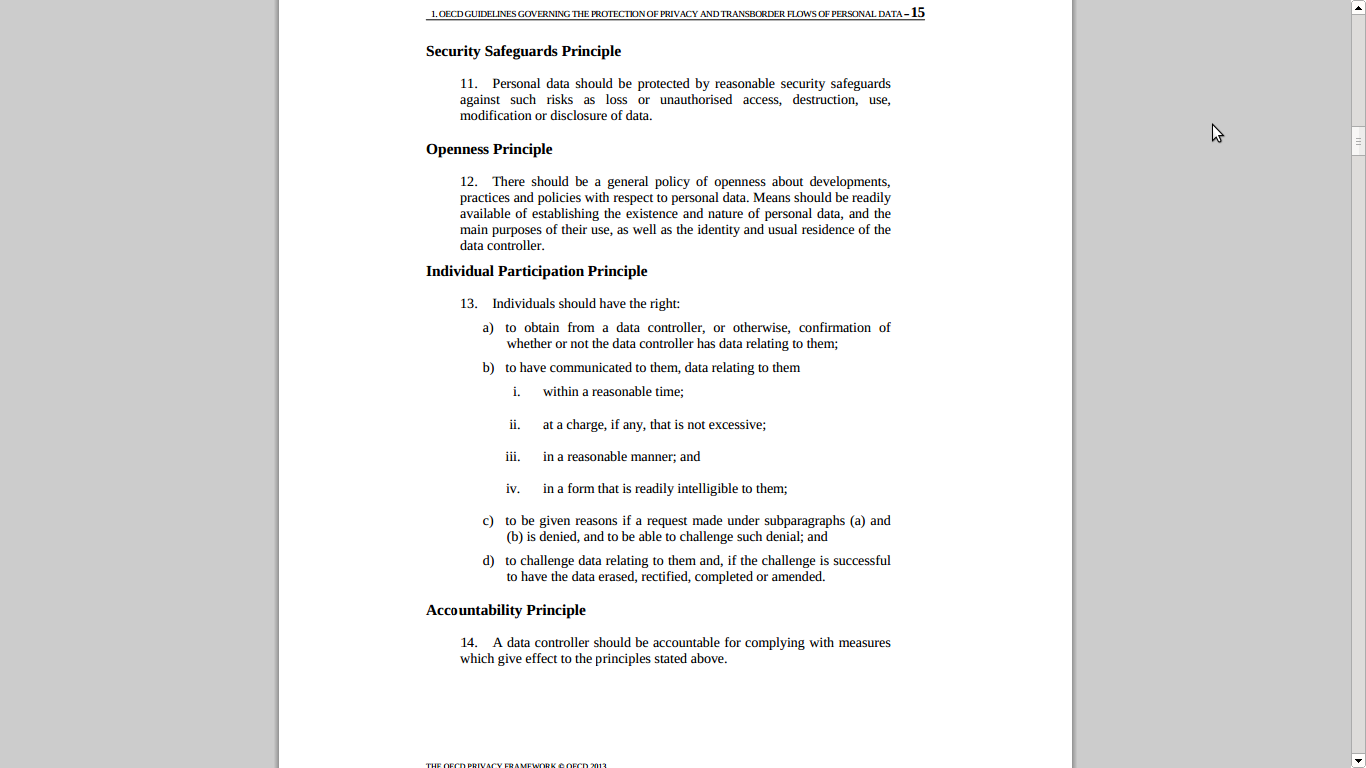
5. Security Safeguards Principle

Personal data should be protected by reasonable security safeguards against such risks as loss or unauthorised access, destruction, use, modification or disclosure of data.

6. Openness Principle

There should be a general policy of openness about developments, practices and policies with respect to personal data. Means should be readily available of establishing the existence and nature of personal data, and the main purposes of their use, as well as the identity and usual residence of the data controller.

7. Individual Participation Principle

An individual should have the right:

a) to obtain from a data controller, or otherwise, confirmation of whether or not the data controller has data relating to him;

b) to have communicated to him, data relating to him

i) within a reasonable time;
ii) at a charge, if any, that is not excessive;
iii) in a reasonable manner; and
iv) in a form that is readily intelligible to him;

c) to be given reasons if a request made under subparagraphs (a) and (b) is denied, and to be able to challenge such denial; and

d) to challenge data relating to him and, if the challenge is successful to have the data erased, rectified, completed or amended.

8. Accountability Principle

A data controller should be accountable for complying with measures which give effect to the principles stated above.

News

Other Privacy Frameworks

APEC Privacy Framework

The Asia-Pacific Economic Cooperation (APEC) Privacy Framework overlaps with other frameworks; however, it concentrates on actual or potential harm as a result of disclosing information, rather than individuals’ rights pertaining to their information

The Internet Economy on the Rise:
Progress since the Seoul Declaration

Published in September 2013, this book reviews progress made since the 2008 OECD Seoul Declaration for the Future of the Internet Economy and identifies areas for future work.
Overall, the review shows that the Internet economy has become a new source of growth, with the potential to boost the whole economy, to foster innovation, competitiveness and user participation, and to contribute effectively to the prosperity of society as a whole.

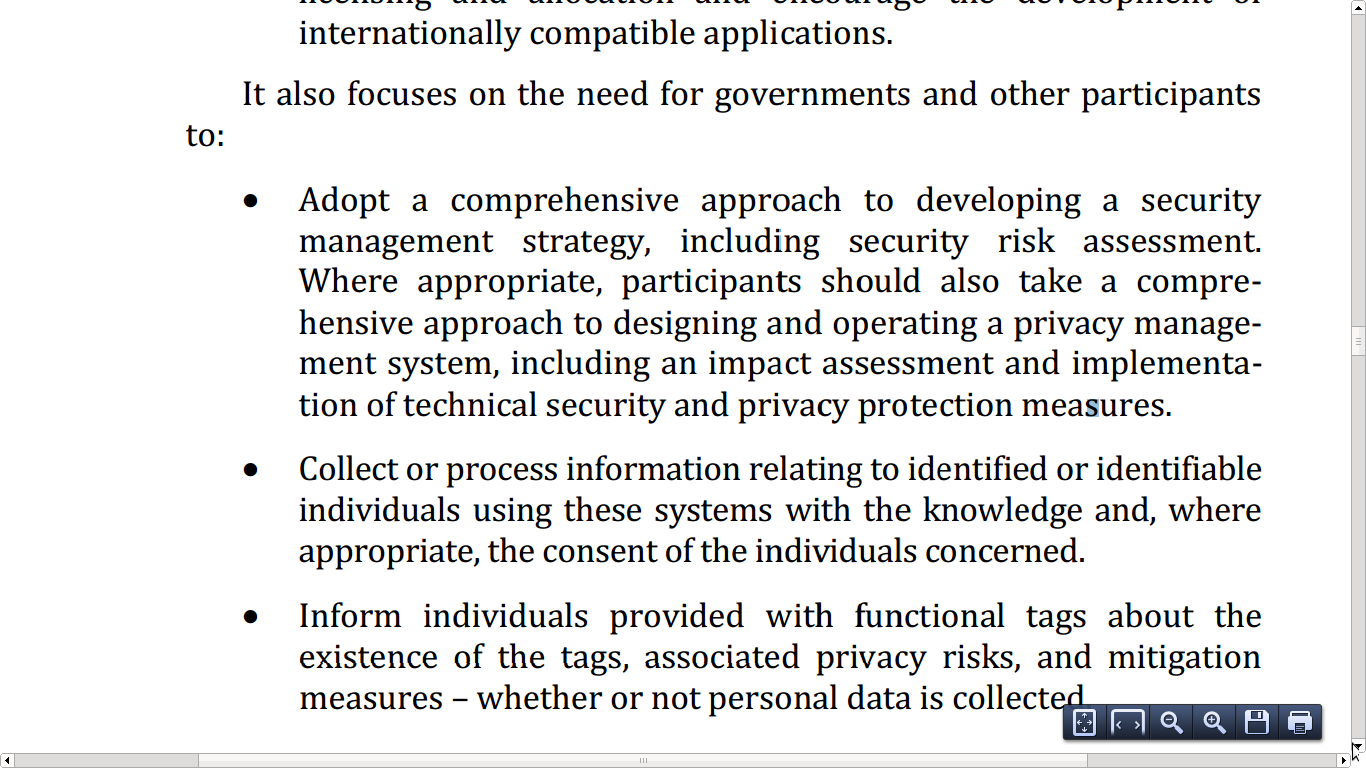
The OECD Policy Guidance for Protecting and Empowering Consumers in Communication Services (Annex B) addresses some of the key issues currently facing consumers in this market.
The guidance advocates:

 Informing consumers about potential security and privacy risks  in using communication services and available measures to limit these risks.

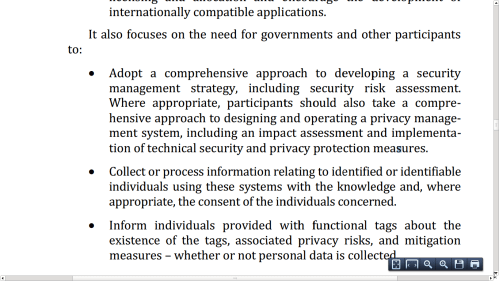
The OECD Policy Guidance on Radio Frequency Identification (Annex C) encourages research on the economic and social impacts of such technologies  The guidance points out the need to prevent and mitigate security risks and to address privacy concerns arising when information relating to an identified or identifiable individual is collected or processed. Screenshot from 2013-10-27 03:59:24
 

AJAY- So the guidelines are there. But who all are following them and who aren’t?

Revised Principles-

http://www.oecd.org/sti/ieconomy/2013-oecd-privacy-guidelines.pdf
Screenshot from 2013-10-27 04:06:56Screenshot from 2013-10-27 04:06:38


rPython – R Interface to Python

a nice package rPython. http://cran.r-project.org/web/packages/rPython/index.html This package permits calls to Python from R
Not to be confused with Restricted Python (RPython at http://doc.pypy.org/en/latest/coding-guide.html#id1)

statcompute's avatarYet Another Blog in Statistical Computing

View original post

Game Review : Google Ingress

  1. Android Only Game
  2. Uses GIS or Google Maps API/ for geo-caching game
  3. Healthy for you- makes players walk from portals to another. You have to be within 40 m of a portal to recharge,capture of attack it.  Makes you really walk a lot.
  4. Addictive and Immersive with impressive follow up media story.
  5. Can be used as base template for other games , and social experimentation
  6. Uses Points, Badges, Leaderboard of gamification
  7. Encourages direct face to face social interaction
  8. Has in game chat facility
  9. Zero in game currency . So no coiners or cheaters here

http://media.tumblr.com/tumblr_meuh4lKkH61rax78x.png

Things I wish I could Classify — by better and easier Machine Learning

  1. Web Analytics- Which customers are likely to convert and didnt. Which customers are not likely to stay and do. More analytics added to Google Analytics like Web Analytics
  2. Web Analytics Time Series models- web analytics is TS data. More forecasts. Automated Error detection and correction in forecasts
  3. Data Cleaning and Quality- Something like Google Refine (or open refine https://github.com/OpenRefine ) added before every Machine Learning Classification system I see. or software I see.
  4. More API integration- for data from the web, to classification models to the web
  5. Financial Data – Better interfaces and easier analytics. Every Financial Data is basically adding to a classification – Buy Sell Hold.
  6. Sentimental Analysis for the People- Easier to integrate Blog Data (though GA api) and Social Media Data (twitter , google plus, facebook APIs) to give user analytics of his own reputation across multiple social networks.
  7. Dating Website Recommendation Systems

These are a few of my favorite things…that I wish I could classify

And some military spying alogirthms that I wish they de classify because everyone has them- so they can show better ads, or build better internet connected night vision Glasses

classified

Plyrmr- bringing #rstats Plyr to Map Reduce for Hadoop

Just saw this package, it is in testing early release now- Love the thought of Hadley’s Split Apply Combine Package being used for Map Reduce which is conceptually similar in many many ways. I do think though Revolution’s work in R and D needs to be applauded- given by the number of packages they have created- or funded  AND donated( seperate blog post on this?) while RStudio seems more content on building basic blocks for infrastructure , without an adequate Big Data solution for R Studio itself.

Of course usage stats on RevoScaleR , Revolution’s Big Data package are not as transparent or in line with Free as Beer and Free as Speech philosophy that RStudio breathes in.

https://github.com/RevolutionAnalytics/RHadoop/wiki/plyrmr

This R package enables the R user to perform common data manipulation operations, as found in popular packages such as plyr and reshape2, on very large data sets stored on Hadoop. Like rmr, it relies on Hadoop mapreduce to perform its tasks, but it provides a familiar plyr-like interface while hiding many of the mapreduce details. plyrmr provides:

  • Hadoop-capable versions of well known data.frame functions: transform, subset, mutate, summarize, melt, dcast and more from packages base, plyr and reshape2.
  • Simple but powerful ways of applying any function operating on data.frames to Hadoop data sets: do and magic.wand.
  • Simple but powerful ways of aggregating data: group, group.f, gather and ungroup.
  • All of the above can be combined by normal functional composition: delayed evaluation helps mitigating any performance penalty of doing so by minimizing the number of Hadoop jobs launched to evaluate an expression.
  • New data frame functions which are also Hadoop-capable that are more suitable for development than some of the above: select and where.