A Tutorial at Statisticviews.com

I just wrote a tutorial on SAS language here at Statisticviews.com

SAS was the first statistical language I learnt, followed by R, Python, Julia..

Of course the first language I learnt was in school BASIC

Here is a tutorial on SAS language again for learners, it uses the SAS University Edition

http://www.statisticsviews.com/details/feature/9692841/A-Tutorial-on-SAS-language.html

SAS (pronounced “sass”) once stood for “statistical analysis system” but now is known simply as SAS. It is a computer language for statistical computing. Much before the term data science, business analytics and business intelligence was coined, SAS was created at North Carolina State University to do the important and useful task of turning raw data into analysis using code and statistics.

SAS System is a suite of products that SAS Institute has been selling since 1976.

Jim Goodnight has been the CEO and vision behind the growth of SAS language since almost 40 years now. John Sall has made additional contributions to statistics by creating JMP (interviewed here at StatisticsViews )

SAS Institute has consistently ranked as one of the best employers within USA. However recently R and Python languages have challenged traditional share of SAS language in statistical computing, while SPSS has been acquired by IBM.

Tutorial Overview

This tutorial is here to help a reader with learning the simple  SAS language, and perhaps to inspire other languages to be both simple and responsive to a wide diversity of users from beginners to advanced, from academics to enterprises of various sizes and in geographies. The tutorial is based on SAS Studio interface given for free in the SAS University Edition.

Read more at

http://www.statisticsviews.com/details/feature/9692841/A-Tutorial-on-SAS-language.html

additional

Python Tutorial at

http://www.statisticsviews.com/details/feature/8868901/A-Tutorial-on-Python.html
Crime Forecasting Challenge : Data Science Contest

The Real-Time Crime Forecasting Challenge seeks to harness the advances in data science to address the challenges of crime and justice. It encourages data scientists across all scientific disciplines to foster innovation in forecasting methods. The goal is to develop algorithms that advance place-based crime forecasting through the use of data from one police jurisdiction.

aims to:

  1. Encourage “nontraditional” crime forecasting researchers to compete against more “traditional” crime forecasting researchers.
  2. Compare available crime forecasting methods.
  3. Improve place-based crime forecasting.

Accordingly, the Challenge will have three categories of contestants: students; individuals/small businesses; and large businesses

This Challenge will be based on the locations listed in calls-for-service (CFS) records provided by the Portland Police Bureau (PPB) for the period of March 1, 2012 through February 28, 2017

find:

  1. Overview
  2. How to Enter
  3. Important Dates
  4. Judges
  5. Judging Criteria
  6. Prizes
  7. Other Rules and Conditions
  8. Prize Disbursement and Challenge Winners
  9. Contact Information
  10. Data for Download


Source

http://nij.gov/funding/Pages/fy16-crime-forecasting-challenge.aspx?utm_source=KDNuggets&utm_medium=Ad&utm_content=Digital&utm_campaign=ForecastingChallenge


How do I shift to a data science career

I get this question a  lot – How do I shift to a data science career. I have been doing data analysis since 2004 (in SAS) when we used to call it business analytics , and since 2007 in R, Since 2014 in Python,  by when we re branded business analytics as data science. So here are a few basics to people trying to SHIFT to data science.

My answer is learn coding, learn math, and most importantly know when to use what for insights. Data scientists are as good as the insights they create or miss not the code they write.

See this first

A slideshare I put forward last year for Summer School

Do this self examination-

  1. What are you good at – programming , stats, or business
  2. What are you bad at- programming , stats or business
  3. What can you learn and at what proficiency

Learning Programming

Learning R, SAS, Python is easy but there is a confusing clutter of resources out there on the internet.

SAS Language -should be learnt from SAS University Edition and for the SAS Certification Exam.

Dont wanna be SAS Certified (its just 100$ psst)

Here is some free SAS Training by Decisionstats

There is no certification in R or Python, though Hadoop has it just like SAS has it.

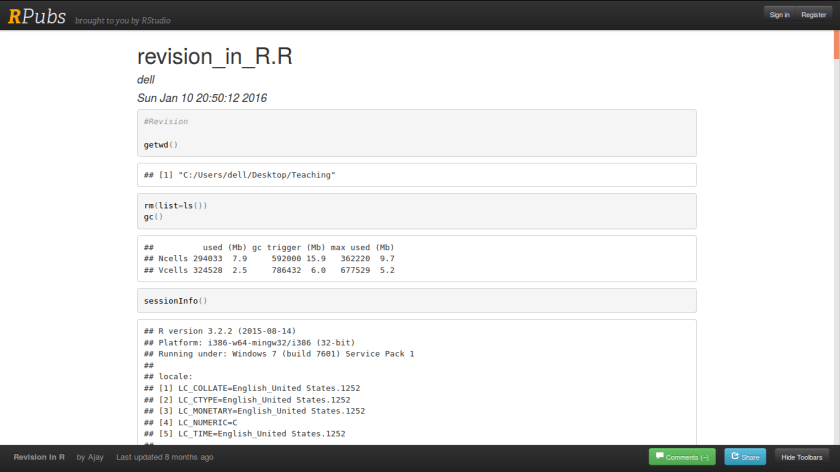
For R- learn R and RStudio till you can master some of the code here

http://rpubs.com/ajaydecis

Screenshot from 2016-08-23 10-48-29

or see all the R packages here at CRAN VIEWS https://cran.r-project.org/web/views/

For Python-

A shorter tutorial on Python by the author is here

http://www.statisticsviews.com/details/feature/8868901/A-Tutorial-on-Python.html
Learn PANDAS and SCIKIT-LEARN  example https://github.com/ipython/ipython/wiki/A-gallery-of-interesting-IPython-Notebooks


Learning Statistics and Techniques


Data Mining in R

http://rattle.togaware.com/rattle-examples.html

Where to learn machine learning

http://scikit-learn.org/stable/tutorial/basic/tutorial.html

Learning Business

This comes with experiences and domain research and study.


I hope this helps. I will follow with specific answers to specific career questions in data science soon.


Analytics as a career

At Business Analytics Summit hosted by WeekendR,

I presented at the Delhi School of Economics Economics Department placement workshop a small presentation on careers in analytics

I basically talked of my 12 years of adventures in consulting, writing and teaching around data science and analytics


13914172_1363844703645649_4806824798457040891_o


Some thoughts on the Revolution Sellout

The revolution will not be televised, brother –Gil Scott-Heron


Veteran R Community members must recall R founder’s Ross Ihaka ‘s warning against Revolution Analytics not being truly open source,

and the sale to Microsoft will be keeping Revolution R open source in the time being ,

it did proved Ross Ihaka was right.

How do you help create an open source revolution in statistics by selling a company to Microsoft beats me.

And how do you just take 6000 packages for free from open source community, add 6-9 packages of your own and then repackage the bundle as a new innovation?

Even though Revolution analytics created 3 CEO JOBs,including SPSS founder Norman Nie, and 1 name change  (from computing to analytics) and  1 mass firing ( with a 50% layoff they wont be winning the best employer award),  in the end what drives software is lots of sales and not lots of blogs

(quoting Larry Ellison‘s purchase of Sun ).

In addition

love for computing and not hypocrisy on love for money should drive science.

A potato is a potato.

In Australia or Seattle or San Fransisco