Fearsome Engines, Part 1

richierocks's avatar4D Pie Charts

Back in June I discovered pqR, Radford Neal’s fork of R designed to improve performance. Then in July, I heard about Tibco’s TERR, a C++ rewrite of the R engine suitable for the enterprise. At this point it dawned on me that R might end up like SQL, with many different implementations of a common language suitable for different purposes.

As it turned out, the future is nearer than I thought. As well as pqR and TERR, there are four other projects: Renjin, a Java-based rewrite that makes it easy to integrate with Java software and has some performance benefits; fastR, another Java-based engine focused on performance; Riposte, a C++ rewrite that also focuses on performance; and CXXR, a set of C++ modifications to GNU R that focus on maintainability and extensibility.

I think that having a choice of R engine is a good thing. The development model of…

View original post 910 more words

Broken Ubuntu Fix libnautilus-extension1a

I kept getting this error-

The package libnautilus-extension1a needs to be reinstalled, but I can’t find an archive for it.

This prevented my Ubuntu 12 from installing anything new

This was the final solution-

$ sudo gedit /var/lib/dpkg/status (you can use vi or nano instead of gedit)

Locate the corrupt package, and remove the whole block of information about it and save the file.

In my case the package libnautilus-extension1a was corrupted so I removed all info about it, and voila now the reinstall is working

Hat tip-

http://askubuntu.com/questions/146150/unable-to-fix-broken-packages-with-sudo-apt-get-install-f


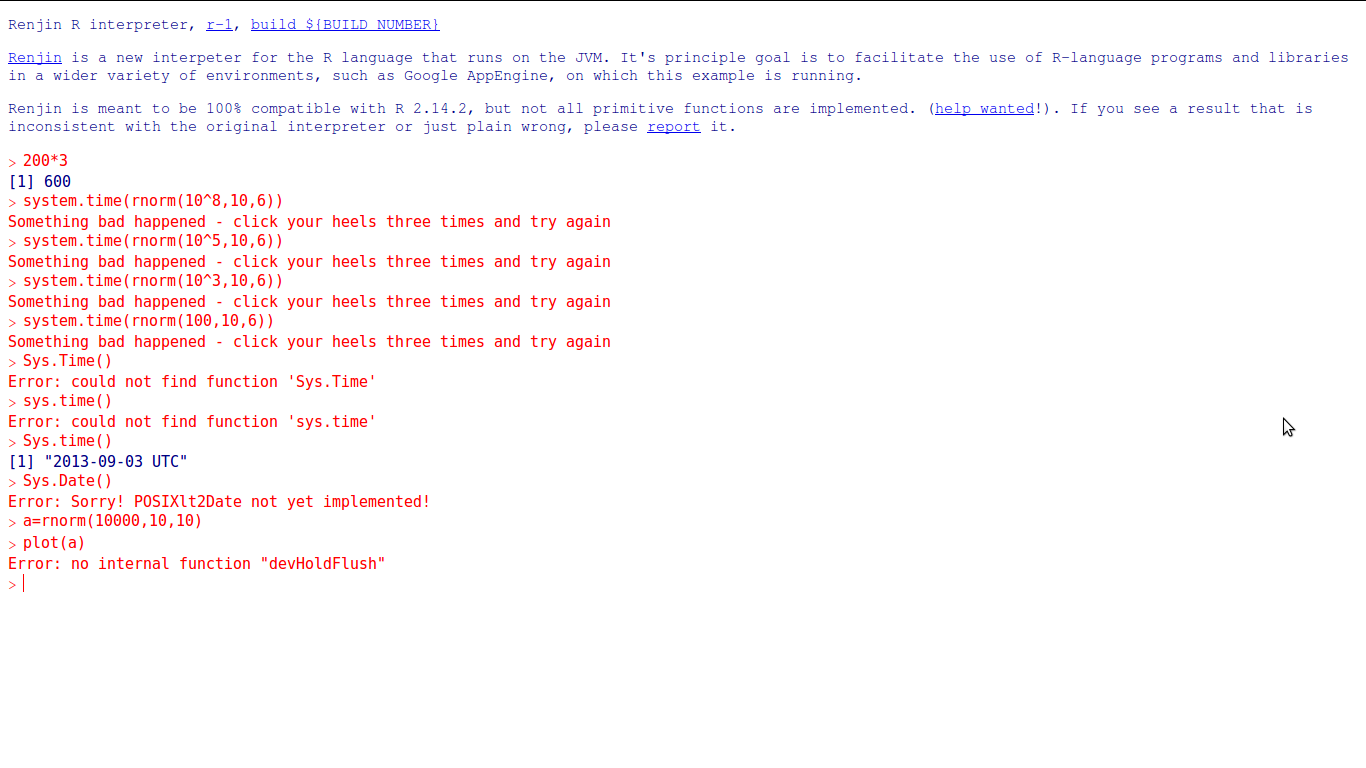
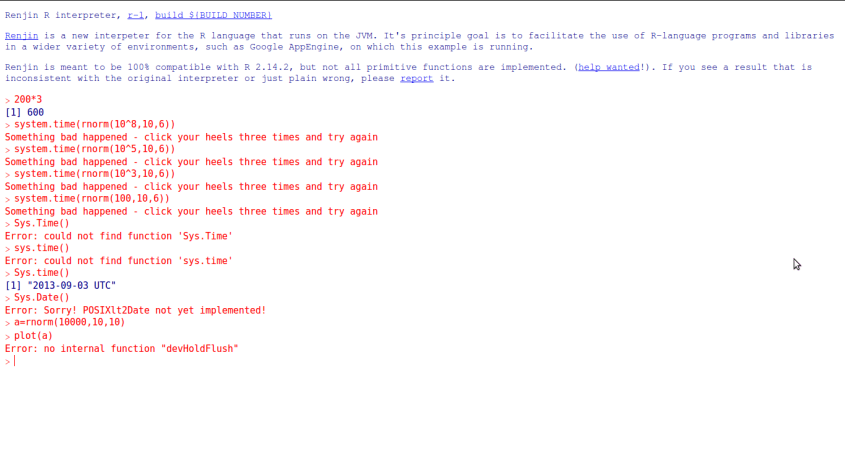
R on a JVM – Renjin is now FOAS #rstats #jvm #cloud

Renjin is now FOAS!

What is Renjin

From- http://www.renjin.org/

Renjin is a JVM-based interpreter for the R language for statistical computing. This project is an initiative of BeDataDriven, a company providing consulting in analytics and decision support systems.

R on the JVM

Over the past two decades, the R language for statistical computing has emerged as the de facto standard for analysts, statisticians, and scientists. Today, a wide range of enterprises –from pharmaceuticals to insurance– depend on R for key business uses. Renjin is a new implementation of the R language and environment for the Java Virtual Machine (JVM), whose goal is to enable transparent analysis of big data sets and seamless integration with other enterprise systems such as databases and application servers.

Renjin is still under development, with a target of a version “1.0” in late 2013, but in the meantime it is being used in production for a number of our client projects, and supports most CRAN packages, including some with C/Fortran dependencies.

Why Renjin?

We built Renjin, a new interpreter for the JVM because we wanted the beauty, the flexibility, and power of R with the performance of the Java Virtual Machine.

Bigger data

R has been traditionally limited by the need to fit data sets into memory, and working with even modest sets of data can quickly exhaust memory due to historical limitations in GNU R interpreter’s implementation.

Renjin will allow R scripts to transparently interact with data wherever it’s stored, whether that’s on disk, in a remote database, or in the cloud.

While there have been attempts to bring big data to the original interpreter, these have generally provided a parallel set of data structures and algorithms, threatening a fragmentation of the language and platform. Renjin, in contrast, will allow existing R code to run on larger datasets with no modification, using R’s familiar and standard data structures and algorithms.

Better performance

Renjin offers performance improvements in executing R code on several fronts:

  • Vector operations: Renjin’s deferred computation engine automatically parallelizes and optimizes vector operation to run an order of magnitude faster, without the memory demands of computing intermediate structures
  • Matrix operations: Renjin allows the user to plugin best-of-class implementations of BLAS, LAPACK, and FFT.
  • Scalar operations: Renjin will compile frequently used portions of R code to JVM byte code on the fly, dramatically increasing performance of R’s notorious performance on for loops and other predominantly scalar code [2013Q3]

These improvements make it possible to perform real-time analyses using complex models.

Cloud-ready

Renjin enables R developers to deploy their code to Platform-as-a-Service providers like Google Appengine, Amazon Beanstalk or Heroku without worrying about scale or infrastructure. Renjin is pure Java – it can run anywhere.


However, I did test it and I think the R and Clojure community and even the professional R product companies can do a bit more to support R on JVM

I would also be careful on the licenses of the Java flavor used 😉

Nopes,   Brian Ripley is still benevolent dictator of life at R. He wont be losing any sleep on this new fork of R!

But seriously 😉 !
Screenshot from 2013-09-03 07:11:13

Jeroen Ooms’s latest APP #rstats #appiness

Jeroen Ooms, famed inventor of Open CPU and advanced Web Apps, just released a new app.

Source-

https://public.opencpu.org/posts/knitr-markdown-opencpu-app/

A new   OpenCPU app allows you to knit and markdown in the browser. It has a unique  code editor which automatically updates the output after 3 seconds of inactivity. It uses the Ace web editor with mode-r.js (thanks to RStudio ).

the source package lives in the opencpu app repo on github. You can try it out on the public cloud server

#install the package
library(devtools)
install_github("markdownapp", "opencpu")

#open it in opencpu
library(opencpu)
opencpu$browse("/library/markdownapp/www")

The app uses the knitr R package and a few lines of javascript to call

Potential Economic Consequences to Western Strike on Assad/Syria

Immediately

  1. Oil goes up.
  2. Rupee goes down
  3. Bonds go up
  4. Stocks go down
  5. Dollar under some pressure

Medium Term

  1. Oil stays >100
  2. Canadian Oil pipeline better likelihood
  3. Russian wrangles or does not some energy deal/benefit
  4. Economic GDP in West inches up
  5. Clear message sent to other nations with WMD including Iran and North Korea
  6. US Distraction encourages spin off ripple effects from other smaller nations
  7. Terrorism or Al Quaeda in Syria comes back

(based on a question asked)

Click Image for Better Look

Screenshot from 2013-08-27 22:23:13

OpenCPU: Cloud Based Analytics comes to age

After 3 years in development, the latest project from Jeroen Ooms is now ready.
Screenshot from 2013-08-26 19:38:03
Check it out-yourself
OpenCPU is a software framework for embedded statistical computation and reproducible research. The server exposes a web API interfacing R, Latex and Pandoc. This API is used for example to integrate statistical functionality into systems, share and execute scripts or reports on centralized servers, and build R based “apps”. The OpenCPU server can run either as a single-user server inside the interactive R session (for local use and development), or as a cloud server that builds on Linux and rApache.
An OpenCPU app is an R package which includes some web page(s) that call the R functions in the package using the OpenCPU API. This makes a convenient way to develop, package and ship standalone R web applications.
Security is enforced using AppArmor. AppArmor is a security module for the linux kernel and enforces mandatory access control policies on a by-process basis. These policies can easily be customized by modifying the AppArmor profiles that ship with the OpenCPU cloud server.
Both the OpenCPU single-user server and OpenCPU cloud server have been tested to work with RStudio 0.98 and above.
See also the appendix in the server manual on this topic.
Absolutely. OpenCPU is released under the Apache2 License.

Websites for Artists

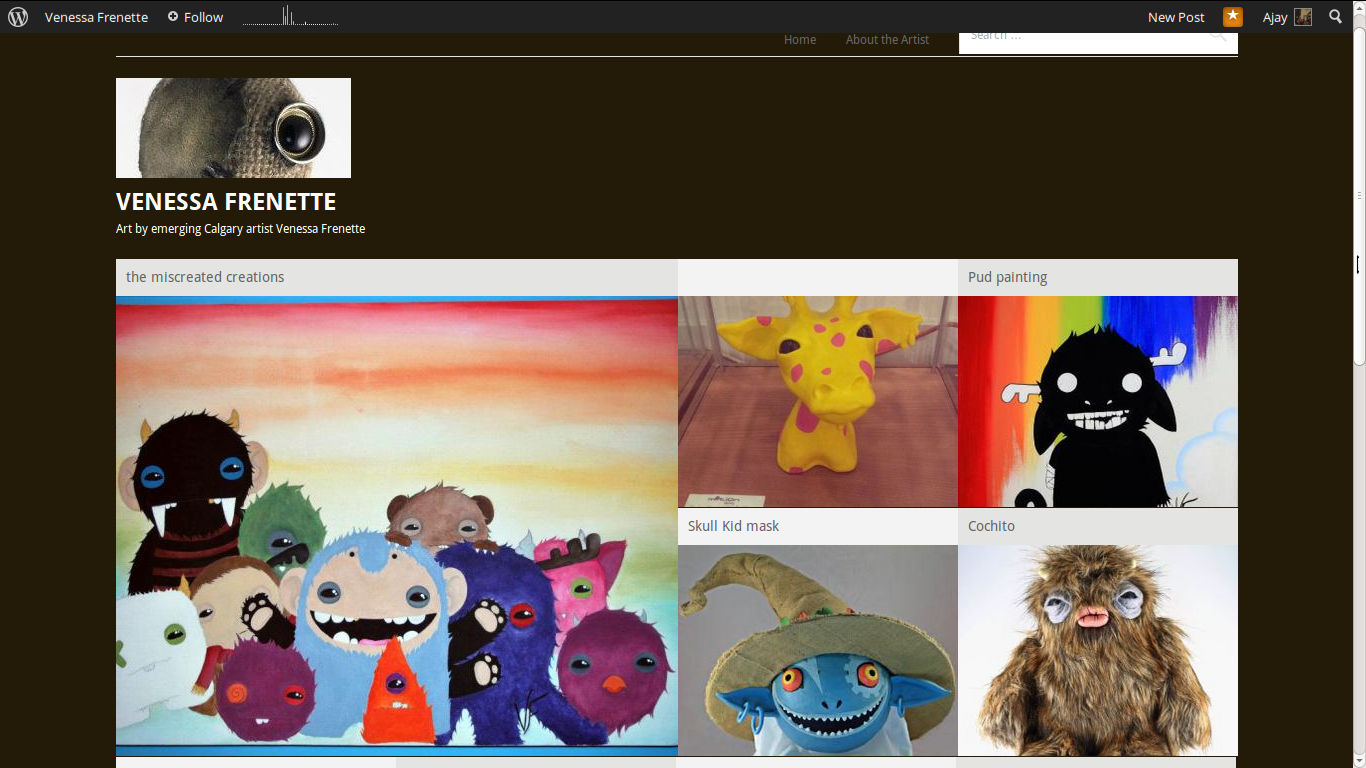
Here is some work I have been doing on a non-profit basis for painters and artists. Most of them are very creative , but especially the smaller artists need help with making a showcase website for their art. This is also a much more professional option than Tumblr for Websites.

  1. Create a WordPress.com account for the artist
  2. Encourage the artist to take the 18$/per year for custom domain name
  3. Exmplain how you login to http://yourwebsitenamehere.com/wp-admin with the username and password you created in step1
  4. Bulk Upload their high quality images in the Dashboard > Media > Add New
  5. Chose a theme like http://www.dessign.net/fontfolio-theme/ because it showcases art work from several posts on the front page
  6. Create a different post  for each painting. At bottom right of the post- set Featured Image. Insert Art work from Add Media button on top> from Media Gallery
  7. Change the About Page by WordPress to add contact details of gallery and information about artist so customers can buy the art
  8. Publish the Website for that painter

Some Websites I have created in less than hour each for artists, for free , are below

http://paintingsbyshelley.com/

1

http://paintingsbykaylee.com/

2

http://artbyvania.wordpress.com/

3

http://johnnyelectricart.com/

4

http://venessafrenette.wordpress.com/

Screenshot from 2013-09-26 18:04:48


http://sarahjoyg.wordpress.com/

Screenshot from 2013-09-26 18:04:34

ps- It ‘s also a great way to help your local art community and meet interesting people 🙂

pps- If you dont really like WordPress also check out Wix at http://www.wix.com/