The Education of Larry Page

From naming the algorithm after himself ( PageRank ?) to forsaking his professors at Stanford ( who legally own the rights to many intellectual property), to first learning under Eric Schmidt and then pushing him out on the pretense of a political appointment to never came, to the era of silent cooperation with the US Government, to collecting a lot of data by assessing the risk of litigation (especially mobile), and to push intellectual property rights between open source and patent rights, to massive expensive lobbying and now even sidelining his brother in arms- Larry Page has emerged as the most ruthless combination of business savvy and formidable technological skills since Bill Gates.

He now owns a representative sample of nearly all the data on video (Youtube) , email (Gmail), website analytics ( Google Analytics), search engine (Google.com), advertising clicks ( Adwords and Adsense), a majority of mobile phones (Android).

And he wants more. To collect data from your thermostat. Your glasses. His government will not file an anti trust case because of national security. As an extension of US foreign policy, he will lead protests against Chinese hackers, censorship and even abandon the market than comply with Chinese Law, but he will gladly pay fines and delete links to comply with European Law.

There are ways to make money that are not evil. But they do not teach what is evil or not, at Stanford. Not even to dropouts.

larry-page_230733

Informatin Asymmetry is the most evil business

What is information asymmetry?

information asymmetry deals with the study of decisions in transactions where one party has more or better information than the other. This creates an imbalance of power in transactions which can sometimes cause the transactions to go awry, a kind of market failure in the worst case. Examples of this problem are adverse selection,[1] moral hazard, and information monopoly

Most commonly, information asymmetries are studied in the context of principal–agent problems. Information asymmetry causes misinforming and is essential in every communication process

Adverse selection, anti-selection, or negative selection  refers to a market process in which undesired results occur when buyers and sellers have asymmetric information (access to different information); the “bad” products or services are more likely to be selected.

The principal–agent problem or agency dilemma occurs when one person or entity (the “agent“) is able to make decisions that impact, or on behalf of, another person or entity: the “principal“. The dilemma exists because sometimes the agent is motivated to act in his own best interests rather than those of the principal.

Monopolies of knowledge arise when ruling classes maintain their political power through their control of key communications technologies.[3] An example of this occurs in ancient Egypt where a complex writing system conferred a monopoly of knowledge on literate priests and scribes.


  1. This especially is true in enterprise software
  2. and online advertising and spam
  3. and commodities across the globe (oil spikes after iraq, oil slumps after heating oil data, climate data, or even releases from strategic reservoirs)
  4. and internet spying which may be for economic espionage or trade negotiations but are justified as looking for terrorists.
  5. and inflation in the developing and poor countries
  6. and lobbying in the developed and rich countries


People who enable information asymmetry are corrupted people, misled by their own greed and agent-employees in decisions that run counter to the principles when they founded their corporation.

Do you think information asymmetry is evil? Or do you think we should jump on the bandwagon and play the game. Click those ads, while we share your data with the government!


Latest Interview – Rapid Miner CEO Ingo Mierswa

Here is an interview I did with the CEO of Rapid Miner, Ingo Mierswa. Ingo, who is something of a prodigy and genius with multi-lingual capabilities, stellar academic and business record talks on navigating the journey for an open source startup.

http://www.kdnuggets.com/2014/06/interview-ingo-mierswa-rapidminer-analytics-turning-points.html

Popularized by Michael (Monty) Widenius, one of the founders of MySQL and an investor in RapidMiner, business source is a commercial software license model that offers many of the benefits of open source, but with a built-in time delay on users being able to access new versions of our products.


Related-

  1. Guide to Data Science Cheat Sheets 2014/05/12
  2. Book Review: Data Just Right 2014/04/03
  3. Exclusive Interview: Richard Socher, founder of etcML, Easy Text Classification Startup 2014/03/31
  4. Trifacta – Tackling Data Wrangling with Automation and Machine Learning 2014/03/17
  5. Paxata automates Data Preparation for Big Data Analytics 2014/03/07
  6. etcML Promises to Make Text Classification Easy  2014/03/05
  7. Wolfram Breakthrough Knowledge-based Programming Language – what it means for Data Science? 2014/03/02

10 for 10 – Packt lowers cost of books for students and researchers alike

The high cost of textbooks and science books is an open scandal. Despite this publishers are barely profitable, and the ecosystem is ripe for disruption.

Packt is one such player. I have reviewed many books for them ( in return I get ebooks and books – some of which I give to my students).

Now they have an intriguing offer.

As you are aware, this month, Packt is celebrating 10 years of success with over 2000 Titles in its Library. To celebrate this huge milestone, we have come up with an exciting opportunity for collaboration which you might be interested in.

Packt is offering all of its eBooks and Videos at just $10 each. This campaign is specifically aimed towards thanking all our customers for their support and opening up our comprehensive range of titles just for $10 each. This promotion covers every title and customers can stock up on as many copies as they like until July 5th. I hope you find this as a great opportunity to explore what’s new and maintain your personal and professional development.

Interested- you can see http://www.packtpub.com/10years

Disclosure- The author was offered 2 free ebooks as part of this campaign on social media. Books is one thing he is willing to blog for 😉

Analysing Google Plus posts using R language #rstats

Here is a short post in retrieving information from the Google+ API using R, and then analysing it.

To create an API key:

  1. Go to the Google Developers Console.
  2. Create or select a project.
  3. In the sidebar on the left, select APIs & auth.
  4. In the displayed list of APIs, find the Google+ API and set its status to ON.
  5. In the sidebar on the left, select Credentials.
  6. Create an API key by clicking Create New Key. Select the appropriate kind of key: Server key  Then clickCreate.

from- https://developers.google.com/+/api/oauth

and the R code

#install.packages("plusser")
library(plusser)
help(plusser)
library(RCurl)
options(RCurlOptions = list(cainfo = system.file("CurlSSL", "cacert.pem", package = "RCurl")))
setAPIkey('AIzaSyBtYqDsAtzp4FOS7FGbrc_n6mD-uJIOvcQ')
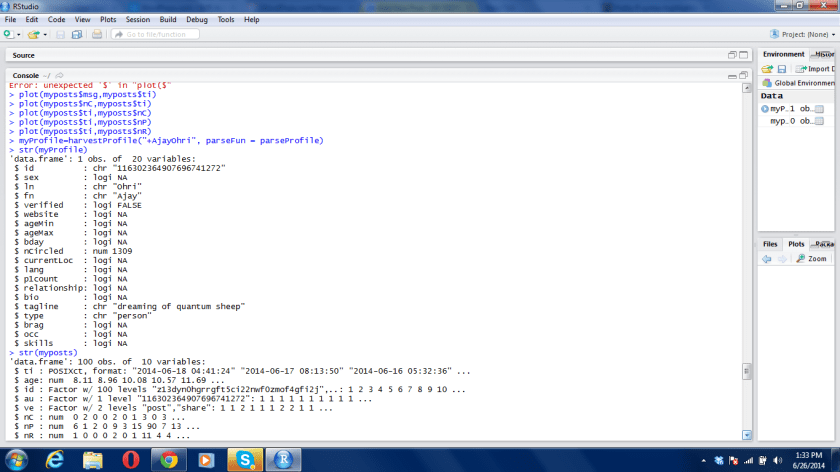
myProfile=harvestProfile("+AjayOhri", parseFun = parseProfile)
str(myProfile)
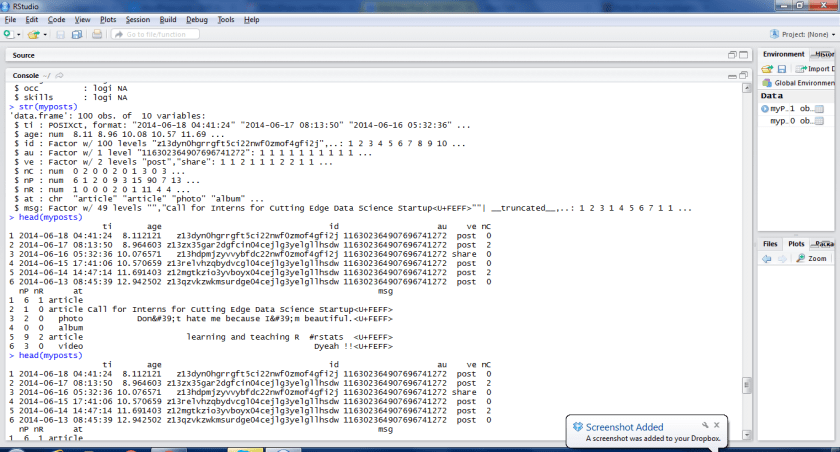
myposts=harvestPage("+AjayOhri", parseFun = parsePost, results = 1, nextToken = NULL, cr = 1)
str(myposts)
head(myposts)
plot(myposts$ti,myposts$nC) #number of comments
plot(myposts$ti,myposts$nP) #number of likes or plus 1
plot(myposts$ti,myposts$nR) #number of reshares

some screenshots and images Screenshot 2014-06-26 13.33.08

Screenshot 2014-06-26 13.32.56

You can also see the Rpubs document here http://rpubs.com/decisionstats2/plusser Now you can do text analysis and sentiment analysis on myposts$msg and do social media analysis on what makes people like what kind of content. 


For better results, use a google plus id (page or person) which has a lot of PUBLIC posts!