Dead Heroes make great T Shirts

Some of my heroes whom I wear on my T Shirts

1 Kurt Cobain – marrying the wrong woman can lead to a hole in your head

2 John Lennon – marrying the wrong woman can break up your band no matter how big. Imagine.

3 Bob Marley – Too many Drugs will kill you everytime

4 Freddy Mercury – Too much love will kill you everytime

5 Gandhi – Peace and Non Violence. Forever

6 Steve Jobs – I can be a jerk and get way with it if I am an iGenius

7 Jesus Christ –  Even Jesus can get angry

Jesus entered the temple courts and drove out all who were buying and selling there. He overturned the tables of the money changers

Terrorists Robots and Data Scientists

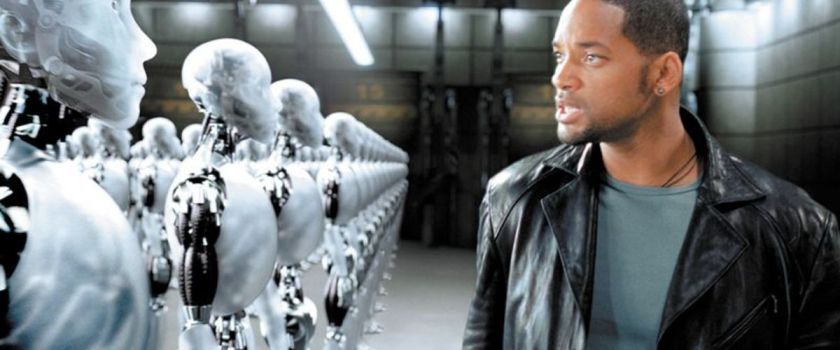
Will Smith stars in

The rules for Robots from “Handbook of Robotics, 56th Edition, 2058 A.D.”, are:

  1. A robot may not injure a human being or, through inaction, allow a human being to come to harm.
  2. A robot must obey the orders given it by human beings except where such orders would conflict with the First Law.
  3. A robot must protect its own existence as long as such protection does not conflict with the First or Second Laws

0. A robot may not harm humanity, or, by inaction, allow humanity to come to harm.

The zeroth law is why democratic governments kill terrorists using all means possible. One dead terrorist  is better than many innocents killed.

to be continued

Ajay Ohri interviews Dr Bradley Jones for StatisticsViews.com

I had the good fortune and privilege to interview a  genuine statistical hero, Dr Bradley Jones

http://www.statisticsviews.com/details/feature/8510051/For-me-the-fun-of-working-with-scientists-and-engineers-is-helping-them-generate.html

He holds a patent on the use of DOE for minimizing registration errors in the manufacture of laminated circuit boards and is the inventor of the prediction profile plot for interactive exploration of multiple input and output response surfaces. In both 2009 and 2011, he received the American Society for Quality’s Brumbaugh Award for the paper making the largest contribution to industrial quality control. He also won the 2010 Lloyd S. Nelson Award for the article having the greatest immediate impact to practitioners. Jones is the Editor-in-Chief of the Journal of Quality Technology, a Fellow of the ASA and co-author of the award winning Optimal Design of Experiments with Peter Goos.

Typically, DOE is taught by rote using pre-packaged designs. This makes it hard for an engineer to see the practical applicability of DOE. In addition, most DOE texts devote most of their pages to analysis rather than the core principles of design. Students do not learn how to evaluate and compare prospective designs for their appropriateness to a specific problem. The textbooks (and professors) need to catch up with the software.

You can read the complete article at http://www.statisticsviews.com/details/feature/8510051/For-me-the-fun-of-working-with-scientists-and-engineers-is-helping-them-generate.html

Famous in X but Failure in Y

Some of my friends on the internet and in real life love food. Note the distinction between internet friends and real life friends. There is more to genuine long lasting relationships than exchange of engaging bits bytes and moving your mouse on icons to say I love this, I plus one that, I really adore it.

Well my friends and I, we love food. Some of us , in fact most of us eat food. Some of us click pictures and share in on the anti-social media. Anti-social because it is anti-real life socializing. A few of us cook food. One or two write recipes. Occasionally one of us tries to make food his business by floating the idea of opening a restaurant. This is despite the fact that just eating food is ahem easy and running a restaurant  business  is inherently risky.

Making your passion into a business is a dream and privilege that is offered to very few of us.  Athletes, technology startup founders, Drug Lords.

Occasionally one may be a success in one line of the business. Someone who loves food can write good books, but will you exchange your mom’s apple pie for that telegenic chef. Someone who writes good books on food can automatically run a very good restaurant. No. Good in books doesnot mean good in business in the same thing.

Genius doesnt travel. IF you are reading this, probability says you are not a genius anyway.


Twitter Analysis Redefined

Because code keeps changing on Twitter


#dev.twitter.com and apps.twitter.com to generate these tokens
#install.packages("twitteR")
#install.packages("ROAuth")
#PACKAGES
library(twitteR)
library(ROAuth)
#ACCESS URLS
reqURL <- "https://api.twitter.com/oauth/request_token"
accessURL <- "https://api.twitter.com/oauth/access_token"
authURL <- "https://api.twitter.com/oauth/authorize"

#ACCESS KEYS
consumerKey <- "4LEjfrnbzMQvxpJzRKnx6v0JM"
consumerSecret <- "aCsJA6jEHhpqFioKmxwtu9BzMm0TnOFQyZv6mgCUo1j82PzRIn"
access_token="3232641518-IFIlyB5oJ7QbFXT3arO218BWbycGMA6q5NO1b7k"
access_secret='XPfpH3l6QjCnRxpZwHtMbRMqnwmhmxlZqFZxnxgEg35K4'

#HANDSHAKE
setup_twitter_oauth(consumerKey,
consumerSecret,
access_token="3232641518-IFIlyB5oJ7QbFXT3arO218BWbycGMA6q5NO1b7k",
access_secret='XPfpH3l6QjCnRxpZwHtMbRMqnwmhmxlZqFZxnxgEg35K4')

a=searchTwitter("delhi", n=2000)
tweets_dfa = twListToDF(a)
tweets_dfa
b=searchTwitter("mumbai", n=200)
tweets_dfb = twListToDF(b)
c=searchTwitter("bangalore", n=200)
tweets_dfc = twListToDF(c)
tweets=rbind(tweets_dfa,tweets_dfb,tweets_dfc)
#tweets
write.csv(tweets,file="tweets.csv")
head(tweets)
library(tm)
library(wordcloud)
b=Corpus(VectorSource(tweets$text), readerControl = list(language = "eng"))
b=tm_map(b, PlainTextDocument)
inspect(b)
b<- tm_map(b, content_transformer(tolower))
#Changes case to lower case
b<- tm_map(b, stripWhitespace) #Strips White Space
b <- tm_map(b, removePunctuation) #Removes Punctuation
inspect(b)
tdm <- TermDocumentMatrix(b)
m1 <- as.matrix(tdm)
v1<- sort(rowSums(m1),decreasing=TRUE)
d130,]
wordcloud(d2$word,d2$freq,colors =brewer.pal(7,"Set1"))
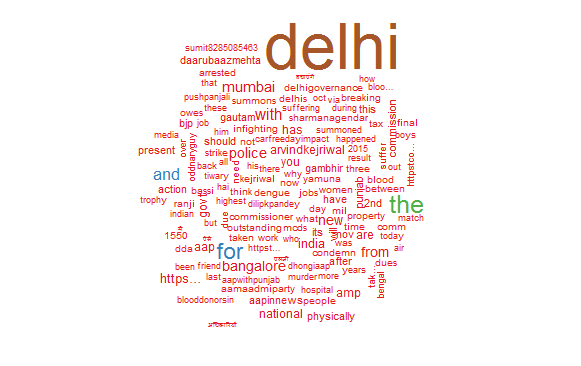

Rplot

Workflows in R compared to Workflows in Python

A workflow consists of an orchestrated and repeatable pattern of business activity enabled by the systematic organization of resources into processes that transform materials, provide services, or process information.

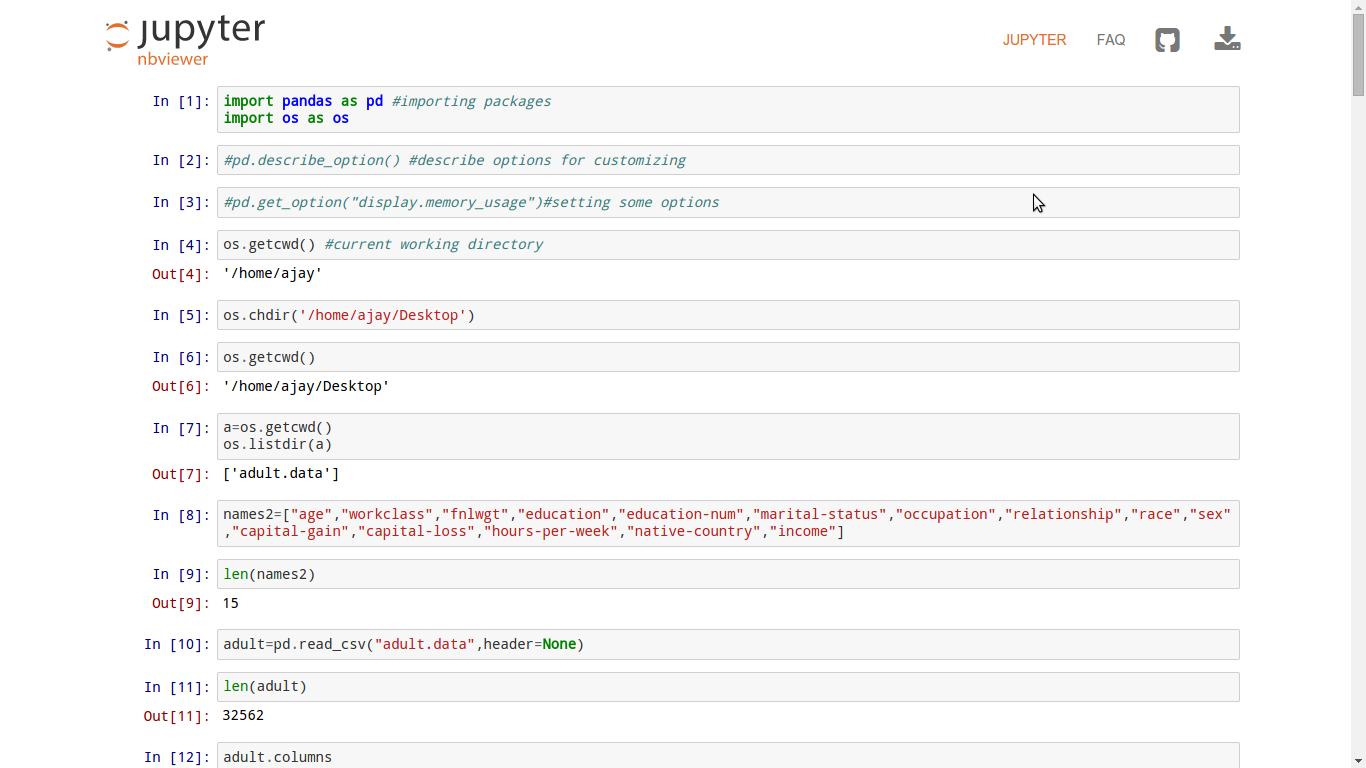
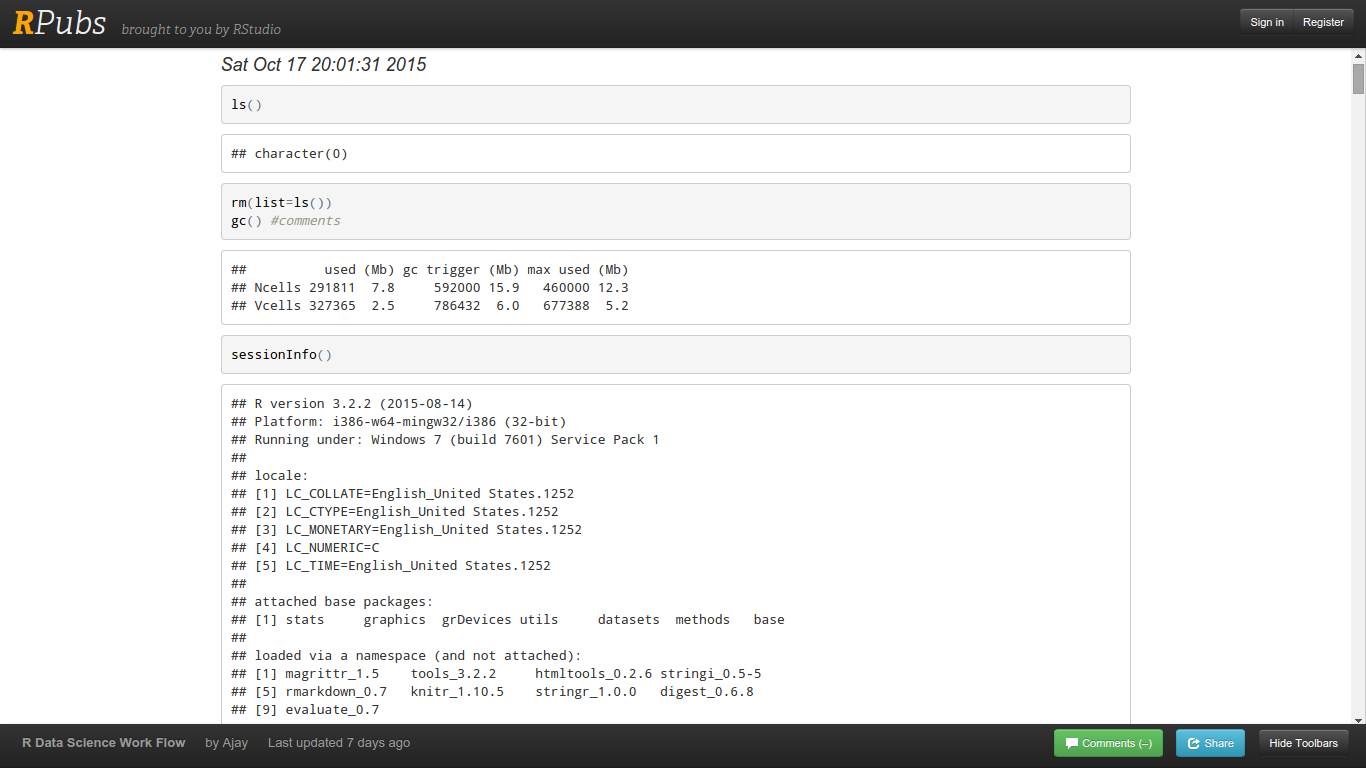
Both R and Python have similar workflows but slightly different syntax. one of the biggest difference is how they refer to parts of object ( $ [] in R while [] in Python) as well as how they apply functions ( fun(object) in R while object.fun() in Python)


a workflow in Python

http://nbviewer.ipython.org//gist/decisionstats/4142e98375445c5e4174

Screenshot from 2015-10-24 08:31:22

a workflow in R

http://rpubs.com/ajaydecis/rworkflow

Screenshot from 2015-10-24 08:31:07

Choices

You wake up every day with a bank balance of 12 hours of productive work time. every night as you go to sleep the balance goes to zero. you wake up every day with a finite energy balance of a few kilojoules willing to be expended. the balance is upto you but it cannot be carried over the next day.

You wake up with choices and you go to sleep with having made the decisions on the choices. You can focus on what lies forward and stay positive.OR . You can swallow the negativity and be swallowed in it’s swamp.

Intelligent men can make bad choices. Choices that you make today will be with you in the future.